A Glimpse into Medieval Devotion: The Golden Ring of the 15th Century
The artifact showcased is a remarkable example of late medieval personal jewelry, dating to approximately the 15th century. This exquisite gold signet ring, characterized by its intricate religious iconography and a deep blue gemstone setting, offers a profound connection to the daily life and spiritual world of a high-status individual in Europe during the late Middle Ages. Often referred to in archaeological contexts as a devotional ring, such items were frequently worn by the nobility or wealthy merchant classes as both a fashion statement and a visible expression of their religious faith. The discovery of such an item, particularly when found in a soil context as depicted in the upper panel, provides archaeologists with vital clues about the movement, trade, and social stratification of the period.
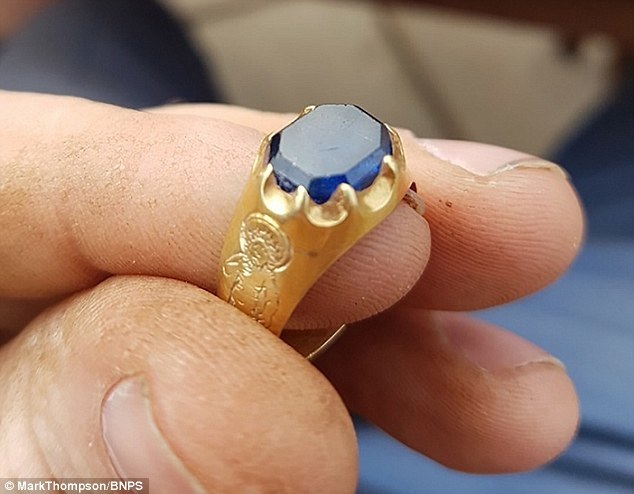
Regarding the materials and fabrication, the ring is constructed from high-quality gold, which was hammered and cast to create a durable, ornate band. The most striking features are the detailed engravings on the sides of the shank, which clearly depict religious figures—likely the Virgin Mary and the Christ Child—encircled by halos, indicative of the period’s intense focus on Marian devotion. The central setting holds a deep blue gemstone, possibly a sapphire or a similar precious stone, which was faceted in a hexagonal shape and secured by distinctive, petal-like prongs. This combination of precious metalwork and gemstone setting demonstrates the high level of technical proficiency achieved by 15th-century goldsmiths, who utilized specialized tools to achieve such fine detail on a very small surface area.

The significance and utility of this ring transcended mere personal adornment; it functioned as an essential talismanic and social tool. In the 15th century, religious imagery on personal effects served as a constant reminder of the wearer’s spiritual allegiances and a protective charm against misfortune. Furthermore, signet rings of this nature were frequently used to seal documents, with the engravings serving as a unique identifier for the wearer in a society where literacy was increasingly tied to administrative and legal power. By wearing such a ring, the individual not only signaled their wealth and status but also participated in a broader cultural language of devotion that defined the social and religious landscape of late medieval European life.

The provenance of such an artifact is often linked to the dedicated work of metal detectorists and field archaeologists who document finds from medieval agricultural sites or settlement ruins. As illustrated in the top section, the ring’s recovery from a raw soil context emphasizes the importance of accurate recording of the find spot, which allows researchers to contextualize the item within a specific historical geography. While many such artifacts enter the archaeological record through private discovery, professional organizations and regional museums often coordinate with these finders to ensure that the context—the soil, the depth, and the proximity to other artifacts—is properly documented, which is crucial for determining if the site was a lost hoard, a grave, or a residential waste deposit.

An illustration depicting Robin Hood, a character from English folklore – a hero who steals from the rich and gives to the poor.
In summary, the ring displayed serves as a vital historical archive, capturing the aesthetic, technical, and theological spirit of the 15th century. Through the careful study of its iconography and material composition, archaeologists are able to reconstruct the personal narratives of the people who shaped the medieval world. The ring is more than a valuable object; it is a testament to the intersection of luxury, devotion, and social idenтιтy. As ongoing archaeological research continues to document similar finds, this ring stands as a clear representative of the sophisticated material culture of the late Middle Ages, inviting us to look closer at the small, intimate items that held such immense meaning for those who wore them centuries ago.
✓ hoangduc
The artifact showcased is a remarkable example of late medieval personal jewelry, dating to approximately the 15th century. This exquisite gold signet ring, characterized by its intricate…