Ancient Dental Ingenuity: An Archaeological Analysis of Etruscan Gold Wire and Band Dental Prostheses

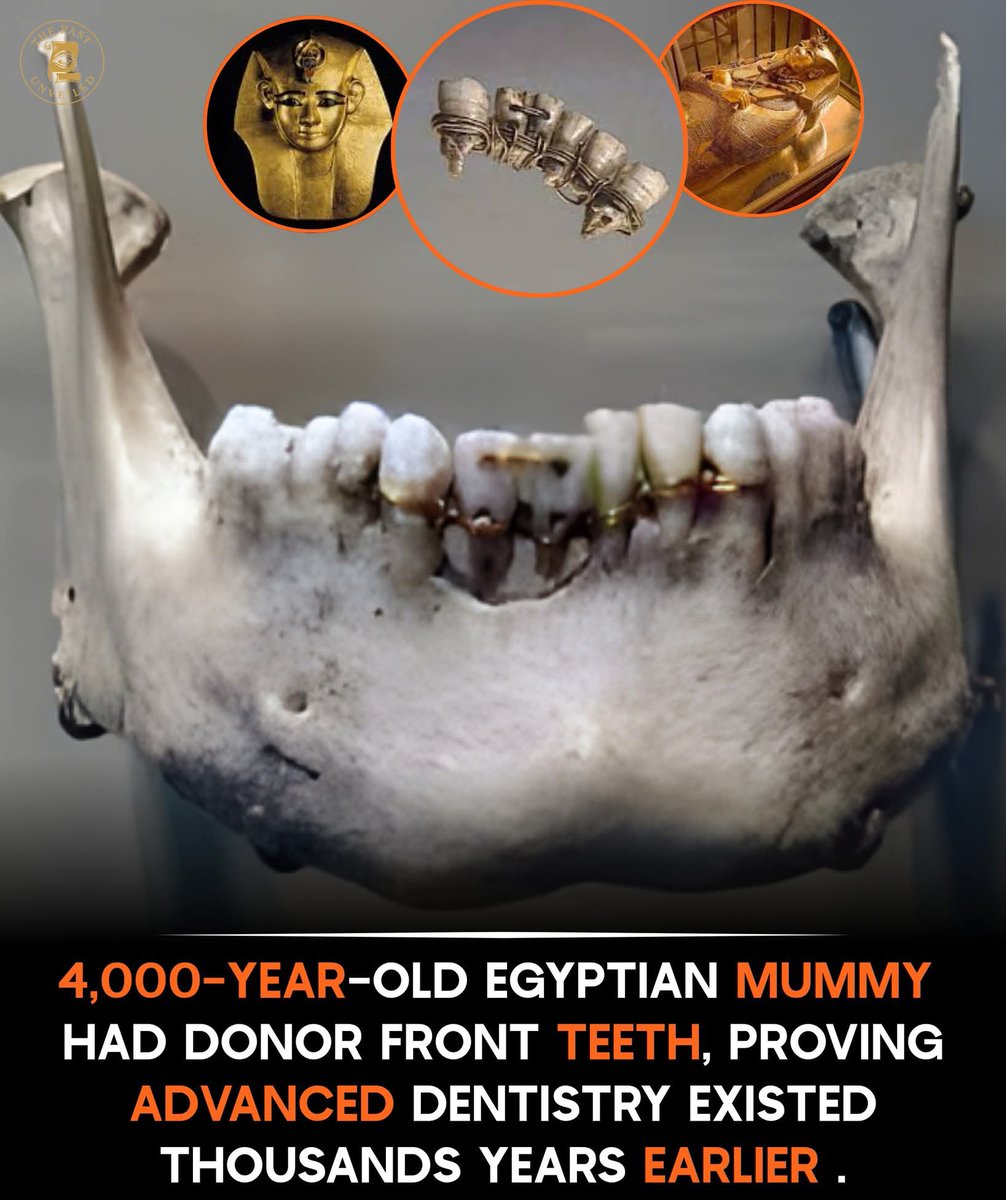
The study of ancient medical technology frequently reveals sophisticated interventions that challenge modern ᴀssumptions about early health and craftsmanship. Chronologically, the most advanced examples of early restorative dental appliances date back to the Etruscan civilization of central Italy, flourishing roughly from the 7th through the 4th centuries BCE (with foundational examples appearing around 630 BCE). The archaeological artifact featured in the image is a reconstructed mandible displaying a historic dental prosthesis—specifically an early form of a gold-band and wire dental bridge modeled after rare Mediterranean antiquities. These specimens offer a fascinating window into pre-modern surgical and metallurgical competence, illustrating how ancient elite populations managed dental health, tooth loss, and oral aesthetics long before the advent of professional dentistry.

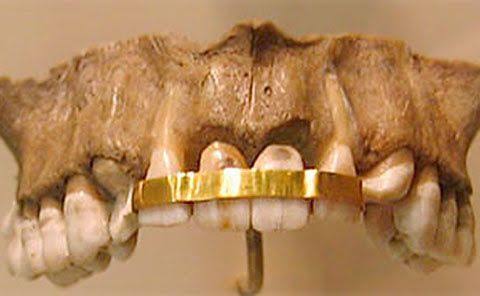
Geographically, these rare dental appliances have been recovered primarily from elite archaeological contexts and ancient burial sites across central Italy, such as Satricum, Orvieto, and Tarquinia, with similar Eastern Mediterranean variants discovered in Phoenician and Egyptian tombs. The physical materials utilized in these prostheses consist of high-purity gold or gold-silver-copper alloys, chosen for their malleability, resistance to bodily corrosion, and radiant appearance. In terms of manufacturing and craftsmanship details, ancient jewelers or proto-dentists hammered gold sheets into thin, ribbon-like bands or drew them into fine wires, meticulously looping, piercing, and adapting them to anchor natural or animal-derived replacement teeth into the empty alveolar gaps of the mandible or maxilla.

From a functional and sociological perspective, these gold appliances served both practical and profound status-driven purposes within ancient society. Contrary to popular myths suggesting they were used as modern orthodontic braces to straighten teeth, archaeological and biomechanical studies confirm that they functioned primarily as prosthetic bridges to secure loose teeth or hold false pontics in place following tooth loss from periodontal disease or deliberate extraction. Interestingly, demographic analysis of Etruscan dental finds reveals that the vast majority of these gold appliances were worn exclusively by elite women, indicating that personal vanity, cosmetic restoration, and high social visibility were paramount concerns in the ancient Mediterranean.
The discovery and scientific cataloging of these rare dental artifacts are the result of meticulous excavations conducted across European necropolises since the late 18th and 19th centuries. Pioneering classical archaeologists and physical anthropologists—such as Marshall Joseph Becker and various European museum curators—have documented roughly two dozen authentic ancient prostheses housed in insтιтutions such as the Danish National Museum in Copenhagen and the Louvre in Paris. Through careful osteological analysis and electron microscopy, these researchers have successfully separated genuine antiquity specimens from modern replicas, mapping out the evolution of ancient dental technology.
In conclusion, the ancient Etruscan gold dental appliances stand as remarkable testaments to the intersection of early metallurgy, medicine, and social status in the classical world. By transforming soft gold into functional restorative bridges, ancient artisans provided practical solutions for dental alignment and facial aesthetics millennia before modern clinical dentistry emerged. Preserved through careful archaeological excavation and insтιтutional curation, these delicate skeletal finds continue to provide profound insights into the daily lives, health standards, and cultural values of ancient civilizations.
✓ hoangduc
The study of ancient medical technology frequently reveals sophisticated interventions that challenge modern ᴀssumptions about early health and craftsmanship. Chronologically, the most advanced examples of early restorative…