Enigmas in Granite: An Archaeological Analysis of Scotland’s Neolithic Carved Stone Balls
The artifacts under investigation represent some of the most enigmatic lithic remains from the British Late Neolithic period, dating back approximately 5,000 years. Primarily discovered in the fertile lands of North-East Scotland, with significant concentrations in Aberdeenshire and the Northern Isles such as Orkney, these objects—technically classified as petrospheres—predate the construction of the Great Pyramid of Giza. Unlike many archaeological finds that are recovered from secure burial contexts or domestic middens, a vast majority of these stone balls were discovered as “stray finds” by farmers plowing fields during the 19th and early 20th centuries. This lack of precise stratigraphy has long challenged archaeologists in pinpointing their exact chronological sequence, though recent controlled excavations at sites like Skara Brae and the Ness of Brodgar have finally anchored them firmly within the sophisticated material culture of Scotland’s early farming societies.
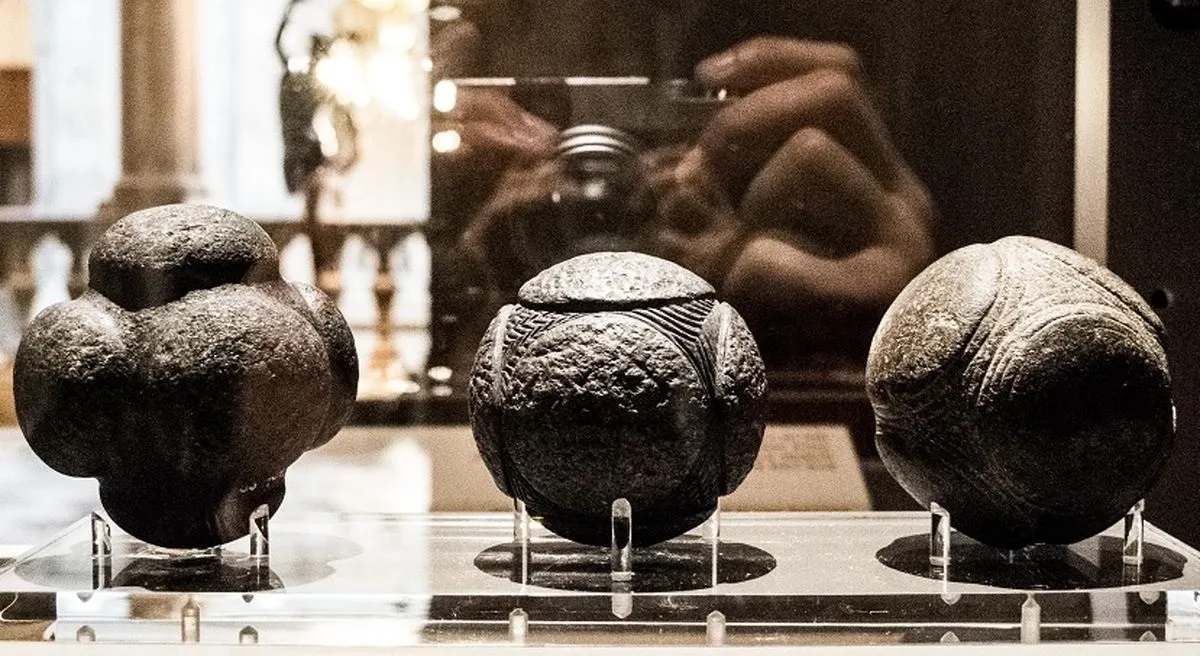
The material composition and manufacturing precision of these petrospheres reveal an extraordinary level of Neolithic pyrotechnology and lithic mastery. Crafted from a variety of local stones including hard greenstone, basalt, and fine-grained granite, each ball has been painstakingly pecked and ground into a near-perfect sphere. The most distinctive feature is the presence of raised “knobs” or bosses—ranging from three to over a hundred—which were meticulously carved out of the solid stone. Some specimens exhibit intricate secondary decoration, such as incised spirals, concentric circles, and hatched patterns that mirror the megalithic art found on the pᴀssage graves of the era. The symmetry and mathematical regularity of these carvings suggest that the makers utilized advanced measuring techniques, transforming raw mineral mᴀsses into highly standardized geometric forms.
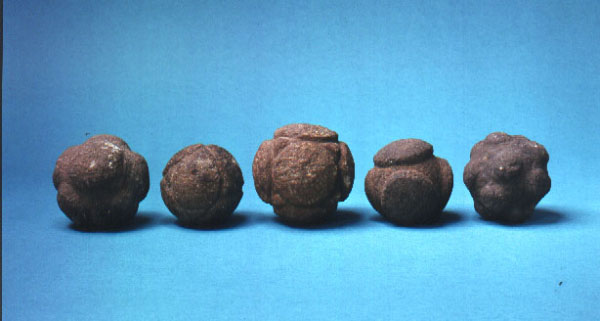
The debate regarding the primary function of these carved stone balls remains one of the most vibrant discussions in Scottish archaeology. Several hypotheses have been proposed: some scholars suggest a utilitarian role, such as weights for fishing nets or components of primitive ball bearings used to transport mᴀssive megaliths. However, the absence of wear patterns typical of heavy labor and the extreme labor-intensity required for their decoration point toward a more symbolic or prestige-based utility. It is widely posited that these objects served as “symbols of authority” or ceremonial maces held by clan leaders during tribal ᴀssemblies. Their tactile nature also suggests a ritualistic use, perhaps as “speaking stones” pᴀssed between individuals during negotiations, or as sacred objects used in divination rites to commune with ancestral spirits.

Information regarding the recovery and formal documentation of these artifacts is largely credited to the National Museum of Antiquities of Scotland (now National Museums Scotland) and pioneering 19th-century antiquarians like John Alexander Smith. Smith was among the first to systematically catalog these finds in the 1870s, recognizing their cultural significance beyond mere “curiosities.” In the modern era, organizations such as Historic Environment Scotland and the University of the Highlands and Islands have utilized advanced 3D pH๏τogrammetry to study the artifacts. These non-invasive digital techniques have allowed researchers to identify microscopic tool marks and remnants of pigments, suggesting that many of these stones may have originally been brightly painted, further enhancing their visual impact during Neolithic ceremonies.
As a testament to the intellectual sophistication of the Late Neolithic period, these carved stone balls continue to bridge the gap between ancient craftsmanship and modern archaeological science. They represent a rare intersection of art, mathematics, and social hierarchy in a pre-literate society. While the exact “language” of their patterns remains a mystery, their existence confirms that the inhabitants of Neolithic Scotland possessed a profound appreciation for geometric abstraction and a complex social structure capable of supporting specialized artisans. Today, they remain iconic symbols of Scotland’s deep past, preserved in museum galleries where they continue to invite speculation and wonder from archaeologists and the public alike, standing as silent witnesses to a forgotten cultural peak.
✓ hoangduc
The artifacts under investigation represent some of the most enigmatic lithic remains from the British Late Neolithic period, dating back approximately 5,000 years. Primarily discovered in the…