Etched in Stone: The Cosmic Cartography of the Newspaper Rock Petroglyphs
Deep within the canyonlands of southeastern Utah, situated along the base of a mᴀssive Wingate Sandstone cliff in San Juan County, lies one of the most prolific and densely concentrated rock art panels in North America. Known colloquially as Newspaper Rock, this monumental open-air archaeological site captures over two millennia of human expression, habitation, and spiritual interconnectivity. The petroglyphs spans multiple cultural epochs, primarily featuring intense activity from the Ancestral Puebloan (formerly Anasazi), Fremont, and subsequent Navajo and Ute societies. Radiocarbon testing of nearby domestic occupations and systematic stylistic cross-referencing indicate that the oldest engravings date back to the late Archaic period (circa 1000 BCE), with continuous artistic additions extending well into the historic era up to 1300 CE.
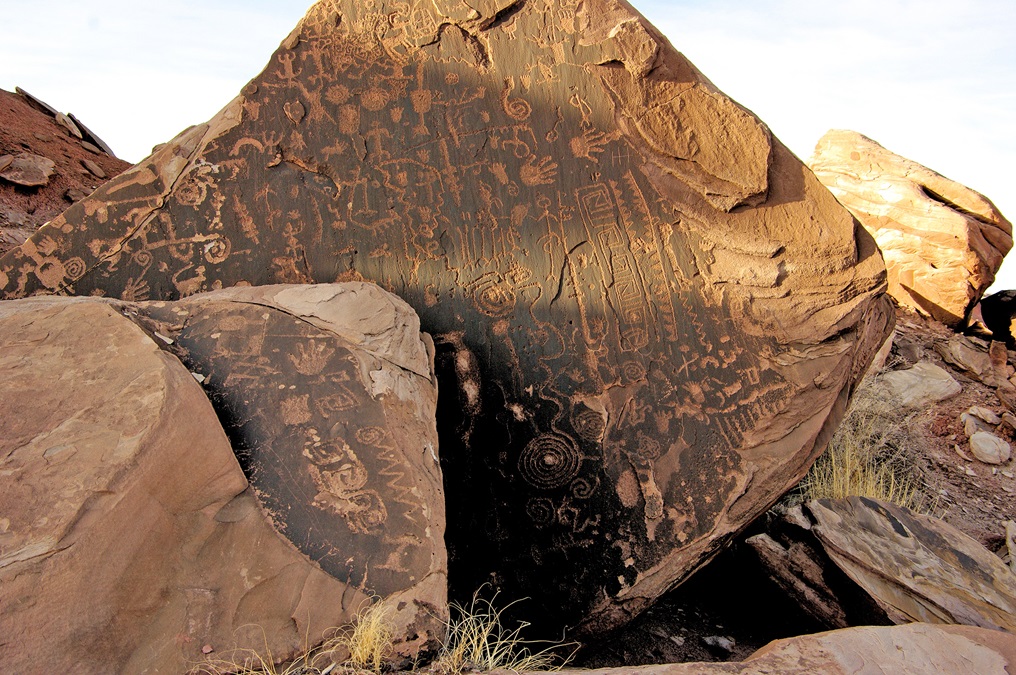
The raw canvas of this ancient repository consists of a monumental, vertical face of sheer sandstone, naturally coated over millennia with a thick, glossy veneer known as “desert varnish.” This dark, manganese-and-iron-rich patina forms slowly through microbial action and environmental oxidation on exposed desert rock. To create the vivid imagery, ancient Indigenous artisans utilized stone hammerstones and chisels made from highly durable silicates like chert or quartzite. By carefully striking or pecking through the dark, obsidian-like surface coat, artists exposed the pale, creamy pink-and-buff sandstone directly underneath. The varying degrees of weathering, re-patination, and overlapping lines visible across the panel allow archaeologists to establish a relative chronological sequence of the diverse artistic styles superimposing one another.
The complex iconography displayed on Newspaper Rock is a masterful mixture of anthropomorphic, zoomorphic, and abstract geometric motifs. Prominent among the carvings are large, broad-shouldered human figures featuring elaborate horned headdresses, alongside a vast menagerie of regional wildlife, including bighorn sheep, pronghorn antelopes, lizards, and stylized snakes. Intriguingly, many of the figures feature bizarrely exaggerated anatomical anomalies, such as polydactyly (six-toed human footprints) and mᴀssive, clawed hands. Additionally, a dynamic series of riders mounted on horses can be seen interspersed among the older figures; because horses were introduced to the American continent by Spanish explorers, these specific etchings can be confidently attributed to post-16th century Ute or Navajo artists adapting to a changing world.

From an anthropological standpoint, the immense significance of Newspaper Rock lies in its function as a dynamic, communal message board and a sacred spiritual landmark. Unlike modern newspapers intended for casual, daily consumption, this panel operated as a permanent visual archive recording territorial boundaries, migration routes, successful hunting tallies, and critical celestial events. More importantly, the highly stylized, horned figures strongly hint at a deeply ingrained shamanistic ritual component. For the Fremont and Ancestral Pueblo cultures, this specific canyon served as a geographical crossroads and a liminal zone where travelers could communicate with spirit guides, appease the animal masters, and document visions experienced during sacred vision quests.
This unparalleled artistic archive was formally brought to scientific prominence during early 20th-century state geological surveys, though it had long been recognized and protected by local Indigenous communities and early pioneer ranchers. Recognizing its vulnerability to vandalism and natural erosion, the National Park Service and the state of Utah jointly designated the area as a State Historic Monument in 1961. Archaeological oversight has since been maintained by the Bureau of Land Management (BLM), which has partnered with modern Puebloan and Diné tribal representatives to implement non-invasive preservation techniques, such as high-resolution 3D pH๏τogrammetry. Through these collaborative, modern preservation efforts, the cryptic petroglyphs of Newspaper Rock continue to provide contemporary archaeologists with an invaluable window into the evolving cognitive and spiritual landscapes of ancient Native America.
✓ hoangduc
Deep within the canyonlands of southeastern Utah, situated along the base of a mᴀssive Wingate Sandstone cliff in San Juan County, lies one of the most prolific…