Göbekli Tepe: The Dawn of Ritual and the World’s First Temple
The archaeological site depicted in the image is Göbekli Tepe, a monumental complex located in the Southeastern Anatolia Region of modern-day Turkey. This site represents one of the most profound paradigm shifts in human history, dating back to the Pre-Pottery Neolithic A (PPNA) and B (PPNB) periods, specifically between c. 9,500 and 8,000 BCE. This makes Göbekli Tepe over 11,000 years old, predating the invention of pottery, the wheel, and even the domestication of agriculture. It was built by hunter-gatherers at the very end of the last Ice Age, challenging the long-held archaeological belief that complex monumental architecture was only possible after a society transitioned to a sedentary, farming lifestyle. As an artifact of human social evolution, it stands as the earliest known example of a “sacred space” on a global scale.
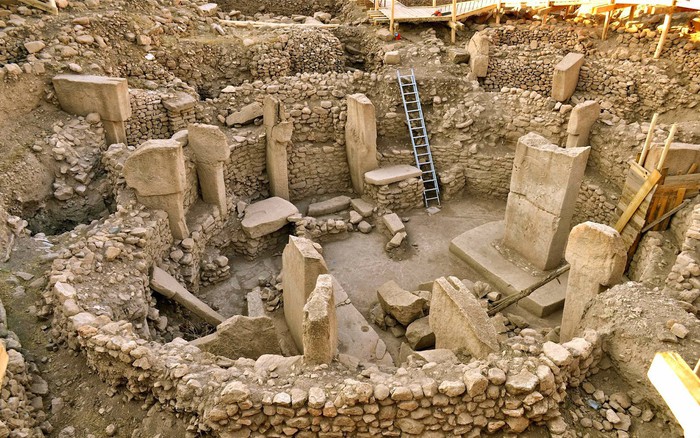
While the site was first noted in a survey conducted by Istanbul University and the University of Chicago in 1963, its true significance was not recognized until 1994 when German archaeologist Klaus Schmidt revisited the mound. Schmidt, working for the German Archaeological Insтιтute (DAI) in collaboration with the Şanlıurfa Museum, realized that the limestone fragments on the surface were the tops of T-shaped pillars rather than medieval gravestones. Until his death in 2014, Schmidt led the systematic excavation of several circular and oval enclosures. Today, the site is a UNESCO World Heritage landmark, and ongoing research is managed by the Göbekli Tepe Research Project, which utilizes non-invasive techniques like ground-penetrating radar to map the vast majority of the site—estimated to still be 95% underground.
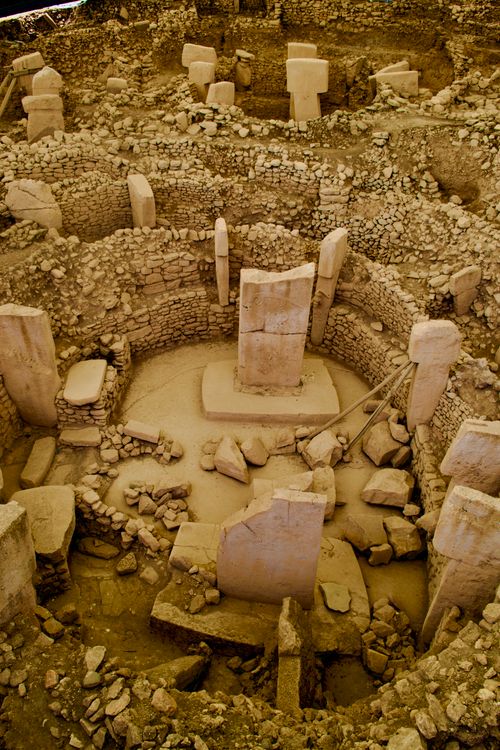
The structures at Göbekli Tepe are primarily composed of local limestone, quarried from the adjacent plateau. The most striking features are the T-shaped pillars, some standing up to 5.5 meters tall and weighing over 10 to 20 tons. The craftsmanship is extraordinary considering the builders lacked metal tools; they used flint and obsidian stone tools to carve, shape, and smooth the limestone. Many of the pillars are adorned with high-relief and bas-relief carvings of wild animals—vultures, scorpions, lions, boars, and foxes—as well as abstract symbols and stylized human arms and hands. The precision with which these mᴀssive blocks were extracted from the bedrock and transported to the center of the circular enclosures suggests a highly organized social structure and a level of engineering coordination previously thought impossible for hunter-gatherer bands.

Archaeologists classify Göbekli Tepe as a communal cult center or a “regional sanctuary.” Unlike typical Neolithic sites, there is no evidence of permanent domestic habitation—no hearths, no trash pits, and no water sources. Instead, the enclosures served as a theater for ritualistic gathering and ancestor worship. The T-shaped pillars are interpreted as stylized human figures, representing mythical ancestors or deities overseeing the ceremonies. The animal carvings may have functioned as totems for different clans or as “guardians” of the sacred space. The site acted as a cultural “hub” where disparate nomadic groups could congregate, likely sharing resources, forging social alliances, and participating in large-scale feasts, as evidenced by the mᴀssive quanтιтies of animal bone remains found in the fill material used to deliberately bury the temples.
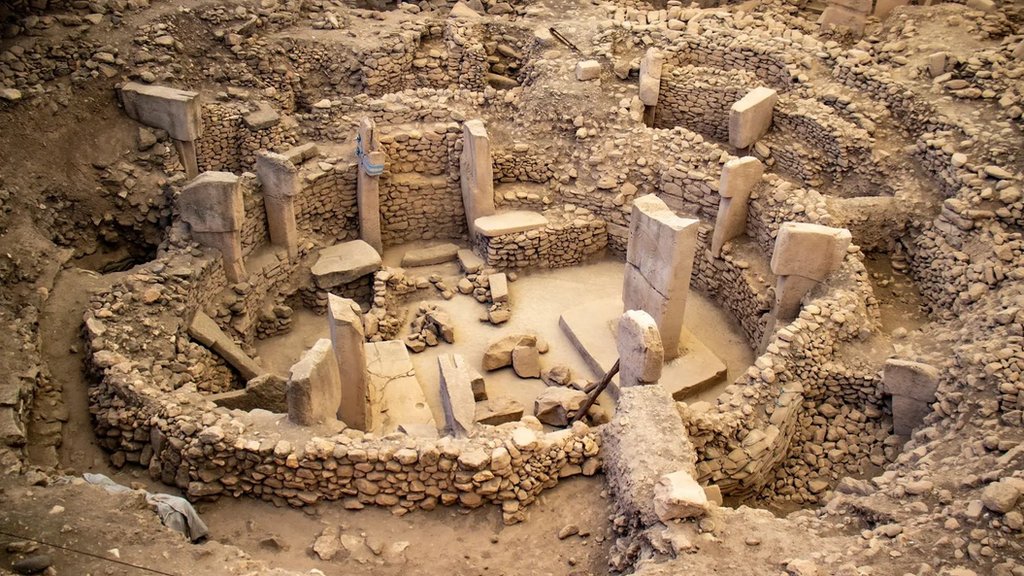
The legacy of Göbekli Tepe has fundamentally rewritten the timeline of human civilization. It suggests that religion and ritual preceded agriculture, serving as the “social glue” that compelled people to settle down and eventually domesticate plants and animals to feed the large labor forces required for such construction. From a scientific perspective, the site provides a unique look at the Pre-Pottery Neolithic toolkit and ancient artistic expression. Today, the site is protected by a state-of-the-art canopy to prevent erosion of the soft limestone. For archaeologists, Göbekli Tepe remains a silent but powerful witness to the moment humanity first reached for the divine, proving that our drive to create meaning and monumentality is as old as the very foundations of our history.
✓ Team
The archaeological site depicted in the image is Göbekli Tepe, a monumental complex located in the Southeastern Anatolia Region of modern-day Turkey. This site represents one of…