Qasr al-Farid: The Lonely Castle of the Nabataean Sands
The monumental structure known as Qasr al-Farid (the “Lonely Castle”) is a prime example of Nabataean funerary architecture, dating to the 1st century AD. Located in the archaeological site of Hegra (modern-day Mada’in Salih, Saudi Arabia), it was constructed during the height of the Nabataean Kingdom. This was a period when the Nabataeans, masters of the desert and controllers of the lucrative incense trade routes, flourished under the influence of both Greco-Roman aesthetics and indigenous Arabian traditions. Despite its name, Qasr al-Farid was never a castle but a tomb, and its isolated position away from the main clusters of Hegra’s 111 other monumental tombs suggests it was intended for an individual of exceptionally high social status or political power.
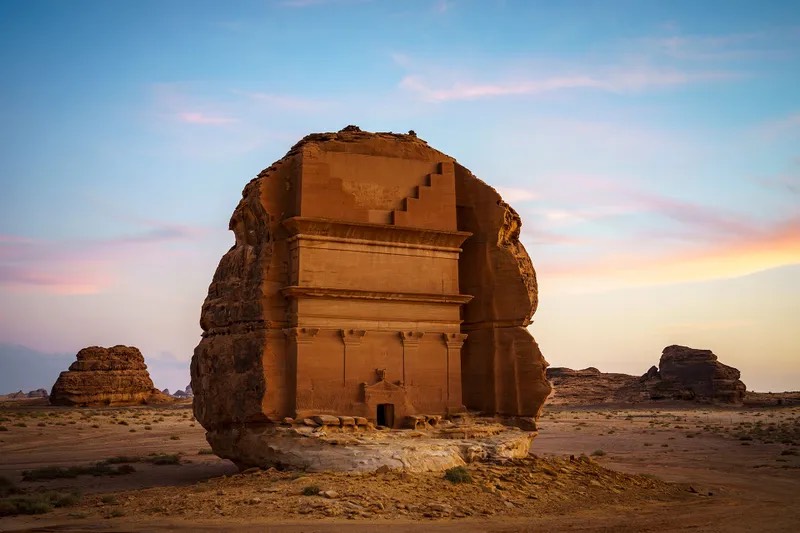
Discovery and Insтιтutional Research While Hegra has been known to local populations for centuries, it gained significant international archaeological attention in the late 19th and early 20th centuries. Initial documentation was provided by travelers like Charles Montagu Doughty in 1876, followed by the French Dominican fathers Antonin Jaussen and Raphael Savignac, who conducted the first systematic pH๏τographic and epigraphic survey between 1907 and 1910. In more recent decades, the site has been the focus of intense scientific study by the CNRS (French National Centre for Scientific Research) and the Royal Commission for AlUla (RCU). Their work, particularly since Hegra became Saudi Arabia’s first UNESCO World Heritage Site in 2008, has involved laser scanning and stratigraphic analysis to understand the complex urban and funerary landscape that surrounded this “lonely” monolith.
Material Composition and Lithic Craftsmanship The tomb is an extraordinary feat of monolithic rock-cut architecture, carved directly into a single, mᴀssive outcrop of aeolian sandstone. The craftsmanship involved a “top-down” excavation method, where Nabataean masons used iron chisels and picks to remove thousands of tons of stone, starting from the crown of the boulder and working their way down to the base. This method was extremely risky; any flaw in the stone or a single misplaced strike could ruin the symmetry of the entire facade. The sandstone’s natural reddish-orange hue, visible in, is the result of iron oxide content, which provides a soft enough medium for intricate carving but remains durable enough to withstand two millennia of desert wind erosion.

Architectural Details and Symbolic Synthesis The facade of Qasr al-Farid displays a sophisticated eclecticism, blending Hellenistic and Near Eastern styles. The most striking feature is the stepped crenellation (the “crowsteps”) at the top, a motif common in Mesopotamian and ᴀssyrian art. Below this, four pilasters with distinct Nabataean capitals—characterized by their simple, blocked-out forms—frame the smooth central face. The entrance is topped by a pediment that echoes the classical architecture of Petra. Interestingly, the lower portion of the tomb remains unfinished, as evidenced by the rougher stone at the base. This lack of completion provides archaeologists with a “frozen” view of the construction process, showing how the artisans prioritized the visual grandeur of the facade before hollowing out the actual burial chamber.
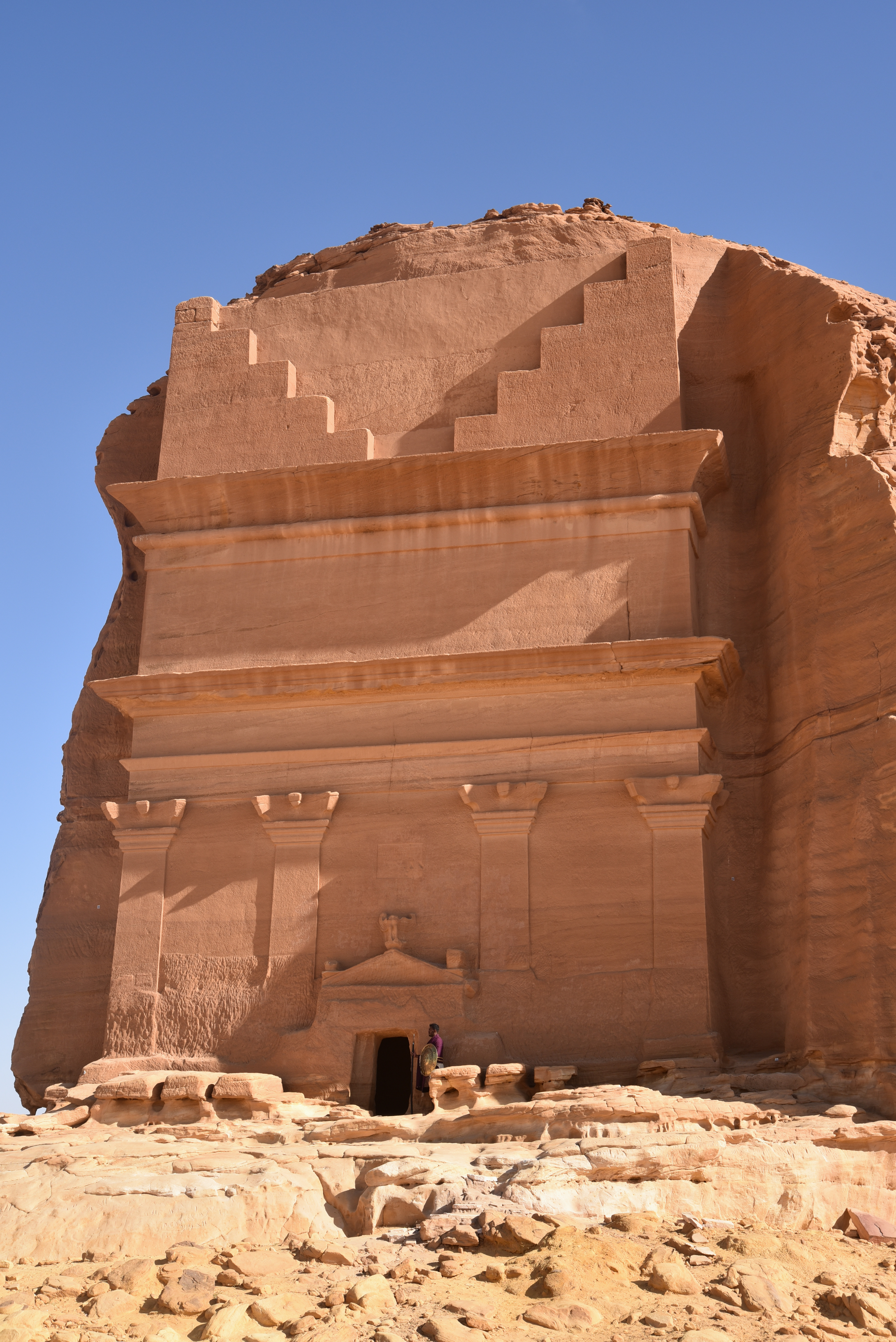
Significance and Funerary Function As a monumental tomb, Qasr al-Farid served as a permanent marker of idenтιтy and lineage in the Nabataean landscape. The hollowing of the interior chamber would have contained loculi (wall niches) for the deceased, though the isolation of this tomb suggests it may have been a family mausoleum that was never fully utilized due to a change in political fortunes or the death of the patron before completion. Beyond its role as a grave, it serves as a testament to the engineering prowess of a civilization that viewed the living rock as a canvas. It stands today as a silent witness to the intersection of ancient trade, religious belief in the afterlife, and the sheer human ambition to carve a lasting legacy out of the unforgiving desert stone.
✓ hoangduc
The monumental structure known as Qasr al-Farid (the “Lonely Castle”) is a prime example of Nabataean funerary architecture, dating to the 1st century AD. Located in the…