The Acámbaro Figurines: An Archaeological Analysis of Out-of-Place Artifacts
From a formal archaeological perspective, the ceramic figure depicting a humanoid riding a triceratops-like creature belongs to a collection known as the Acámbaro figurines. Discovered at the foot of El Toro Hill in Guanajuato, Mexico, the site initially appeared to be a significant burial ground for a previously unknown Pre-Columbian culture. However, unlike genuine Mesoamerican sites—such as those of the Chupícuaro or Tarascan people—the context of these finds is highly irregular. Professional archaeologists note that the “stratigraphy” of the discovery was disturbed, with thousands of pieces found in shallow, loose soil without the expected layers of domestic refuse or ritual architecture. This lack of a verifiable archaeological primary context suggests that the “discovery” was not a result of ancient deposition but of modern placement.
The “materiality” of this artifact consists of low-fired terracotta or sun-dried clay. The craftsmanship is distinctive, characterized by smooth, non-weathered surfaces and a lack of the mineral encrustation (patina) typically found on ceramics buried for millennia. In genuine archaeological ceramics, we observe “fire clouds” from primitive pit-firing and microscopic root etchings. This specimen, however, shows clean lines and a whimsical, expressive style that diverges sharply from the highly stylized, symbolic art of traditional Mexican cultures. Scientific testing, specifically Thermoluminescence (TL) dating conducted in the late 1960s and 70s, initially gave ancient dates due to technical errors; however, subsequent more precise TL testing and Carbon-14 analysis of ᴀssociated charcoal indicated that the items were fired only decades before their discovery.
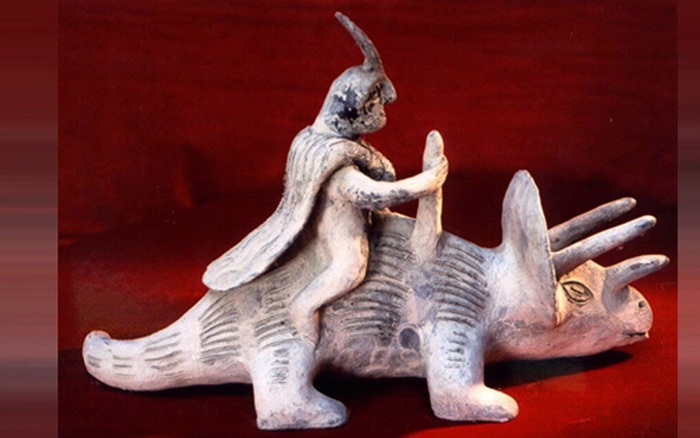
The morphology of the object is its most controversial feature: a humanoid with a cape and helmet mounted on the back of a dinosaur. From a paleontological and archaeological standpoint, this is an “anachronism”—a chronological inconsistency. The figure’s posture and the “saddle” arrangement reflect a 20th-century understanding of domesticated animals rather than ancient iconographic traditions. Furthermore, the creature resembles a Triceratops, a species that went extinct approximately 66 million years before the emergence of humans. Archaeologists interpret these morphological choices as a reflection of “paleo-fiction” or modern mythological imagination, tailored to appeal to mid-century interests in the “lost world” genre of literature and film.
While the artifact is often presented by fringe theorists as evidence of humans and dinosaurs coexisting, its true “function” in an archaeological sense was socio-economic. In the 1940s, the rural community of Acámbaro was experiencing economic hardship. The production and “discovery” of these figurines provided a source of income through their sale to curious collectors and researchers. Rather than serving a ritual or funerary purpose for an ancient civilization, these objects functioned as “curio artifacts.” They were designed to satisfy the demand for evidence of alternative history, acting as a bridge between local folk-craft and the global market for sensational archaeological discoveries.
The collection was brought to international attention by Waldemar Julsrud, a German hardware merchant and amateur archaeologist, who claimed to have found the first pieces in 1944. Julsrud eventually collected over 32,000 figurines. The discovery was formally investigated by the National Insтιтute of Anthropology and History (INAH) of Mexico and individual researchers like Charles Di Peso from the Amerind Foundation. Di Peso’s 1952 excavation concluded that the pieces were modern fakes, noting that the “excavation” pits showed signs of recent digging and that the figurines lacked the wear and tear of centuries in the earth. Today, the Acámbaro figurines are housed in the Waldemar Julsrud Museum as a fascinating study in “pseudo-archaeology,” serving as a reminder of the complex relationship between amateur discovery and scientific verification.
✓ hoangduc
From a formal archaeological perspective, the ceramic figure depicting a humanoid riding a triceratops-like creature belongs to a collection known as the Acámbaro figurines. Discovered at the…