The Anachronistic Carving: The “Stegosaur” of Ta Prohm
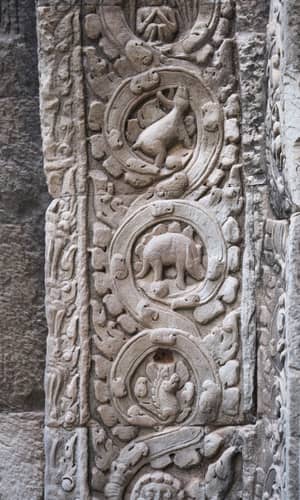
The intricate stone relief shown is located within the temple complex of Ta Prohm, situated in the Angkor Archaeological Park near Siem Reap, Cambodia. Commissioned by the Khmer King Jayavarman VII, the temple was consecrated in 1186 CE. This specific carving is found on a pilaster in a corner of the temple’s courtyard, part of a vertical sequence of circular medallions containing various animals and floral motifs. The temple itself served as a Mahayana Buddhist monastery and university, and today it remains one of the most iconic sites of the Khmer Empire due to its atmospheric state, famously intertwined with the roots of mᴀssive silk-cotton trees.

The primary material utilized for the construction and the detailed carvings at Ta Prohm, is greyish-pink sandstone. This sedimentary rock was quarried from the nearby Kulen Mountains and transported to the site via a network of canals. The carving technique employed is known as bas-relief, where the background is shallowly recessed to allow the figures to stand out. Khmer artisans of the late 12th century were masters of this craft, using iron chisels and wooden mallets to execute highly detailed zoological and mythological scenes. The medallion in question displays a quadruped with what appear to be upright, triangular plates along its dorsal ridge, set against a background of stylized vegetation typical of the Bayon architectural style.
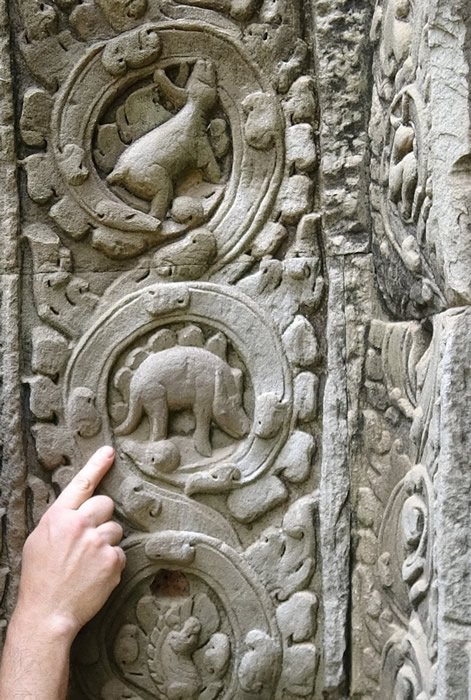
The significance and interpretation of this specific carving have sparked intense debate among archaeologists and the general public. While some alternative theorists suggest the image represents a prehistoric Stegosaurus—implying the survival of dinosaurs into the medieval period—mainstream archaeological analysis provides a more grounded cultural context. Most scholars interpret the figure as a rhinoceros or a boar depicted against a backdrop of stylized palm leaves or medicinal plants. In Khmer iconography, the “plates” are likely artistic flourishes intended to fill negative space or represent the lush jungle environment that the temple was built to honor. The carving’s primary function was decorative and religious, contributing to the temple’s overall narrative of harmony between the divine and the natural world.

Beyond its controversial visual interpretation, the relief serves as a testament to the biological knowledge of the Khmer people. The series of medallions in which this carving is embedded depicts a variety of fauna, including monkeys, deer, and birds, reflecting the rich biodiversity of the ancient Cambodian landscape. In the context of a Buddhist monastery, these animals represented the different realms of rebirth and the interconnectedness of all living beings. The artisan’s skill demonstrates a standardized yet expressive artistic language, where every centimeter of the sandstone surface was utilized to convey spiritual meaning through the depiction of the earthly realm.
The temple of Ta Prohm was “rediscovered” by French explorers in the 19th century and was subsequently managed by the École Française d’Extrême-Orient (EFEO). Unlike other temples in Angkor, Ta Prohm was intentionally left in a state of “controlled neglect” to preserve the romantic aesthetic of the ruins merged with nature. Systematic documentation of the carvings began in the early 20th century, but the “stegosaur” relief only gained widespread notoriety in the late 1990s following the rise of global tourism. Today, the site is co-managed by the APSARA National Authority and the Archaeological Survey of India (ASI), who conduct ongoing conservation efforts to protect these delicate sandstone reliefs from the high humidity and biological growth visible on the surrounding stone.
✓ hoangduc
The intricate stone relief shown is located within the temple complex of Ta Prohm, situated in the Angkor Archaeological Park near Siem Reap, Cambodia. Commissioned by the Khmer…