The Architectural Marvel of the Kailasa Temple: A Monolithic Masterpiece
The Kailasa Temple, stands as one of the most extraordinary archaeological achievements in human history, located within the Ellora Caves in Maharashtra, India. Dating back to the 8th century AD, specifically the reign of the Rashtrakuta king Krishna I (reigned c. 756–773 AD), this temple is a profound example of rock-cut architecture. Unlike traditional construction methods that involve ᴀssembling individual stones, this site was created through a subtractive process, carved entirely from a single, mᴀssive basaltic rock cliff. The sheer scale and precision of the excavation demonstrate a level of engineering mastery that remains a subject of intense study among modern archaeologists and historians alike, marking a zenith in medieval Indian temple craftsmanship.
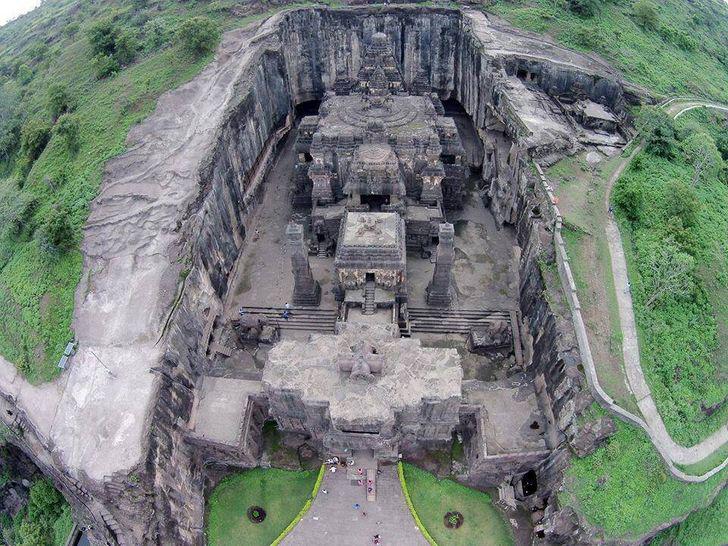
The material composition of the temple is volcanic basalt, a dense and durable rock prevalent in the Deccan Plateau. The fabrication technique is characterized by a “top-down” approach, where master artisans began carving at the very summit of the cliff and moved progressively downward. This vertical excavation allowed for the creation of intricate galleries, pillars, and chambers without the need for scaffolding, as the craftsmen worked within the natural confines of the gradually deepening quarry. The precision involved is staggering; architects had to possess a perfect mental map of the interior layout before a single strike of the chisel, as any significant error in the upper layers would have been irreparable for the structural integrity of the lower levels.
![Viện Kỷ Lục Châu Á (ASRI) - Đề Cử - P.545] Kailasa Temple (Ấn Độ): Công trình kiến trúc từ đá nguyên khối lớn nhất thế giới - HỘI KỶ LỤC GIA](https://kyluc.vn/Userfiles/Upload/images/kaila2.jpg)
Regarding its significance and function, the Kailasa Temple was constructed as a Hindu sanctuary dedicated to Lord Shiva, designed to replicate Mount Kailash, the deity’s mythical abode in the Himalayas. Beyond its religious utility, the temple served as a physical manifestation of the political power and cultural sophistication of the Rashtrakuta Dynasty. The walls are adorned with elaborate relief sculptures depicting scenes from the Ramayana, the Mahabharata, and various Puranic legends, which functioned as visual narratives for pilgrims. Its orientation and design reflect a deep understanding of cosmology and celestial alignment, intended to bridge the earthly realm with the divine through its towering central shikhara (spire) and integrated architectural harmony.

The recognition and documentation of this site as an archaeological treasure have evolved over centuries. While the temple remained known to local populations, formal archaeological documentation and scholarly attention flourished during the colonial era, with notable surveys conducted by the Archaeological Survey of India (ASI) in the 19th and 20th centuries. The ASI has been instrumental in the mapping, conservation, and preservation of the Ellora site, including the Kailasa temple complex. These efforts have facilitated the site’s inclusion as a UNESCO World Heritage site, ensuring that the legacy of those ancient artisans—who removed an estimated 200,000 tons of rock to birth this monument—is preserved for future generations to study.
Ultimately, the Kailasa Temple continues to challenge our contemporary understanding of ancient technological capabilities. The surrounding quarry walls highlight the immense physical exertion required to carve such a structure directly into the living rock face. Archaeological investigations are now utilizing advanced pH๏τogrammetry and 3D laser scanning to better understand the tool marks and structural planning that allowed such a mᴀssive project to be completed in roughly 18 to 20 years. This monument stands not merely as a relic of stone, but as an enduring testament to the ingenuity, spiritual devotion, and administrative precision of 8th-century Indian civilization.
✓ hoangduc
The Kailasa Temple, stands as one of the most extraordinary archaeological achievements in human history, located within the Ellora Caves in Maharashtra, India. Dating back to the…