The Architectural Zenith of Chichén Itzá: Decoding the Temple of Kukulcán
The monumental structure captured, widely recognized as the Temple of Kukulcán or El Castillo, stands as the crowning achievement of the Maya-Toltec civilization at Chichén Itzá in the Yucatán Peninsula of Mexico. Constructed primarily between the 8th and 12th centuries CE, this iconic step-pyramid serves as a profound testament to the advanced astronomical and mathematical knowledge of the Maya. Its deliberate alignment and complex geometric form demonstrate a society that integrated its cosmological beliefs directly into the urban landscape, creating a permanent, physical manifestation of the Maya calendar through its unique design features and orientation.

The construction of El Castillo utilized locally sourced limestone, a material abundant in the region, which was expertly quarried and shaped into modular blocks. The exterior surfaces were meticulously finished with fine lime plaster, originally painted in vibrant colors, while the internal structural core consists of rubble-fill encased within sturdy masonry walls. The excavation revealing the lower foundations and staircases exposes the site’s layered architectural history, confirming that the pyramid was constructed through successive stages of building—an common practice where newer, larger structures were built over older, smaller temple platforms to mark cycles of power and renewal.

In terms of symbolic significance and utility, the temple functioned as a celestial observatory and a religious center dedicated to the deity Kukulcán, the feathered serpent. Its design is engineered to interact with the sun’s cycle; for instance, during the equinoxes, the play of light and shadow on the northern staircase creates the striking illusion of a serpent descending the structure, signaling the transition of seasons crucial for agricultural success. Beyond its role as a calendar, the temple served as a locus for elite ritual activity, facilitating the connection between the ruling class and the divine forces governing the cosmos, thereby reinforcing political authority through the display of sophisticated engineering and astronomical timing.
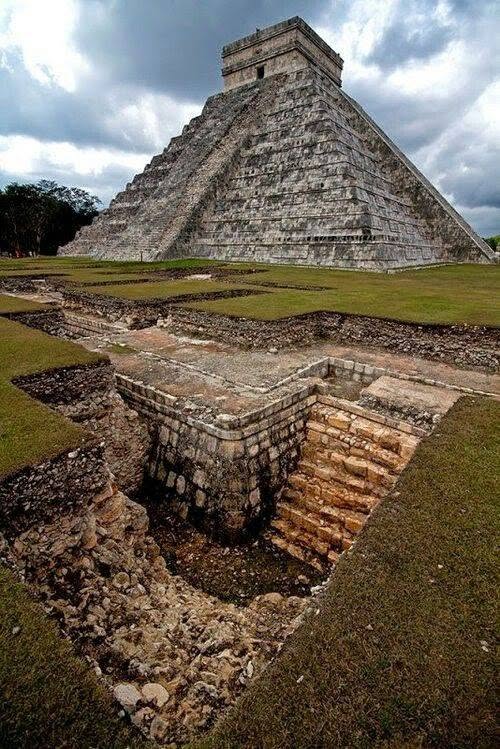
The study of Chichén Itzá has been advanced by decades of dedicated archaeological inquiry, beginning with early explorers and continuing through formal projects by insтιтutions such as the Carnegie Insтιтution of Washington and the Mexican National Insтιтute of Anthropology and History (INAH). Through rigorous stratigraphic excavations and the meticulous documentation of these architectural stages, researchers have mapped the complex development of the site, ensuring that the history of its construction is preserved as a scientific record. These endeavors have successfully distinguished the various layers of the structure, providing a deeper understanding of how the Maya evolved their architectural language and urban planning over several centuries.
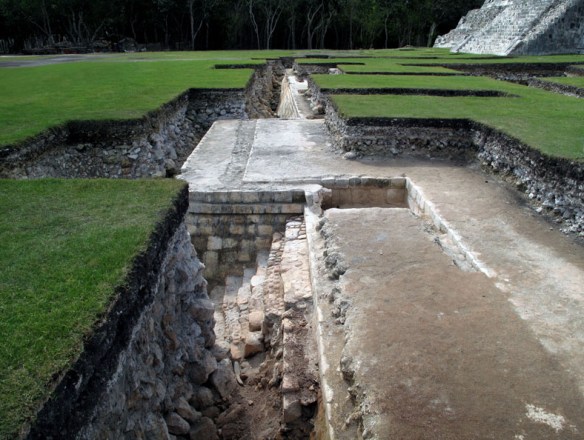
In conclusion, the visual evidence provided offers a unique glimpse into the sophisticated stratigraphy and engineering that characterize the Temple of Kukulcán. By exposing the older foundations beneath the current pyramid, we gain an appreciation for the long-term, iterative processes that defined the evolution of Chichén Itzá. As ongoing preservation efforts continue to protect this UNESCO World Heritage site, it remains a vital bridge to our past, providing a clearer window into the technical skill, spiritual depth, and political organization of the ancient Maya. The pyramid stands not only as an architectural wonder but as a enduring record of human achievement in navigating and interpreting the natural world.
✓ hoangduc
The monumental structure captured, widely recognized as the Temple of Kukulcán or El Castillo, stands as the crowning achievement of the Maya-Toltec civilization at Chichén Itzá in…