The Athenian Treasury: A Marble Monument to Victory and Piety at Delphi
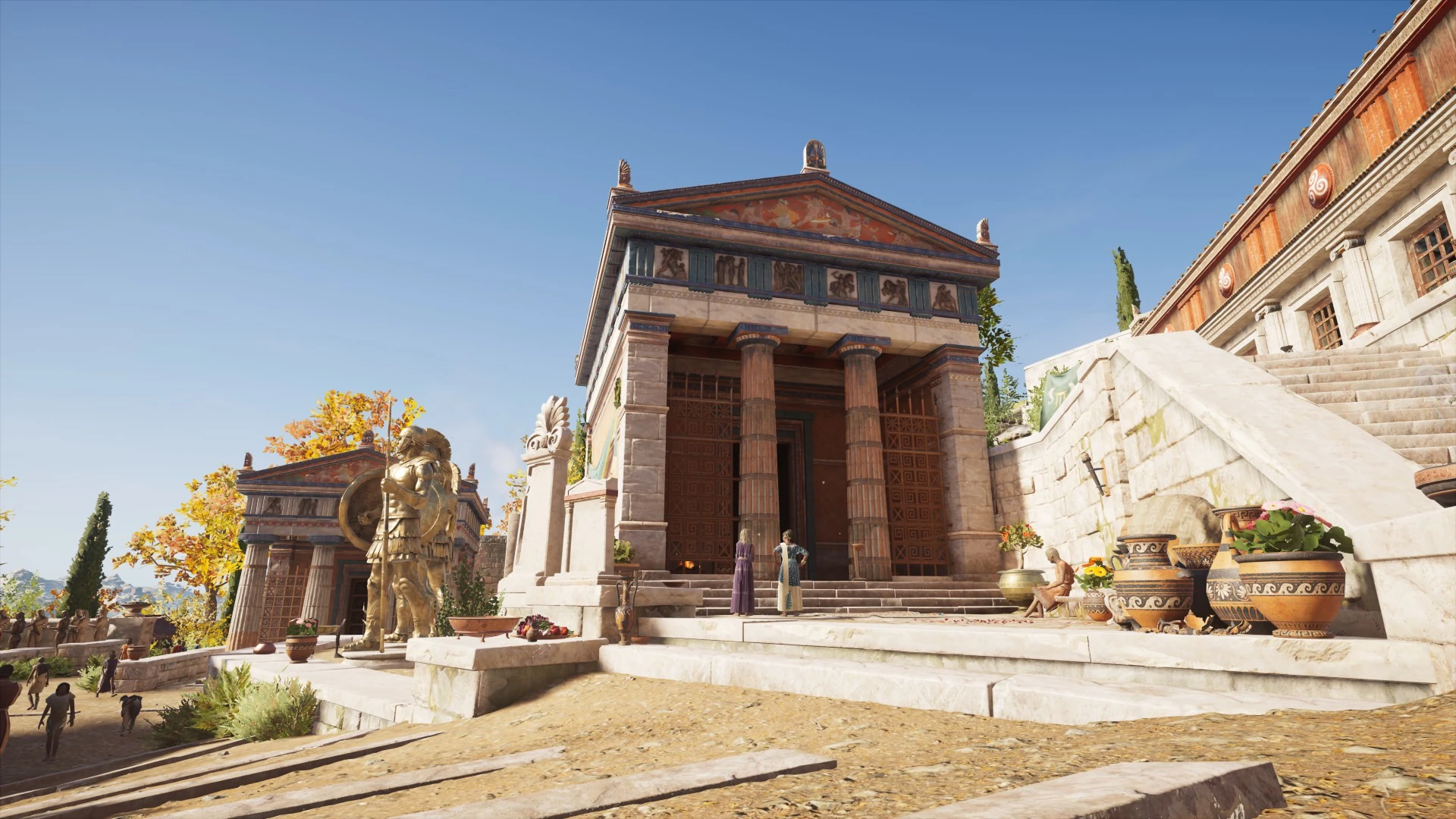
The images provide a compelling contrast between the weathered reality of the present and a vibrant digital reconstruction of the Athenian Treasury. This architectural masterpiece is situated within the Sanctuary of Apollo at Delphi, perched along the Sacred Way on a sharp turn known as the “Crossroads.” Archaeologically, it represents one of the most significant examples of a “thesauros”—a small, temple-like building dedicated by a city-state to house costly votive offerings and spoils of war. While scholars continue to debate the exact occasion for its construction, the prevailing theory links its completion to the aftermath of the Battle of Marathon (490 BCE), serving as a permanent, stone-bound “thank you” to the gods for the Athenian victory over the Persian Empire and the preservation of Greek democracy.
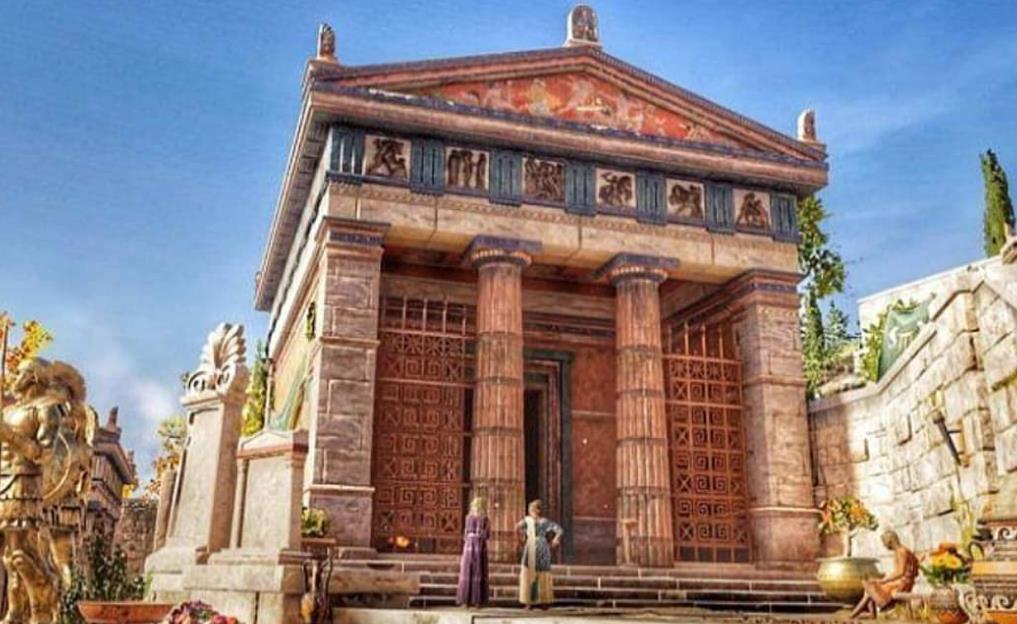
The material selected for this monument reflects the immense wealth and prestige of Athens: it is constructed almost entirely of Parian marble, sourced from the island of Paros and prized in antiquity for its translucent, fine-grained quality. The structure is a Doric order building in distyle in antis form, meaning it features two columns set between two projecting wall ends (antae). The craftsmanship is characterized by the transition from Archaic rigidity to Classical fluidity. Every surface was originally finished with “anathyrosis”—a technique where only the edges of the stone blocks are perfectly smoothed to create airтιԍнт joints without mortar. The digital reconstruction reminds us that the now-bare marble was once a riot of color, with the metopes, triglyphs, and pediments painted in vivid blues, reds, and golds, emphasizing the intricate relief carvings of the labors of Herakles and Theseus.

The decorative program of the Athenian Treasury served a dual purpose of religious devotion and political propaganda. The metopes—the rectangular panels above the columns—systematically compare the traditional Panhellenic hero Herakles with the specifically Athenian hero Theseus. By placing these figures side-by-side, Athens was effectively claiming a heroic lineage that justified its rising dominance in the Greek world. Functionally, the treasury acted as a high-security vault. Behind its mᴀssive bronze-clad doors, it guarded “тιтhes” (one-tenth of war spoils), ceremonial vessels, and precious tripods. It was a physical manifestation of “aparchai”—the first fruits of success—designed to be seen by the thousands of pilgrims who traveled to consult the Pythia (the Oracle), ensuring that Athenian glory was witnessed by the entire Mediterranean world.
The systematic excavation and eventual reconstruction of the Athenian Treasury were monumental achievements of the French School at Athens (École française d’Athènes). Under the leadership of Théophile Homolle, the “Great Excavation” of Delphi began in 1892, requiring the relocation of an entire modern village that sat atop the ruins. The treasury was found in a state of collapse, its marble blocks scattered by centuries of earthquakes. Between 1903 and 1906, the building was meticulously reconstructed using the method of anastylosis—reᴀssembling original fragments with minimal new material. This project was largely funded by the Municipality of Athens, highlighting the enduring symbolic connection between the modern Greek capital and its ancient spiritual representative at the “navel of the world.”

From an archaeological standpoint, the Athenian Treasury remains an invaluable “lithic document.” Inscribed upon its southern walls are the Delphic Hymns to Apollo, complete with musical notation, providing a rare window into the auditory world of ancient Greece. Furthermore, the base of the structure still bears the remains of the dedication inscription, confirming that it was built from the “spoils of the Medes.” Today, the treasury stands as the only building at Delphi to have been fully restored to its original height. It serves as a reminder that in the ancient world, architecture was not merely shelter; it was a loud, colorful, and permanent declaration of idenтιтy, faith, and the triumph of a city-state over the encroaching shadows of empire.
✓ Team
The images provide a compelling contrast between the weathered reality of the present and a vibrant digital reconstruction of the Athenian Treasury. This architectural masterpiece is situated…