The Awakening of Karahantepe: The Anthropomorphic Monolith of the Neolithic
In the rugged limestone hills of the Tektek Mountains, a groundbreaking discovery has emerged that challenges our fundamental understanding of human civilization. During the 2023 excavation season at Karahantepe, archaeologists unearthed a striking life-sized human statue, found in situ within a monumental circular structure. This site is part of the “Taş Tepeler” (Stone Hills) project, a network of contemporary sites that includes the world-famous Göbeklitepe. The statue was discovered seated on a stone bench, positioned amidst a complex of T-shaped pillars and phallic totems, suggesting that the site was not a residential settlement but a high-status ceremonial center dedicated to complex rituals of the early Holocene.

The statue is carved from a single block of indigenous limestone, a material chosen for its relative softness when freshly quarried but significant durability once weathered. Standing approximately 2.3 meters tall, the figure is a masterpiece of prehistoric subtractive sculpture. The craftsmanship is remarkably realistic for its era; the sculptor utilized high-quality flint and obsidian pressure tools to define the anatomical features. Notably, the ribs and collarbones are rendered in high relief, giving the figure an “emaciated” or skeletal appearance. This suggests a deep knowledge of human anatomy and a specific stylistic choice to emphasize the fragility of the body, a common theme in the symbolic language of the Neolithic Near East.
The “Karahantepe Man” is depicted in a seated or crouching posture, with both hands grasping his phallus—a potent symbol of fertility and lineage. The facial features are deeply expressive, with large, hollowed eye sockets that may have once held inlays of bone or colored stone, and a prominent nose and beard. Unlike the stylized T-shaped pillars found at neighboring sites, this monolith represents a shift toward true anthropomorphism. The articulation of the fingers and the detailed carving of the spinal column on the reverse side demonstrate a level of artistic sophistication that predates the invention of metal tools by several millennia, proving that hunter-gatherer societies possessed advanced technical skills.

From a functional perspective, the statue likely served as a totemic ancestor or a representation of a primordial deity within a “cult of the ᴅᴇᴀᴅ.” Its placement within the sunken circular room suggests it was a focal point for communal rites, possibly involving seasonal transitions or shamanistic initiations. The emaciated torso, combined with the focus on reproductive organs, may symbolize the eternal cycle of life, death, and rebirth. For the people of the Pre-Pottery Neolithic, this statue was not merely art; it was a physical manifestation of their social idenтιтy and a permanent witness to the sacred ceremonies that bound their emerging community together.
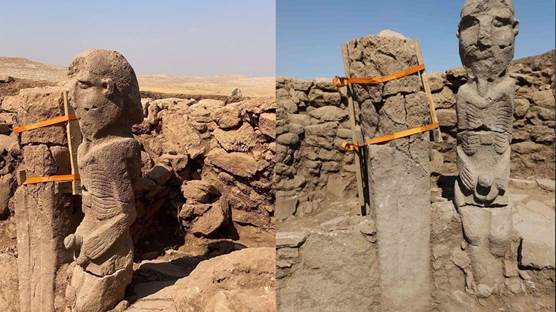
The excavation was conducted by an international team under the direction of Professor Necmi Karul of Istanbul University, in coordination with the Turkish Ministry of Culture and Tourism. The discovery of this statue has shifted the global archaeological focus toward the “Upper Mesopotamian” region as the true cradle of monumental art. To ensure the preservation of the fractured stone, the team employed state-of-the-art stabilization techniques, using tension straps and temporary scaffolding during the delicate extraction process. This artifact is currently housed in the Şanlıurfa Archaeology Museum, where it serves as a silent ambᴀssador for a lost world that stood at the very dawn of human history.
✓ hoangduc
In the rugged limestone hills of the Tektek Mountains, a groundbreaking discovery has emerged that challenges our fundamental understanding of human civilization. During the 2023 excavation season…