The Beacon of the Agora: An Archaeological Study of the Temple of Hephaestus
The monumental structure featured in the foreground of this image is the Temple of Hephaestus, located on the northwest side of the Ancient Agora of Athens, Greece. Perched atop the Agoraios Kolonos hill, it is one of the best-preserved ancient Greek temples in the world. Unlike many ruins that required extensive excavation to be revealed, the temple has remained a standing landmark for over two millennia. Systematic archaeological investigations of the surrounding Agora began in the 19th century, but the most comprehensive excavations were initiated in 1931 by the American School of Classical Studies at Athens (ASCSA), under the direction of prominent archaeologists such as T. Leslie Shear and Homer Thompson. These excavations unearthed the complex network of workshops, administrative buildings, and religious shrines that once vibrated with life around the temple’s base.

The Temple of Hephaestus dates to the Classical Period of Greek history, with construction believed to have begun around 449 BC and concluded by 415 BC. This timeline places it as a contemporary of the Parthenon (visible on the Acropolis in the background). Archaeologically, it represents the “Golden Age” of Periclean Athens. The temple’s longevity is largely attributed to its functional transformation; in the 7th century AD, it was converted into a Christian church dedicated to Saint George. This repurposing protected the structure from the systematic stone robbing and destruction that befell other pagan temples during the late Roman and Byzantine periods, preserving its architectural integrity until it was declared a national monument in the 19th century.
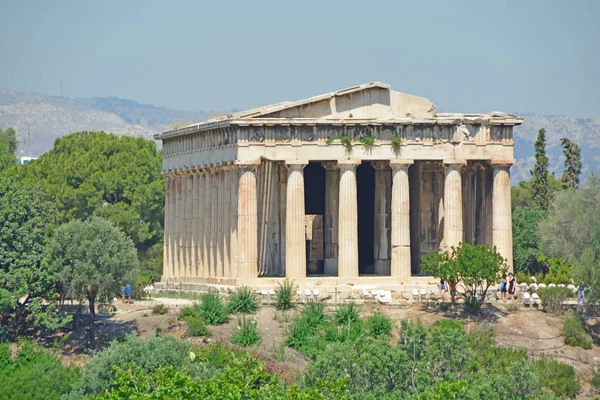
In terms of materiality, the temple is constructed primarily of Pentelic marble, quarried from Mount Pentelicus, renowned for its fine grain and white brilliance. The foundations, however, are made of Piraic limestone. Structurally, the temple is a peripteral hexastyle of the Doric order, meaning it is surrounded by a colonnade with six columns at the ends and thirteen along the sides. The craftsmanship is a pinnacle of Greek engineering, featuring subtle “optical refinements” such as entasis (a slight swelling of the columns) to correct human visual distortion. The metopes (sculptural panels) depict the Labors of Heracles and Theseus, carved with high-relief precision. The roof was originally covered with marble tiles, supported by an intricate wooden internal framework—a masterpiece of both lithic and timber joinery that reflects the peak of Athenian architectural capability.

From an archaeological and socio-religious perspective, the temple served a dual purpose. It was dedicated to Hephaestus, the god of metalworking and craftsmanship, and Athena Ergane, the goddess of pottery and crafts. This dedication was highly functional, as the surrounding district of the Agora was the Kerameikos and the industrial heart of Athens, populated by blacksmiths, foundry workers, and potters who viewed these deities as their patrons. Inside the cella (inner chamber), two mᴀssive bronze cult statues of the deities once stood. Beyond its role as a house for the gods, the temple functioned as a focal point for the Panathenaic Way, reinforcing the religious and civic idenтιтy of the Athenian polis through public ritual and the display of artistic wealth.
The ongoing preservation and study of the temple are managed by the Ephorate of Antiquities of the City of Athens and the Greek Ministry of Culture, in continued collaboration with the ASCSA. Modern conservation efforts have focused on stabilizing the friezes and protecting the marble surfaces from environmental degradation. Extensive mapping of the “Garden of Hephaestus”—the area immediately surrounding the temple—revealed evidence of ancient planting pits, suggesting that the Greeks maintained a landscaped environment of pomegranate and myrtle trees around the sanctuary. Today, the Temple of Hephaestus stands not only as a feat of ancient architecture but as a vital primary source for scholars studying the urban planning and spiritual life of the cradle of democracy.
✓ Team
The monumental structure featured in the foreground of this image is the Temple of Hephaestus, located on the northwest side of the Ancient Agora of Athens, Greece….