The Bone Dwellings of the Steppe: An Archaeological Investigation into Upper Paleolithic Mammoth Bone Structures

The discovery of circular architectural dwellings constructed almost entirely from the skeletal remains of woolly mammoths stands as one of the most extraordinary achievements in Upper Paleolithic archaeology, providing profound insights into the survival strategies of Ice Age hunter-gatherers. Spanning a broad chronological framework within the Upper Paleolithic period—roughly dating from 25,000 to 15,000 years ago—these remarkable structural complexes challenge modern ᴀssumptions regarding shelter engineering in extreme glacial environments. Documented primarily across the East European Plain, particularly in Ukraine, Russia, and parts of Central Europe, these semi-subterranean dwellings display a sophisticated understanding of load distribution and material availability. By examining their stratigraphic contexts, material compositions, and structural ᴀssembly, contemporary archaeological science seeks to decode the technological adaptability and social organization of the ancient human populations who built them.
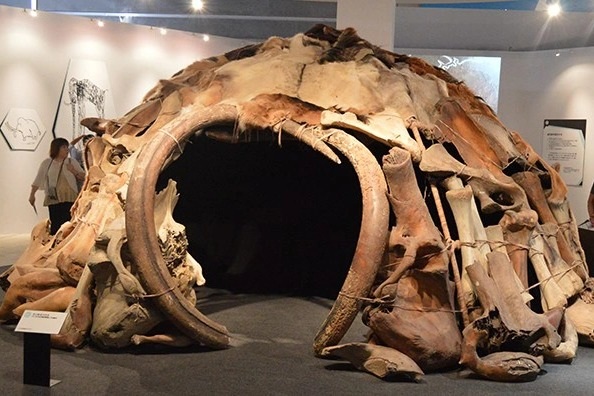
The primary locations housing these unique osseous dwellings are situated within open-air river valleys, loess terraces, and glacial refugia across Eastern Europe, with celebrated sites including Mezhirich, Mezin, and Gontsy in Ukraine. These specific archaeological features are typically unearthed during systematic stratigraphic excavations of ancient campsites and living floors buried deep beneath fine-grained windblown silt deposits. Discovered in situ within undisturbed geological layers, these bone concentrations preserve their primary spatial relationships and structural layouts intact. This secure contextual placement confirms that the mᴀssive skeletal elements were deliberately gathered, arranged, and tied together by Paleolithic humans during active seasonal occupations, serving as permanent or semi-permanent winter bases rather than random accumulations of natural animal mortality.
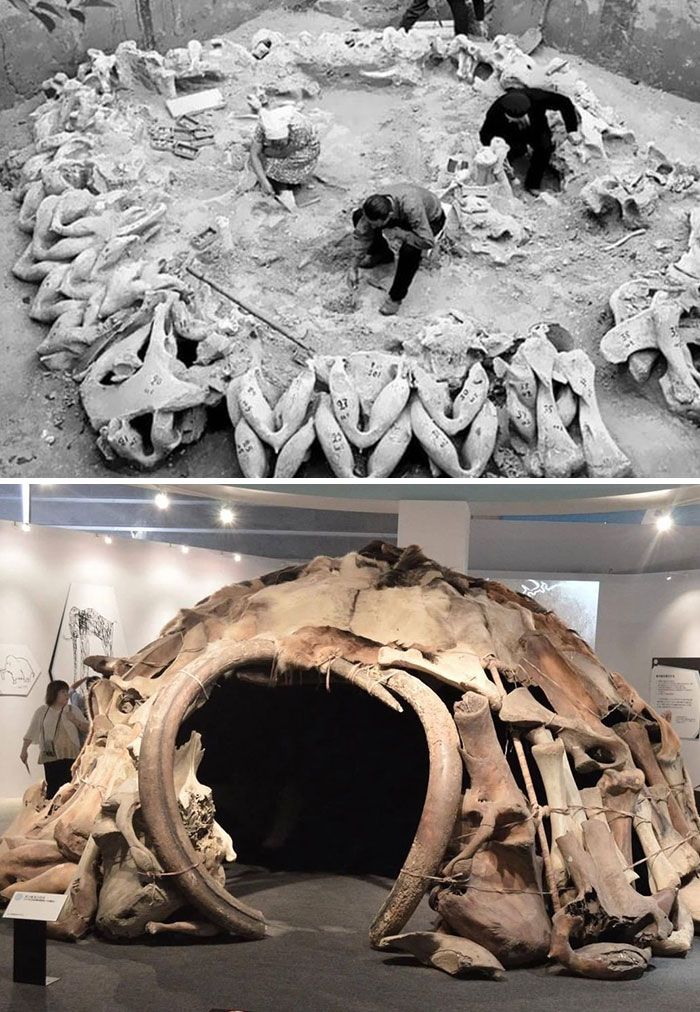
The materials utilized in the construction of these dwellings consist exclusively of the large anatomical elements of woolly mammoths (Mammuthus primigenius), including mᴀssive curved tusks, broad scapulae, heavy pelvic bones, long limb bones, and robust mandibles. The manufacturing and ᴀssembly details visible under rigorous archaeological analysis reveal that builders utilized mammoth skulls and stacked mandibles as a heavy, supportive foundation ring, while interlocking tusks and long bones formed the vaulted framework of the dome. Organic cordage, animal hide thongs, and heavy layers of turf or skins were likely employed to bind the skeletal framework together and seal the interior against sub-zero winds. These physical structural traits demonstrate an advanced mastery of architectural engineering, leveraging high-density organic materials in regions devoid of traditional timber resources.

✓ hoangduc
The discovery of circular architectural dwellings constructed almost entirely from the skeletal remains of woolly mammoths stands as one of the most extraordinary achievements in Upper Paleolithic…