The Casing of Khafre: Geomorphological Echoes on the Giza Plateau
The images focus on the structural upper reaches of the Pyramid of Khafre, the second-largest of the Ancient Egyptian pyramids at the Giza Plateau. This architectural giant is unique because it is the only one of the three Great Pyramids that still retains a significant portion of its original exterior facing at the apex. Archaeologically, these remains provide an invaluable record of the final aesthetic state of the Old Kingdom pyramids before centuries of quarrying and environmental degradation stripped them bare. The lower portion of the image highlights a fascinating “parabolic” pattern of wear, which some fringe theories attribute to water erosion or energy harmonics, but which mainstream archaeology identifies as a complex interaction between wind-driven sand, thermal expansion, and the historical removal of the limestone blocks by later dynasties.
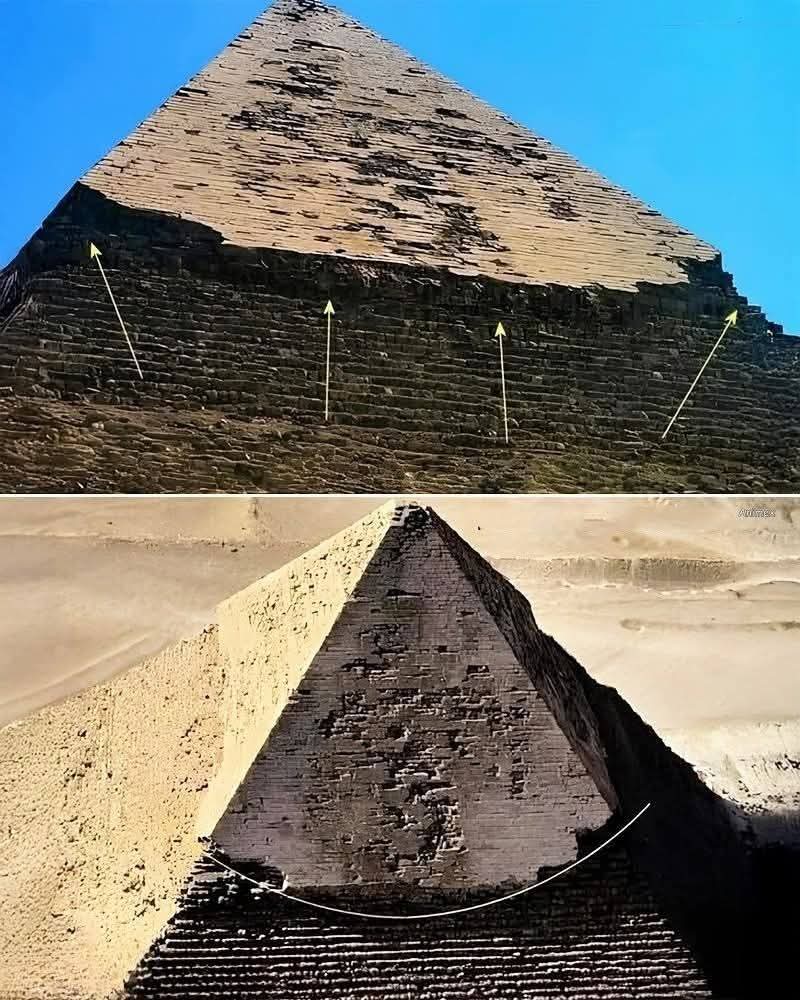
The material used for the exterior casing was Tura limestone, a high-quality, fine-grained white stone quarried from the eastern bank of the Nile. The “craftsmanship” of these blocks represents the pinnacle of ancient lithic technology. Each block was carved with extreme precision to create a seamless, sloped surface that once made the pyramid appear as a single, gleaming white monolith reflecting the sun’s rays. To achieve this, masons used copper saws and dolerite pounders, followed by fine abrasive polishing with quartz sand. The “undercut” seen in the upper image reveals the transition between the inner core of rough-hewn local yellow limestone and the sophisticated Tura casing. The тιԍнтness of the joints—often less than a fraction of a millimeter—demonstrates a mathematical mastery over angles that ensured the structure’s stability against the immense pressure of its own weight.
The functionality of the limestone casing was both practical and deeply theological. Practically, the polished Tura stone acted as a protective “skin,” shielding the inner core from the harsh desert elements and preventing moisture from penetrating the structure. Symbolically, the pyramid was conceived as a “Benben” stone, the primordial mound of creation. The reflective casing was intended to make the pyramid shine like a beacon, embodying the presence of the Sun God, Ra, on earth. The pyramid was not merely a tomb but a “resurrection machine” (or Akhet, meaning “Horizon”), designed to facilitate the Pharaoh’s transformation into an Ahk (an effective spirit) and his subsequent ascent to the stars. The smooth, white surface served as the literal interface between the terrestrial kingdom and the divine heavens.
The scientific documentation of the Giza Plateau has been a multinational endeavor spanning centuries, but the systematic study of Khafre’s pyramid owes much to the work of the Harvard University-Boston Museum of Fine Arts Expedition, led by George Reisner in the early 20th century. Later, the Giza Plateau Mapping Project, directed by Dr. Mark Lehner, provided modern topographical and architectural data that allowed researchers to understand how the casing was applied and subsequently removed. While the “Great Excavation” of the plateau began with explorers like Giovanni Belzoni, who first entered the interior of Khafre’s pyramid in 1818, modern organizations like the Egyptian Ministry of Tourism and Antiquities now focus on the geomorphological conservation of the remaining casing, monitoring how wind and “undercut erosion” affect the integrity of the surviving stone.
In conclusion, the remaining casing of Khafre’s pyramid is a “lithic document” that records over 4,500 years of environmental and human history. The erosion patterns shown in the user’s images—whether labeled as “undercut” or “parabolic”—are the scars of time on a structure that was built to be eternal. Archaeologically, these fragments are essential for reconstructing the original visual landscape of the Old Kingdom, a time when the desert was dominated by mᴀssive, glowing white geometric forms that bridged the gap between man and god. As we study the wear on these stones, we gain insight into the durability of ancient engineering and the relentless power of the natural world, reminding us that even the most monumental achievements of civilization are subject to the slow, inevitable rhythm of the earth’s geological processes.
✓ Team
The images focus on the structural upper reaches of the Pyramid of Khafre, the second-largest of the Ancient Egyptian pyramids at the Giza Plateau. This architectural giant…