The Celestial Traveler: An Archaeological Analysis of King Tutankhamun’s Winged Scarab Pectoral
The artifact featured in the image is a magnificent Winged Scarab Pectoral, a centerpiece of the funerary jewelry belonging to Pharaoh Tutankhamun. This world-renowned archaeological treasure was discovered in November 1922 within the Valley of the Kings, specifically in the tomb designated as KV62 in Luxor, Egypt. The discovery was the culmination of years of persistence by British Egyptologist Howard Carter, whose work was financed by George Herbert, 5th Earl of Carnarvon. This pectoral was found inside one of the many gilded chests in the Treasury room, located beyond the burial chamber. Unlike many other royal burials that fell victim to grave robbers, the intact nature of KV62 allowed archaeologists to document the precise placement of such jewelry, providing invaluable data on the ritual adornment of the New Kingdom’s boy-king.
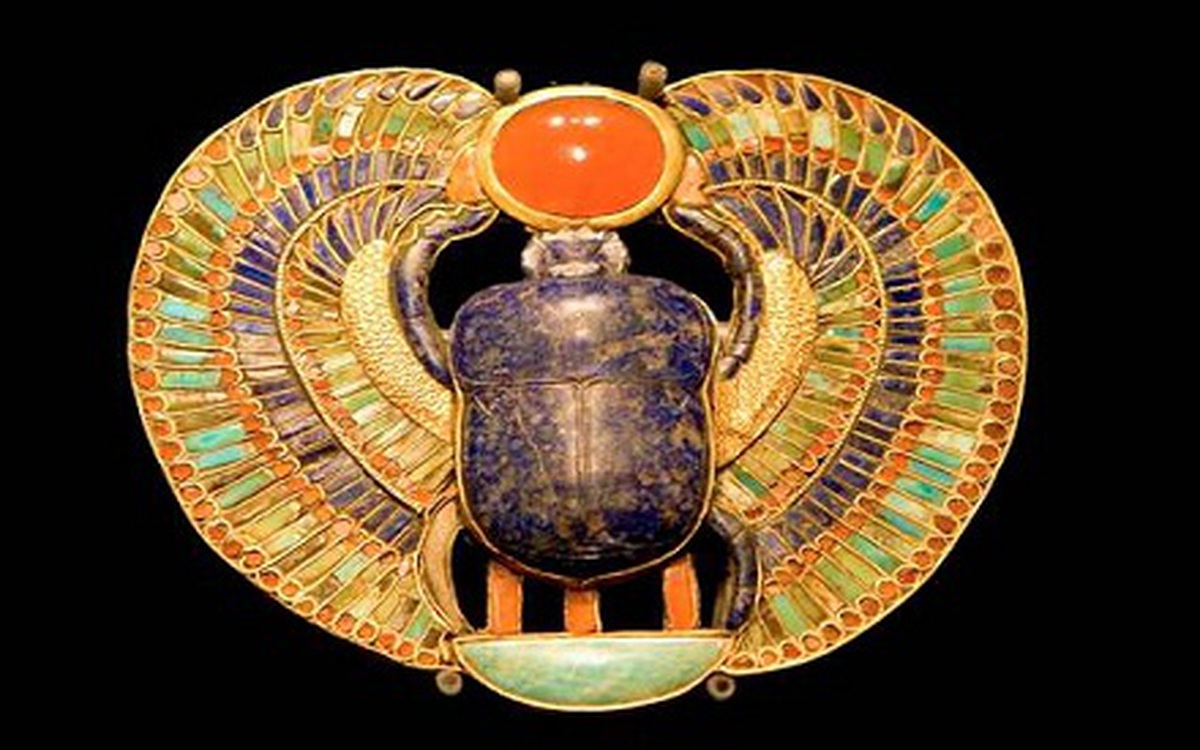
This pectoral dates to the 14th century BC, during the Eighteenth Dynasty of the New Kingdom (c. 1332–1323 BC). This era is considered the golden age of Egyptian imperial power and artistic sophistication. The piece was crafted during a pivotal moment of religious restoration; after the radical “Amarna” revolution of his father Akhenaten, Tutankhamun’s reign marked a return to the traditional polytheistic worship of the Theban pantheon. The dating is corroborated by the stylistic synthesis seen in the artifact—blending the naturalism of Amarna-era art with the rigid religious symbolism of the older, traditional Egyptian aesthetic.
From a technical standpoint, the pectoral is a masterclass in Ancient Egyptian jewelry-making. It is constructed from a foundation of solid gold, which serves as the framework for an intricate cloisonné inlay. The materials chosen were highly symbolic: the central scarab is carved from a vibrant slab of lapis lazuli, a semi-precious stone imported from as far as modern-day Afghanistan. The wings are inlaid with a rhythmic pattern of turquoise, carnelian, and multicolored glᴀss paste, mimicking the iridescent plumage of a bird. At the top sits a solar disc made of red carnelian, while the bottom is anchored by a bar of turquoise. The craftsmanship involved—specifically the “cold-joining” of stones into gold cells and the precision of the stone-carving—reflects the peak of the royal workshop’s technical capabilities.
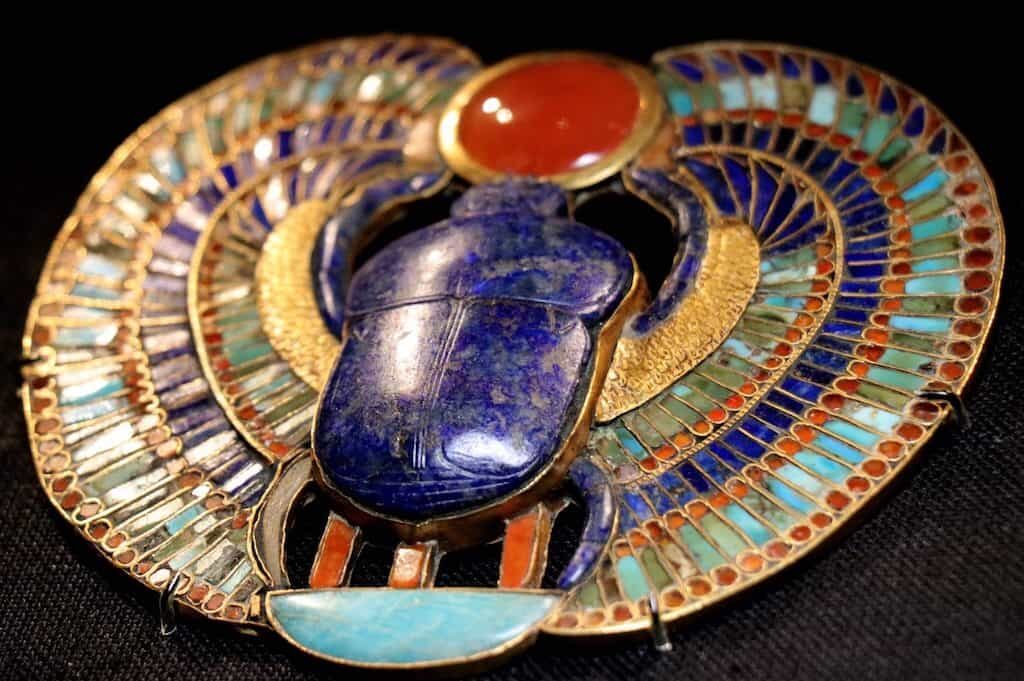
In the context of Egyptian bio-archaeology and theology, this pectoral was more than a decorative ornament; it was a powerful amulet for the afterlife. The central scarab represents Khepri, the god of the rising sun and the personification of rebirth and transformation. The wings represent the protective embrace of the sky goddess or perhaps the soul’s ability to fly through the underworld. Functionally, it was designed as a “pectoral” (chest-piece), suspended by a gold chain or straps around the neck. Its purpose was to safeguard the heart and the breath of the deceased king as he journeyed through the Duat (the underworld). By wearing the symbol of the self-created scarab pushing the solar disc, the king ensured his own eternal resurrection, paralleling the daily cycle of the sun.
Since its excavation, the pectoral has been under the permanent care of the Egyptian Ministry of Tourism and Antiquities. For decades, it was a highlight of the Egyptian Museum in Cairo, but it has recently been relocated to the Grand Egyptian Museum (GEM) near the Giza Pyramids. Continuous scientific analysis by the Supreme Council of Antiquities using X-ray fluorescence and microscopic imaging has revealed the chemical signatures of the glᴀss and gold, tracing trade routes across the ancient Mediterranean. As a symbol of Tutankhamun’s enduring legacy, the pectoral remains a vital primary source for scholars studying the intersection of ancient metallurgy, religious philosophy, and the profound human desire to conquer mortality through art.
✓ Team
The artifact featured in the image is a magnificent Winged Scarab Pectoral, a centerpiece of the funerary jewelry belonging to Pharaoh Tutankhamun. This world-renowned archaeological treasure was…