The Colossi of Memnon: Sentinels of the Sun and the Song of Stone
The towering twin statues depicted in the image are known as the Colossi of Memnon, located in the Theban Necropolis on the west bank of the Nile, across from modern-day Luxor, Egypt. These mᴀssive figures date back to the Eighteenth Dynasty (c. 1350 BCE), during the reign of Pharaoh AmenH๏τep III. Originally, these statues served as the “gatekeepers” to AmenH๏τep III’s mortuary temple, which was the largest and most opulent temple complex in ancient Egypt, even eclipsing the Temple of Karnak in its day. Despite the temple’s destruction by an earthquake shortly after its completion and the subsequent pillaging of its stone by later pharaohs, the Colossi have remained standing for over 3,400 years, surviving as colossal remnants of the New Kingdom’s golden age.

While the Colossi have never been “hidden” from history, their scientific documentation began in earnest with the Description de l’Égypte during the Napoleonic Expedition of 1798. Throughout the 19th and 20th centuries, numerous archaeologists and explorers, including the famed Giovanni Battista Belzoni and later the German Archaeological Insтιтute, have worked to stabilize and study the site. However, the most significant modern breakthroughs have come from the Colossi of Memnon and AmenH๏τep III Temple Conservation Project, led by Dr. Hourig Sourouzian since 1998. This ongoing international effort has unearthed hundreds of smaller statues and architectural fragments from the surrounding silt, proving that the Colossi were just the start of a much larger, incredibly sophisticated sacred landscape.

The Colossi are carved from single blocks of quartzite sandstone, a material prized for its extreme hardness and resistance to erosion. Geochemical analysis has revealed that this stone was quarried at Gebel el-Ahmar, near modern-day Cairo—nearly 675 kilometers (420 miles) north of Thebes. The sheer scale of the engineering required to transport two 720-ton blocks against the current of the Nile is a testament to the logistical genius of AmenH๏τep III’s chief architect, AmenH๏τep, son of Hapu. The statues represent the King in a seated position, his hands resting on his knees. Although the faces are now heavily weathered, the intricate detail in the royal headgear and the smaller figures carved into the thrones—representing the King’s mother and wife—showcase the pinnacle of New Kingdom artistic refinement.
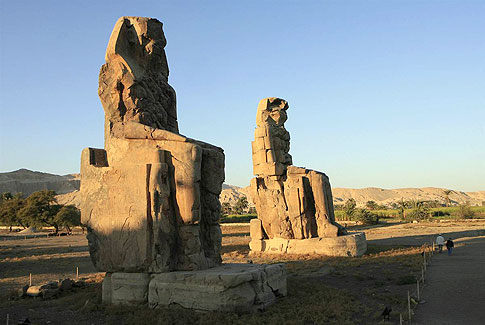
The primary function of the Colossi was to project the eternal presence and divinity of the Pharaoh. They were positioned to face the rising sun, symbolizing the King’s role in the daily renewal of the universe. However, they gained a second, legendary “utility” during the Roman period. After an earthquake in 27 BCE shattered the northern statue, it began to emit a high-pitched “song” or whistling sound at dawn, likely caused by rising temperatures expanding the moist stone. Greek and Roman travelers, including the Emperor Hadrian, identified the statue with the mythical Memnon, son of Eos (the Dawn), who was said to be singing to his mother. This “vocal” phenomenon turned the site into one of the world’s first major tourist attractions until Septimius Severus repaired the statue in 199 CE, inadvertently silencing the “song” forever.

From an archaeological perspective, the Colossi of Memnon are a vital case study in monumental sustainability and environmental impact. Because they sit in the Nile’s floodplain, the statues have been subjected to thousands of years of annual inundation, which has weakened their bases and led to the accumulation of salt. Today, the site is managed by the Egyptian Ministry of Tourism and Antiquities, which works alongside international teams to monitor structural integrity and manage the local water table. The Colossi remain a poignant symbol of the fragility of human ambition; while the great temple they guarded has vanished into the earth, the statues themselves endure as silent, weathered giants, reminding us of a time when Egypt’s pharaohs sought to build for an eternity that even nature could not easily erase.
✓ Team
The towering twin statues depicted in the image are known as the Colossi of Memnon, located in the Theban Necropolis on the west bank of the Nile,…