The Crystal Dagger of Montelirio: A Masterpiece of Prehistoric Lithic Technology
From an archaeological perspective, the crystal dagger found at the Montelirio tholos represents one of the most extraordinary technical achievements of the European Chalcolithic period. Discovered between 2007 and 2010, the site is part of a mᴀssive megalithic complex in Southwestern Spain. The dagger was unearthed within a large collective burial chamber that contained the remains of at least 25 individuals. Unlike typical utilitarian finds, this “artifact” was discovered in a primary funeral context, ᴀssociated with high-status grave goods such as ivory objects, amber beads, and ostrich eggshells. The site is a crucial data point for archaeologists studying social stratification and the emergence of elite lineages in the early metal ages of the Iberian Peninsula.
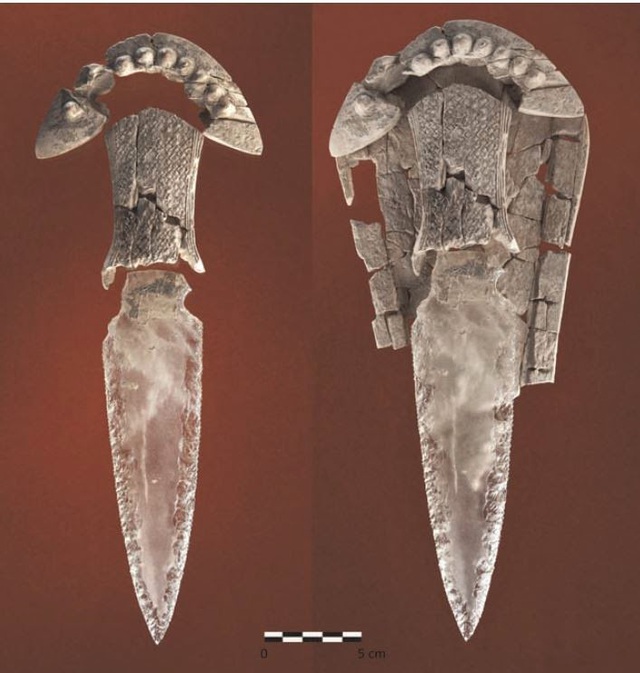
The “materiality” of this dagger is its most striking feature: it is carved entirely from a single, high-purity rock crystal (clear quartz). The craftsmanship required to produce such an object is staggering, as rock crystal is notoriously difficult to shape due to its hardness and its tendency to shatter along unpredictable cleavage planes. The artisan employed a sophisticated “pressure flaking” technique, typically reserved for high-quality flint, to create the serrated edges and the tapering point. This level of precision indicates a specialized master-craftsman who understood the optical and physical properties of quartz, transforming a raw mineral into a semi-translucent, razor-sharp blade that remains functional even after five millennia.
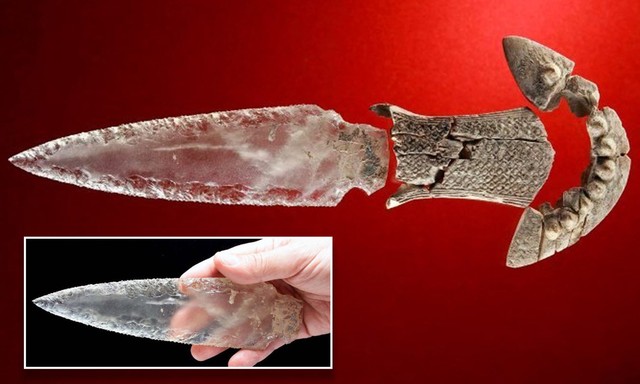
The morphology of the dagger consists of a leaf-shaped blade approximately 214 mm in length. Its surfaces are remarkably smooth, showing the intentional removal of thinning flakes to achieve a consistent thickness. Accompanying the blade was an ivory hilt and sheath, which, though found in a fragmented state (as seen in the secondary image), shows intricate cross-hatched carvings. Archaeologists have noted that the hilt was designed with a “v-shaped” notch to securely hold the crystal tang. The visual contrast between the icy, transparent quartz and the opaque, carved ivory would have created a profound aesthetic impact, marking the object as a pinnacle of prehistoric luxury and specialized “prestige technology.”
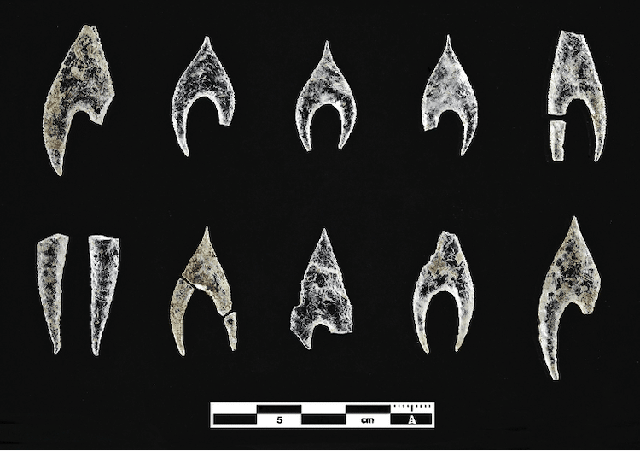
The primary function of the Montelirio dagger was almost certainly ritualistic rather than military. While quartz can hold a sharp edge, its brittleness makes it impractical for prolonged combat or domestic labor. In many ancient cultures, rock crystal was believed to possess magical properties, such as the ability to channel light or represent “frozen water.” Its “utility” lay in its ability to signify the immense wealth and religious authority of the deceased. By burying such a labor-intensive and rare object, the community effectively “retired” a symbol of power, perhaps as an offering to the afterlife or to solidify the social standing of the living elite during a period of increasing communal complexity.
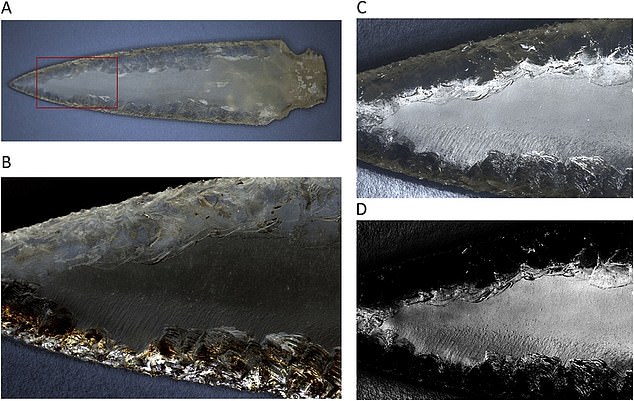
The excavation and subsequent analysis were conducted by a multidisciplinary team from the University of Seville, the University of Huelva, and the Spanish National Research Council (CSIC). Lead researchers, including archaeologists like Álvaro Fernández Flores and Leonardo García Sanjuán, have utilized Raman spectroscopy and microscopic wear-analysis to confirm that the quartz was sourced from hundreds of kilometers away, indicating vast trade networks. Today, the crystal dagger is preserved at the Archaeological Museum of Seville. It stands as a testament to the “hidden histories” of the Copper Age, reminding us that ancient people valued transparency, light, and artistic perfection as much as they valued the raw utility of metal and stone.
✓ hoangduc
From an archaeological perspective, the crystal dagger found at the Montelirio tholos represents one of the most extraordinary technical achievements of the European Chalcolithic period. Discovered between…