The Digital Mirage: Deconstructing Modern Myths of Gigantism in Archaeology
The images provided do not document a genuine archaeological discovery but are contemporary AI-generated fabrications that surfaced on social media platforms around 2023. Unlike traditional archaeological finds that emerge from controlled excavations, these “artifacts” appeared within the digital realm of “Alternative History” forums. From a modern archaeological and media-forensic perspective, the “site of discovery” is a generative neural network, likely Midjourney or DALL-E, designed to mimic the aesthetic of early 20th-century sepia pH๏τography. The intention behind such creations is often to propagate “Forbidden Archaeology” narratives, which suggest that mainstream insтιтutions like the Smithsonian or national museums suppress evidence of a giant prehistoric human race. In reality, no archaeological organization or university has ever documented or cataloged the biological remains of a 12-foot-tall bearded hominid as depicted.
While the images claim to represent a historical period—roughly the late 19th or early 20th century based on the Victorian-era clothing of the onlookers—their true “date of manufacture” is the early 21st century. Archaeologically, we analyze the “stratigraphy” of the image itself. The textures of the clothing on the central figure are hyper-detailed yet biologically inconsistent with human physiology; the hands exhibit common AI artifacts, such as fused digits and distorted proportions. The dating of the supposed giants mentioned in such hoaxes often claims they belong to the Neolithic or Bronze Age, yet there is a complete lack of ᴀssociated material culture—pottery, tools, or carbon-datable remains—that would be present in a legitimate archaeological context. These images are anachronistic “ghosts” designed to exploit the visual authority of old pH๏τography.
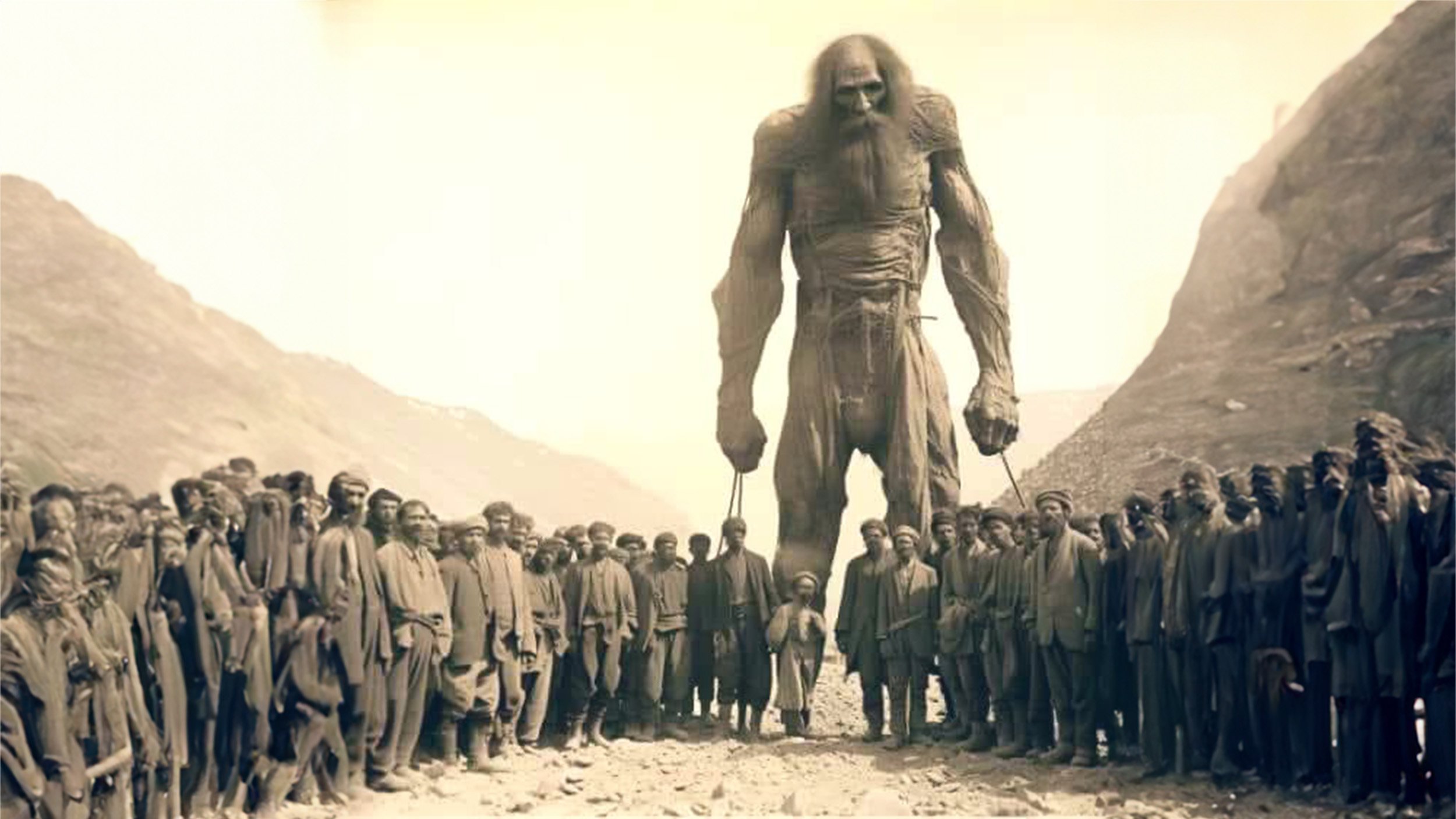
In archaeology, we examine the material of an artifact (stone, bone, ceramic). In the case of these digital images, the “material” is pixel data and algorithmic patterns. The “craftsmanship” involved is not that of an ancient mason or a physical hoaxer (like the 1869 Cardiff Giant, which was carved from gypsum), but rather the prompt-engineering of a digital creator. Key technical giveaways include the lighting inconsistencies and the lack of atmospheric perspective; the “giant” appears to have a different focal depth than the men standing directly beside him. Furthermore, the skin texture on the giant’s arms resembles weathered stone or elephant hide more than human dermis, a common stylistic choice by AI to emphasize “ancientness” or “otherness,” which lacks any biological precedent in the human fossil record.

The significance of these images lies not in physical history, but in cultural anthropology and modern folklore. These fabrications function as visual “evidence” for proponents of the Nephilim or “Lost Race of Giants” mythos. From an analytical standpoint, the “use” of such an artifact is to challenge the established scientific consensus on human evolution. By presenting a “giant” alongside men of normal stature, the creator seeks to evoke a sense of wonder and distrust in “official” history. In legitimate archaeology, the study of human remains (Bioarchaeology) confirms that while human height has fluctuated due to nutrition and environment, it has remained within a consistent biological range (approx. 1.5m to 2.1m) for hundreds of thousands of years. These images serve as modern “digital relics” for those seeking a more fantastical past.
The “organizations” often cited in conjunction with these pH๏τos are usually fictionalized versions of the Smithsonian Insтιтution or the National Geographic Society, frequently portrayed as “villains” who hide these bones to protect the theory of evolution. However, in the professional archaeological community, such a discovery would be the most celebrated event in history, not something to be hidden. Real excavations, such as those of the Denisovans or Homo floresiensis (the “Hobbit” humans), are published with rigorous peer review and physical evidence that can be touched, measured, and DNA-tested. These AI images, by contrast, lack a paper trail, a museum accession number, or a physical location. They remain a fascinating study in how digital technology can be used to “manufacture” a past that never existed, highlighting the need for digital literacy in the field of modern archaeology.
✓ Team
The images provided do not document a genuine archaeological discovery but are contemporary AI-generated fabrications that surfaced on social media platforms around 2023. Unlike traditional archaeological finds…