The Enigma of Al Naslaa: A Geological Masterpiece
Standing amidst the vast, arid expanse of the Tayma Oasis in northwestern Saudi Arabia, the Al Naslaa rock formation presents a sight that defies immediate comprehension. This monumental sandstone outcrop, rising roughly six meters from the desert floor, is bisected by a vertical, laser-straight gap that splits the boulder into two perfectly balanced halves. Each side rests precariously on its own slender, naturally eroded pedestal, creating a silhouette that appears more like a deliberate architectural feat than a product of nature. For decades, this geological wonder has captivated explorers and scientists alike, sparking intense debate between those who see the unmistakable hand of ancient human craftsmanship and those who point to the unrelenting, yet artistic, forces of geological time.
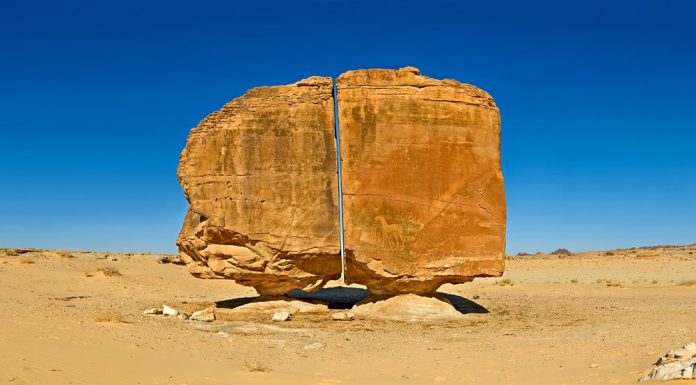
From a strictly geological perspective, Al Naslaa is primarily composed of sandstone, a sedimentary rock susceptible to the cumulative stresses of its environment. While alternative theories often suggest the involvement of advanced ancient technologies or extraterrestrial intervention to explain the precision of the cut, mainstream geology posits that the split is a natural phenomenon known as a joint—a fracture where rock separates without significant displacement. Scientists suggest that tectonic stress or movement along a fault line beneath the rock likely initiated the crack. Over millions of years, this fracture was then refined by a combination of freeze-thaw weathering and the relentless abrasive action of wind-blown sand, which polished the inner faces of the gap to its current, smooth state.
Despite the prevailing scientific consensus, the archaeological significance of the site remains profound, rooted deeply in its human history. The southeastern face of the rock is adorned with intricate petroglyphs, including depictions of horses, ibex, and human figures, which serve as a silent testament to the ancient civilizations that once traversed this region. While the formation itself is a natural artifact, its presence made it a focal point in the landscape—likely acting as a vital landmark, a gathering place for nomadic trade caravans, or even a site imbued with symbolic or religious importance by the inhabitants of the Tayma Oasis. The artistry found on its surface links the monument to the long history of human interaction with the desert environment.
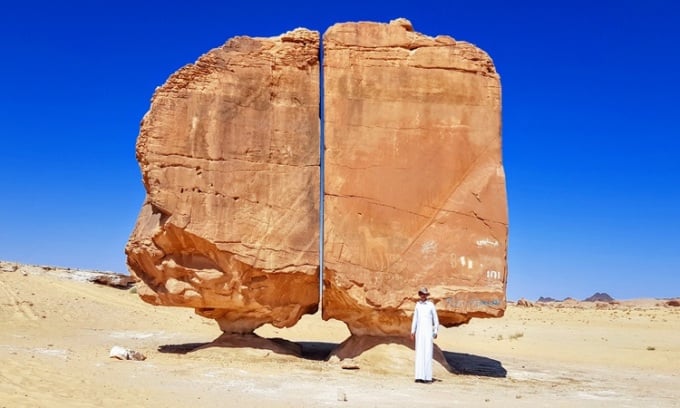
The documentation and study of Al Naslaa have been a collaborative effort, involving both local heritage organizations and international researchers dedicated to mapping the archaeological treasures of the Tabuk Province. Excavations and surveys in the surrounding area, spearheaded by Saudi authorities and teams ᴀssociated with the Saudi Commission for Tourism and National Heritage, have sought to place the rock within the broader context of Tayma’s rich history as a major commercial center. These investigations underscore that while the “cut” may be a result of geological serendipity, the site’s enduring fame is inextricably linked to the cultural stories etched onto its stone skin by past generations.
As we continue to analyze this enigmatic formation, Al Naslaa stands as a humbling reminder of the dialogue between natural processes and human perception. Whether viewed as an inexplicable engineering mystery or a masterpiece of natural erosion, the rock serves as a bridge between deep geological time and the transitory nature of human activity. It challenges us to look closer at the world around us, inviting us to contemplate how nature, through its own slow and patient methods, can produce marvels that feel entirely human-made, thereby enriching the tapestry of our collective heritage and scientific understanding.
✓ hoangduc
Standing amidst the vast, arid expanse of the Tayma Oasis in northwestern Saudi Arabia, the Al Naslaa rock formation presents a sight that defies immediate comprehension. This…