The Enigmatic Dacian Bronze Matrix: A Masterpiece of Ancient Metalworking
The artifact in the image is known as the Sarmizegetusa Regia Matrix, one of the most significant archaeological finds in Romania. It was discovered by pure chance in June 2013 during a heavy storm that uprooted a tree in the archaeological site of Sarmizegetusa Regia, the ancient capital of the Dacian Kingdom, located in the Orăștie Mountains. The discovery was immediately reported to the authorities, and subsequent excavations were led by a team of archaeologists from the National Museum of Transylvanian History (MNIT) in Cluj-Napoca, under the coordination of Dr. Gelu Florea. This hexagonal bronze block was found within the sacred precinct of the UNESCO World Heritage site, suggesting it belonged to a high-status workshop serving the Dacian aristocracy or priesthood before the Roman conquest in 106 AD.

Based on the stratigraphic context and the stylistic features of the engravings, the matrix is dated to the 1st century BC – 1st century AD (Late Iron Age). It is a mᴀssive piece of cast bronze, weighing approximately 8 kilograms and measuring nearly 15 centimeters across. The object is a thick, hexagonal prism with five of its sides (including the top and bottom) intricately engraved with negative patterns. The bronze alloy used is of high quality, designed to withstand the immense pressure and heat involved in the metalworking process. The dark green patina visible today is a result of centuries of oxidation in the damp soil of the Transylvanian mountains, which has preserved the fine details of the carvings remarkably well.
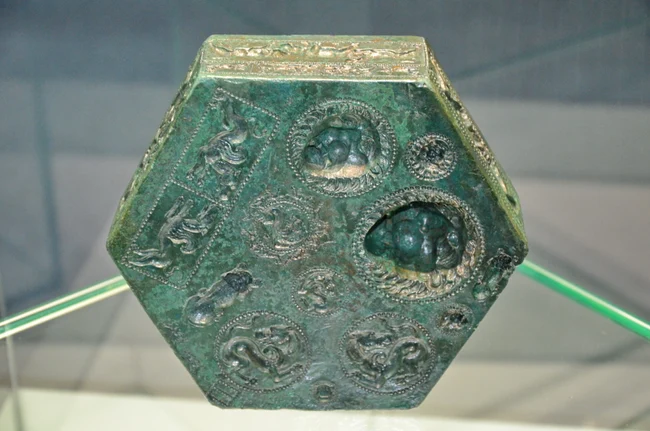
The craftsmanship of the matrix is extraordinary, displaying a synthesis of local Dacian, Mediterranean (Greco-Roman), and even Near Eastern artistic influences. The sides are covered in a “bestiary” of mythological and real animals, including griffins, lions, tigers, leopards, rhinoceroses, and hippopotamuses, alongside stylized floral motifs. Each figure was carved into the bronze using specialized chisels and punches to create deep, precise hollows. The presence of exotic animals like the rhinoceros indicates that the Dacian elite were part of a vast trade network that connected the Carpathian region to the distant reaches of the Roman Empire and beyond. The complexity of the compositions suggests that the master artisan who created this tool was among the most skilled in the ancient world.

From an archaeological standpoint, this artifact functioned as a master matrix (or mold) for creating luxury jewelry and decorative elements from precious metals like gold and silver. A thin sheet of metal would be placed over the desired pattern, and by using a technique known as repoussé or stamping with a lead or wooden mallet, the metal would be forced into the crevices of the matrix to take its shape. This allowed for the mᴀss production of consistent, high-quality ornaments such as phalerae (medallions worn on armor), belt buckles, and vessel decorations. Its multi-sided design served as a versatile “catalogue” of patterns, allowing the goldsmith to rotate the block and choose from dozens of different scenes and figures depending on the commission.
The Sarmizegetusa Matrix is more than just a tool; it is a historical document that reshaped our understanding of Dacian civilization. Prior to its discovery, it was often ᴀssumed that Dacian art was purely geometric or abstract. This find proves that Dacian society was deeply integrated into the cosmopolitan culture of the era, possessing a sophisticated taste for figurative and classical imagery. It confirms Sarmizegetusa Regia as a major metallurgical center of Eastern Europe. Today, the matrix is a national treasure of Romania, exhibited prominently at the Museum of Dacian and Roman Civilization in Deva. It stands as a silent witness to the wealth and cultural brilliance of a kingdom that once challenged the might of Imperial Rome.
✓ Team
The artifact in the image is known as the Sarmizegetusa Regia Matrix, one of the most significant archaeological finds in Romania. It was discovered by pure chance…