The Enigmatic Prehistoric Screw: An Out-of-Place Metallurgical Mystery

Among the most controversial and captivating anomalies studied in the borderlands of archaeology and fringe geology is the discovery of metallic components completely encased within solid rock matrixes, often referred to as “out-of-place artifacts”. One of the most famous examples features a small, finely threaded metal screw-like shaft firmly embedded inside a jagged fragment of hard rock. This extraordinary specimen immediately challenges conventional timelines of human industrial development due to its uncanny structural precision. While mainstream geologists frequently categorize such objects as natural fossilized marine organisms like crinoid stems or complex mineral concretions, alternative researchers point to its geometric regularity as evidence of forgotten prehistoric technology.

The primary specimen and similar anomalous finds have surfaced primarily in remote mountainous terrain, notably in regions like the Mazong Mountains of China and various mineral-rich deposits across Eastern Europe and Russia. The matrix enclosing the metallic element typically consists of hard volcanic or sedimentary rock, such as dense sandstone, quartz, or hardened feldspar granite. The embedded object itself exhibits a distinct spiral threading pattern that mimics modern machine-tooled screws, boasting uniform pitch and depth. The physical composition of the shaft involves processed metal alloys, raising profound technical questions regarding how a finely crafted mechanical component could become intimately bonded with geological formations traditionally dated by standard stratigraphy to hundreds of millions of years old.
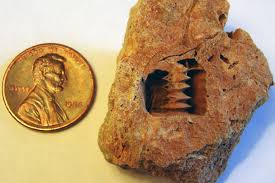
From a chronological perspective, proponents of ancient anomaly theories suggest that if the host rock genuinely formed during ancient geological epochs, the object pushes the timeline of advanced metallurgy back into deep prehistory—potentially tens or hundreds of thousands of years before the accepted dawn of human civilization. However, mainstream archaeological and paleontological evaluations offer a completely different chronological context. They identify the “threads” not as manufactured screws, but as the fossilized remains of ancient crinoids (sea lilies) whose stem segments naturally break down into cylindrical, segmented disks that leave screw-like impressions when embedded and eroded in stone. This stark divergence in dating and origin highlights the intense debate between conventional uniformitarian geology and alternative historical interpretations.
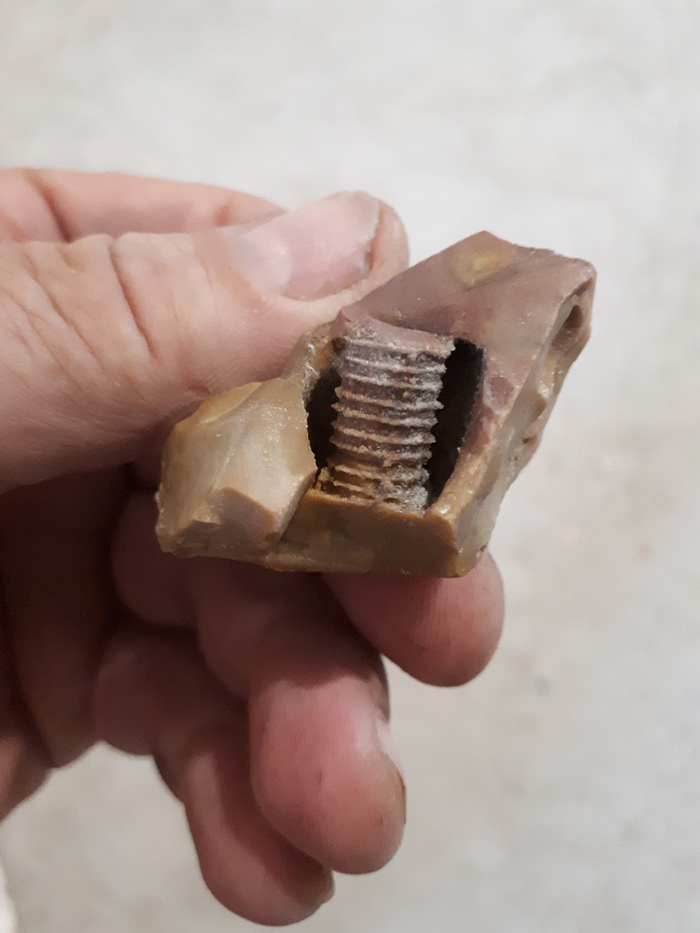
The principal utility or function of the object, ᴀssuming an artificial origin, remains a subject of intense speculation among independent researchers and crypto-archaeologists. Some fringe theories propose that it represents a remnant fastener from an ancient, lost mechanical device, precision instrument, or pre-diluvian infrastructure utilized by an advanced forgotten society. Conversely, evolutionary and geological analyses dismiss any functional utility in an archaeological sense, arguing that the item possesses no technological context, tool ᴀssociation, or workshop debris field. Instead, its “function” is purely epistemic—serving as a focal point for debates regarding the limits of historical timelines and the anomalies generated by natural fossilization processes.

The discovery and initial documentation of these stone-embedded metallic anomalies are generally credited to independent field explorers, local mineral collectors, and amateur rockhounds rather than insтιтutional archaeological bodies. Notable specimens, such as the famous stone-encased rod found by collector Zhilin Wang in China, were brought to public prominence through alternative science publications and internet documentation. Because mainstream academic organizations typically categorize these items as pseudoarchaeological misidentifications or natural geological mimics, formal insтιтutional excavations of these specific objects are rare. Nonetheless, these curious specimens continue to captivate public imagination, standing as enduring symbols of the mysteries that lie hidden within the Earth’s stony crust.
✓ hoangduc
Among the most controversial and captivating anomalies studied in the borderlands of archaeology and fringe geology is the discovery of metallic components completely encased within solid rock…