The Enigmatic Stela 1 of Chocolá: A Window into Preclassic Maya Sovereignty
The archaeological site of Chocolá, nestled in the verdant piedmont of the Suchitepéquez department in southern Guatemala, stands as a testament to the sophisticated development of the Preclassic Maya civilization (c. 600 BC – AD 200). Among its most significant discoveries is “Monument 1,” commonly known as Stela 1. This remarkable artifact represents a critical period of transition and complexity in Mesoamerican history. The relief was originally unearthed in fragments, suggesting a history of movement and fragmentation that likely occurred during the site’s post-abandonment or colonial-era agricultural activities. Its rediscovery and subsequent documentation have allowed archeologists to analyze the artistic and political prowess of the early Maya polities that flourished in this region, long before the monumental classic centers of the lowlands reached their zenith.
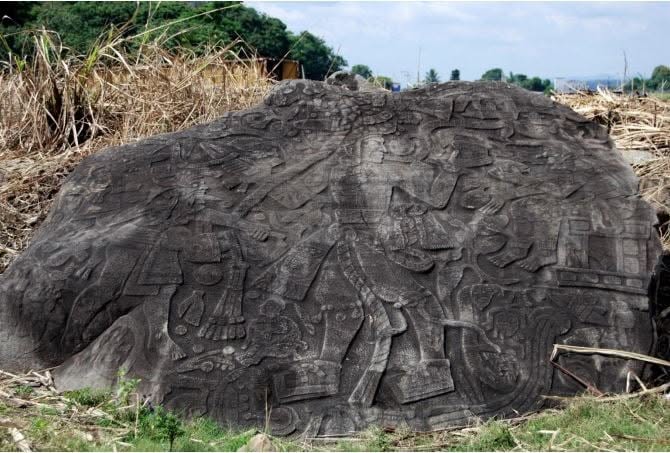
The material composition and craftsmanship of Stela 1 reflects the high level of technological skill possessed by the ancient artisans of the southern Maya region. Carved from a substantial block of volcanic rock—typical of the geological profile of the Guatemalan piedmont—the monument exhibits an exquisite bas-relief technique. The sculpture captures a dynamic scene featuring a central human figure, believed to be a ruler or a high-ranking elite, surrounded by ornate iconography. Detailed analysis of the carving, particularly the way the stone’s thickness varies to create depth, demonstrates a masterful command over hard volcanic material. The smooth, curved back of the fragment indicates it was originally designed as a vertical, free-standing stela rather than a flat altar, serving as a permanent, public statement of authority and divine lineage.
Archaeological investigations of Monument 1 were notably advanced by the work of Robert Burkitt, an early investigator who documented the site’s monuments and recognized their significance. Burkitt’s meticulous notes confirmed that the fragments he recovered were comprised primarily of a single, cohesive monument. In more recent decades, scholars like Jonathan Kaplan have further contextualized this find within the broader socio-economic framework of Chocolá. By linking the presence of such elite monuments to the site’s sophisticated hydraulic engineering and its role as a regional hub for cocoa production, researchers have posited that Chocolá served as a powerful administrative and political center. The discovery is not merely of an aesthetic object, but of a functional component in the political landscape of a thriving early state.

The iconography of Stela 1 carries deep symbolic weight, serving as a visual narrative of power and ritual. The central figure is depicted with elaborate regalia, holding objects that signify social status and ritual duties. Notably, under the figure’s arm, he holds a human head with distinct facial features, a motif that has sparked extensive academic debate about human sacrifice, ancestor worship, or the symbolic representation of conquered adversaries. The surrounding imagery, including intricate textiles and complex symbolic elements, strengthens the ruler’s role as the intermediary between the human and supernatural realms. Such monuments were likely erected to legitimize the ruler’s authority, marking the site as a sacred space where the political elite exercised control over both the spiritual life and the economic resources—specifically water and cocoa—of the local populace.
Today, the surviving fragment of Stela 1 is housed at the University of Pennsylvania Museum of Archeology and Anthropology, where it continues to be a subject of intense study. Its existence highlights the cultural continuity between the Preclassic southern Maya and their successors, proving that many hallmarks of the “Classic” Maya civilization—such as the stela-altar complex—emerged much earlier and in a wider geographical area than previously ᴀssumed. As we continue to examine these ancient stone records, Stela 1 serves as an essential link in understanding the evolution of the early Maya. It offers a rare, tangible glimpse into the lives of the rulers who presided over the fertile slopes of the Guatemalan piedmont, reminding us that the foundations of one of the world’s greatest civilizations were built upon a complex interplay of environmental mastery, economic surplus, and profound symbolic artistry.
✓ hoangduc
The archaeological site of Chocolá, nestled in the verdant piedmont of the Suchitepéquez department in southern Guatemala, stands as a testament to the sophisticated development of the…