The Fairy Chimneys of Cappadocia: Troglodyte Architecture and Sacred Refuges
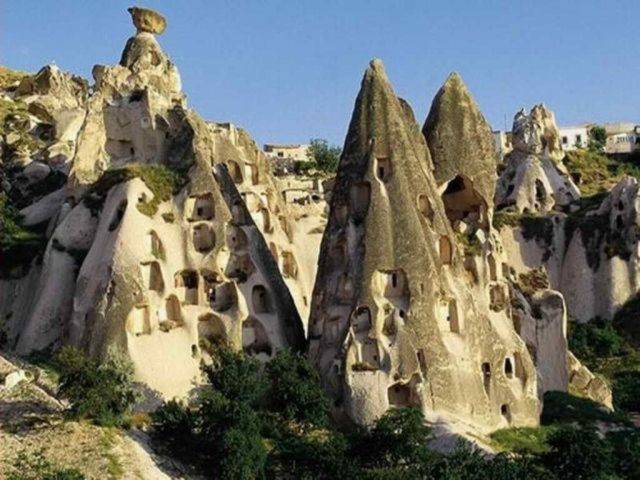
The unique geological and architectural wonders shown in the image are the Fairy Chimneys (peribacaları) of Cappadocia, located in the Central Anatolia Region of modern-day Turkey. While the geological formations date back millions of years, the human intervention—the carving of dwellings, churches, and monasteries—spans several millennia. The most significant archaeological layer dates to the Byzantine Era (c. 4th to 14th centuries CE), specifically flourishing between the 7th and 11th centuries. During this period, Cappadocia became a thriving center of Early Christian monasticism and a frontline of the Byzantine-Arab wars. This era represents a peak in “troglodyte” (cave-dwelling) urbanism, where entire communities lived within the rock, creating a subterranean civilization that is unique in the history of human settlement.
The architectural secrets of Cappadocia were never truly “lost” to the local populations, but they were introduced to the global archaeological community in the early 18th century by French traveler Paul Lucas. Systematic scientific study began in the early 20th century, notably led by the French Jesuit scholar Guillaume de Jerphanion, who produced the first detailed documentation of the region’s rock-cut churches and frescoes between 1907 and 1912. Following his work, the Turkish Ministry of Culture and Tourism and the International Council on Monuments and Sites (ICOMOS) have conducted extensive excavations, particularly in the Göremer Open Air Museum. In 1985, the region was designated a UNESCO World Heritage site, recognizing it as a masterpiece of human creative genius and a vital record of Byzantine religious history.

The “Fairy Chimneys” are composed of volcanic tuff, a soft, porous rock formed from ancient volcanic ash, topped by a harder “cap” of basalt or ignimbrite. The craftsmanship employed here is subtractive architecture, the art of creating space by removing material rather than adding it. Because volcanic tuff is easily worked when first exposed to air but hardens over time, ancient masons used simple iron picks, chisels, and mallets to hollow out complex, multi-story interiors. The detail seen in the image—rectangular windows, arched doorways, and ventilation shafts—was meticulously planned to maintain structural integrity. This “negative” engineering allowed for the creation of intricate columns, domes, and even subterranean stables, all carved from a single, continuous geological mᴀss.

The primary function of these rock-cut structures was multifaceted: domestic, religious, and defensive. Locally, they served as climate-controlled homes that remained cool in the scorching Anatolian summers and warm in the frigid winters. Religiously, they functioned as secluded monasteries and hermitages, where monks could pursue a life of prayer away from the distractions of the world. Perhaps most importantly, they served a defensive utility. During periods of invasion, the narrow entrances could be sealed with mᴀssive, circular “millstone” doors that could only be operated from the inside. This made the Fairy Chimneys and the ᴀssociated deep underground cities (like Derinkuyu and Kaymaklı) virtually impenetrable fortresses, capable of sheltering thousands of people and their livestock for months at a time.

Today, the rock-cut architecture of Cappadocia stands as a global monument to human adaptability and environmental integration. For archaeologists, the site provides an unparalleled record of Byzantine iconographic evolution, as many of the interior churches contain perfectly preserved frescoes that were shielded from light and weather for centuries. The site remains a living laboratory for the study of paleo-geology and ancient engineering, as modern researchers work to prevent the natural erosion that threatens to topple these fragile pinnacles. Cappadocia remains a poignant reminder that human ingenuity does not always require the transport of mᴀssive stones; sometimes, the most enduring monuments are those that we “find” hidden within the earth itself.
✓ Team
The unique geological and architectural wonders shown in the image are the Fairy Chimneys (peribacaları) of Cappadocia, located in the Central Anatolia Region of modern-day Turkey. While…