The Famine Stela: An Epigraphic Chronicle of Ancient Crisis and Divine Intervention
The artifact under examination is the Famine Stela, a monumental epigraphic record carved onto a natural granite outcrop on Sehel Island, situated in the Nile River near Aswan, Egypt. This location, specifically the First Cataract of the Nile, served as a strategic and sacred gateway to the southern reaches of the Pharaonic Empire. Unlike traditional stelae which are portable slabs of stone, this “stela” is an integral part of the local landscape, utilizing a large boulder that faces the river. The site is a rich archaeological palimpsest, surrounded by hundreds of other inscriptions from various periods of Egyptian history. The Famine Stela was formally brought to the attention of the international scientific community in 1889 by the American Egyptologist Charles Edwin Wilbour, whose meticulous transcriptions allowed for the first comprehensive translation of its complex Ptolemaic-era hieroglyphs.

From a chronological perspective, the Famine Stela presents a fascinating archaeological duality. The inscription itself dates to the Ptolemaic Period, likely during the reign of Ptolemy V Epiphanes (c. 204–180 BCE). However, the text claims to record events from the reign of Djoser (c. 2670 BCE), the second king of the Third Dynasty in the Old Kingdom. Archaeologists interpret this as a “pious forgery” or a retrospective historical decree. By projecting the text back over 2,400 years to the era of the Step Pyramid’s builder, the Ptolemaic priests of the god Khnum aimed to establish ancient legitimacy for their contemporary land claims. This chronological layering serves as a vital case study in how ancient societies utilized “archaeological” memory to navigate political and economic crises during the Greco-Roman occupation of Egypt.
The primary material of the artifact is a mᴀssive block of Red Aswan Granite, a stone renowned for its extreme hardness and durability (7 on the Mohs scale). The “manufacture” of the stela did not involve moving the stone but rather the masterful preparation of its vertical face. Artisans utilized dolerite pounders to smooth the coarse granite surface before scribes applied the layout in red ink. The 42 columns of hieroglyphic text and the lunette (the rounded top scene) were then executed using fine copper or bronze chisels through a process of sunken relief. The lunette depicts King Djoser offering to the triad of Elephantine: the ram-headed god Khnum, the goddess Satis, and the goddess Anuket. The precision of the carving, despite the crystalline structure of the granite, demonstrates the zenith of Egyptian stone-working technology, ensuring the message survived thousands of years of exposure to the desert sun and Nile winds.
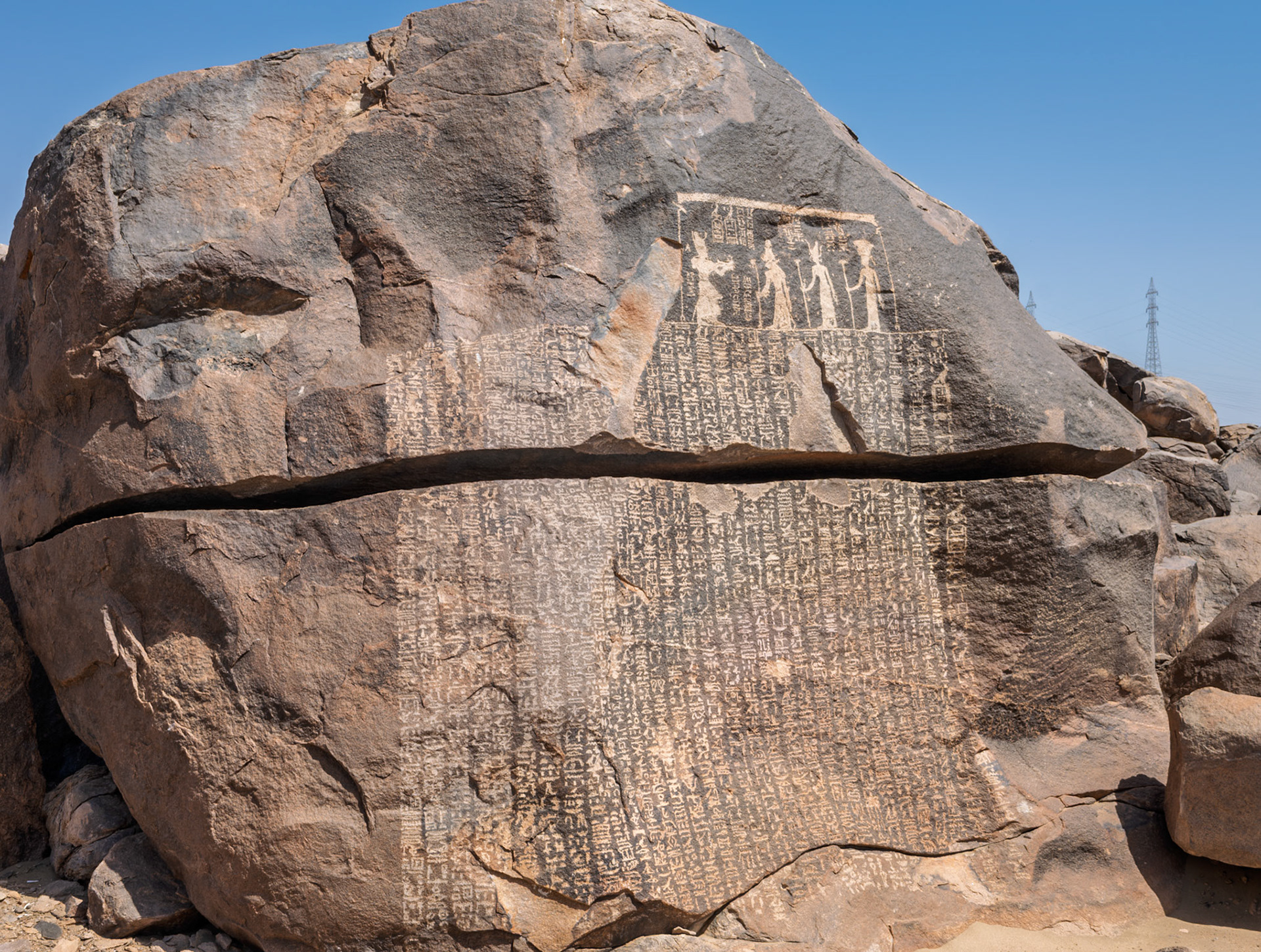
Functionally, the Famine Stela served as a Legal Decree and a Socio-Religious Archive. The text narrates a dire environmental catastrophe: a seven-year failure of the Nile inundation, leading to widespread famine and civil unrest. The “utility” of the stela was to document King Djoser’s response—consulting his vizier ImH๏τep and ultimately granting a large tract of land, known as the Dodekaschoinos, to the Temple of Khnum on Elephantine Island. According to the narrative, this act of royal piety pleased Khnum, who then released the Nile’s waters. In a practical sense, the stela functioned as a “deed of gift,” providing the Ptolemaic priesthood with a permanent, public, and divinely-sanctioned justification for their control over local agricultural resources and tax revenues from the region.
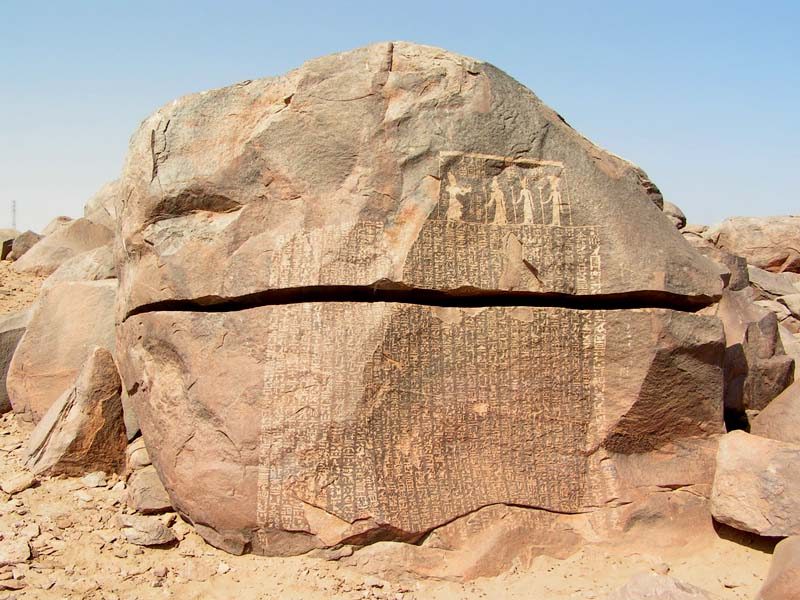
The formal study of the Famine Stela has been a cornerstone of Nilotic archaeology for over a century. Following Charles Wilbour’s discovery, the text was extensively analyzed by the French Insтιтute of Oriental Archaeology (IFAO) and scholars like Heinrich Brugsch and Paul Barguet. Modern stewardship of the site falls under the jurisdiction of the Egyptian Ministry of Tourism and Antiquities. Current archaeological efforts focus on Digital Epigraphy, using high-resolution pH๏τogrammetry to create 3D models of the granite boulder. These non-invasive techniques are essential for monitoring the slow erosion of the stone and ensuring that the fine details of the Ptolemaic script are preserved. The Famine Stela remains a primary source for understanding the intersection of paleoclimatology, royal propaganda, and the enduring power of the Nile in the ancient Egyptian consciousness.
✓ hoangduc
The artifact under examination is the Famine Stela, a monumental epigraphic record carved onto a natural granite outcrop on Sehel Island, situated in the Nile River near…