The Forica: Sanitation, Socialization, and Engineering in the Ancient Roman World
The communal latrines of the Roman Empire, known as foricae, represent one of the most fascinating intersections of advanced civil engineering and distinct cultural norms in antiquity. While toilets existed in earlier civilizations, the standardized, public multi-seater latrines visible today—such as those at Ostia Antica, Pompeii, or Hadrian’s Villa—proliferated during the height of the Roman Empire, primarily between the 1st and 4th centuries CE. Unlike the private, isolated nature of modern sanitation, the Roman forica was a public space where citizens of various social strata would sit side-by-side without parтιтions. These facilities were integral to the Roman urban landscape, reflecting a society that prioritized large-scale public health infrastructure and viewed communal hygiene as a hallmark of “civilized” Mediterranean life under the Pax Romana.
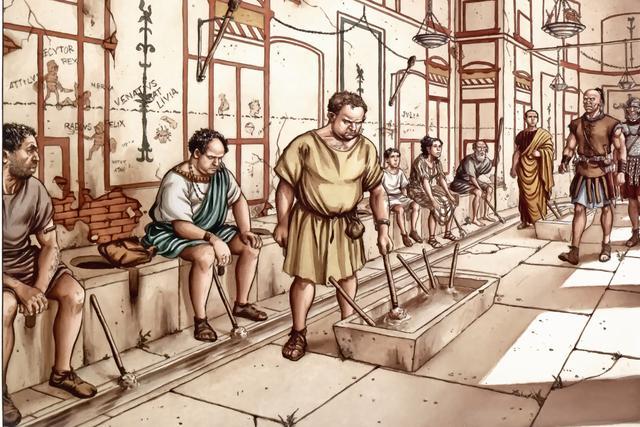
The construction and material composition of a forica demonstrate the Romans’ mastery of hydraulic logistics and durable masonry. The seating benches were typically crafted from solid marble or high-quality travertine, polished smooth for comfort and ease of cleaning. Beneath these benches lay a deep, vaulted trench through which a constant stream of water flowed, diverted from the city’s aqueducts. The seats themselves featured keyhole-shaped openings; the circular part was for sitting, while the vertical slit in the front allowed for the use of a xylospongium—a sea sponge on a wooden stick used for personal hygiene. Furthermore, a shallow stone gutter filled with clean, running water was usually carved into the floor in front of the seats for rinsing the sponges, showcasing a sophisticated “flush and clean” system that functioned entirely through gravity and constant flow.
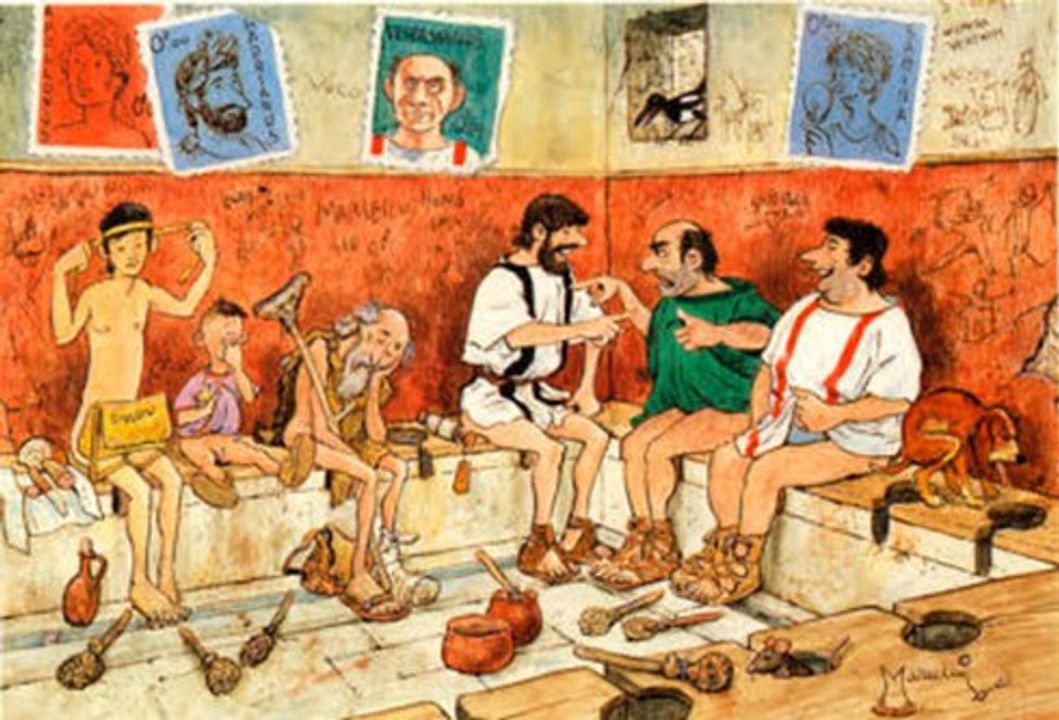
In terms of function and social significance, the forica served as much more than a simple waste disposal site; it was a vibrant social hub. Archaeologists and historians note that because there were no dividers between the seats, Romans utilized this time to discuss politics, gossip, or even arrange business deals. The hygiene practiced here was remarkably advanced for the time, as the continuous flow of water moved waste directly into the Cloaca Maxima (the Great Sewer) or similar local sewage networks, significantly reducing the stench and disease risks ᴀssociated with stagnant cesspools. However, from a modern bioarchaeological perspective, these communal spaces were also centers for the transmission of parasites, as the shared use of the xylospongium in buckets of vinegar or salt water—while appearing organized—facilitated the spread of intestinal worms among the urban population.

The systematic archaeological excavation and documentation of these latrines began in earnest during the 18th and 19th centuries, particularly with the uncovering of Pompeii and Herculaneum. Organizations such as the Soprintendenza Archeologica di Pompei and the British School at Rome have spent decades analyzing these sites to reconstruct daily Roman life. A pivotal moment in the study of Roman sanitation occurred in the mid-20th century with the extensive excavations at Ostia Antica, Rome’s ancient harbor city, where exceptionally well-preserved latrines allowed researchers to understand the connection between domestic apartment blocks (insulae) and public sanitation. Scholars like Gemma Jansen, a leading expert in Roman water management, have utilized these excavations to prove that Roman toilets were not merely utilitarian holes but carefully designed architectural features that integrated aesthetics, such as mosaics and frescoes, into the experience of public relief.

Today, the ruins of Roman foricae across Europe, North Africa, and the Middle East continue to provide critical data for environmental archaeology and the history of technology. By analyzing the “coprolites” (fossilized feces) and sediment found within the ancient sewer trenches, modern scientists can determine the diet, health, and even the social class of the people who used these facilities centuries ago. These stone benches stand as a durable reminder that the Romans viewed the management of human waste not as a private embarrᴀssment, but as a collective engineering challenge. As we look at the weathered marble seats and the intricate water channels, we recognize a civilization that understood that the greatness of a city was measured not just by its temples and palaces, but by the efficiency and cleanliness of its most humble public spaces.
✓ hoangduc
The communal latrines of the Roman Empire, known as foricae, represent one of the most fascinating intersections of advanced civil engineering and distinct cultural norms in antiquity….