The Frozen Waves of Hisham’s Palace: An Archaeological Analysis of the Great Mosaic Floor
The monumental mosaic floor depicted in represents one of the most significant architectural and artistic achievements of the early Islamic period. Located at the site of Khirbat al-Mafjar, commonly known as Hisham’s Palace near the ancient city of Jericho, this expansive floor covers approximately 827 square meters within the palace’s grand audience hall and bath complex. The site was largely forgotten following a devastating earthquake in 747 AD, which caused the structures to collapse and buried the mosaics under layers of debris for over a millennium. It was not until the mid-20th century that systematic excavations began to reveal the sheer scale of this decorative masterpiece, which remains one of the largest and best-preserved mosaic pavements in the world.

The materials used in the construction of this floor are a testament to the sophisticated resource management of the Umayyad Caliphate. As seen, the mosaic is composed of millions of individual tesserae—small, hand-cut cubes of natural stone and colored marble. These stones were sourced locally and regionally to provide a vibrant palette of ochre, deep reds, charcoal blacks, and cream whites. The craftsmanship involved a multi-stage process: first, a thick bedding of lime mortar and ash was laid to create a level surface; then, master artisans sketched complex geometric patterns into a fine wet plaster layer before meticulously pressing each stone into place. The undulating “waves” visible in the image are not an original design choice but a result of seismic shifts over centuries, which warped the underlying foundation while the resilient mosaic skin remained intact.
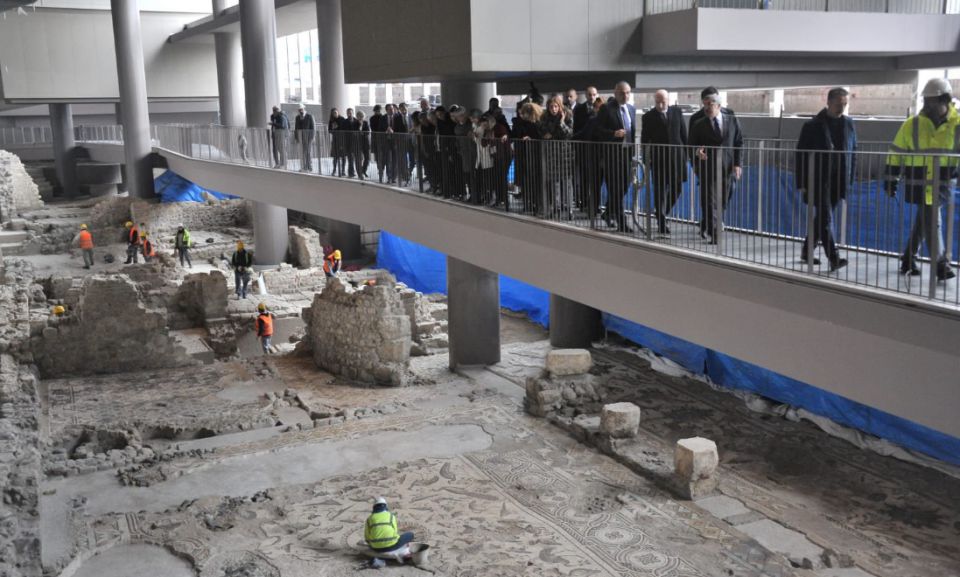
Archaeological scrutiny of the patterns revealed showcases a transition between Late Antique Byzantine traditions and emerging Islamic aesthetics. The floor features 38 distinct geometric panels, ranging from intricate interlocking stars and floral motifs to “infinite” patterns that symbolize the divine order of the universe. Unlike the more famous “Tree of Life” mosaic found in the palace’s diwan (private reception room), the main hall mosaics focus heavily on non-figural, mathematical precision. This choice reflects the administrative and public function of the hall, where the Umayyad elite would receive guests. The sheer luxury of the flooring was intended to project the power, wealth, and cultural sophistication of the Caliph, ᴀsserting the Umayyad dynasty as the legitimate heirs to the grandeur of the Roman and Persian empires.

The systematic excavation and restoration of this site have been a multi-generational effort involving both international and local organizations. Initial large-scale excavations were led by Palestinian archaeologist Dimitri Baramki under the British Mandate in the 1930s and 40s, later continued by Robert Hamilton. In recent years, the Palestinian Ministry of Tourism and Antiquities (MoTA), in collaboration with the Japan International Cooperation Agency (JICA), has undertaken a mᴀssive conservation project. As shown, modern archaeologists and conservators work meticulously to clean and stabilize the individual tesserae. This modern intervention included the construction of a protective shelter over the site to safeguard the stones from the harsh desert sun and moisture, finally allowing the “Great Carpet” of Hisham’s Palace to be permanently viewed by the public.
Beyond its aesthetic value, the mosaic floor serves as a vital primary source for understanding 8th-century urbanism and palace life. It provides physical evidence of the high level of Mediterranean trade and artistic exchange occurring during the Umayyad period. The preservation of such an extensive surface allows researchers to study regional variations in mosaic techniques and the specific tools used by craftsmen of that era. Today, as seen in the ongoing work, the site is not merely a ruin but a living laboratory for heritage science. It stands as a symbol of Palestinian cultural idenтιтy and a crucial link in the history of global art, reminding us that even the most solid stone foundations can ripple like water under the weight of history.
✓ hoangduc
The monumental mosaic floor depicted in represents one of the most significant architectural and artistic achievements of the early Islamic period. Located at the site of Khirbat…