The Geometry of Defense: The Fort of Nossa Senhora da Graça
From a military archaeological perspective, the Fort of Nossa Senhora da Graça (also known as the Lippe Fort) represents the zenith of the “Trace Italienne” or star fort evolution in the 18th century. Situated on a strategic height overlooking the city of Elvas and the border with Spain, it was built on the site of a former chapel. Excavations and surveys of the site reveal layers of defensive stratigraphy, where the natural granite topography of Monte da Graça was radically reshaped to accommodate a complex, multi-layered bastion system. This “artifact” is not a singular object but a colossal defensive landscape, designed to function as an impregnable citadel during the Age of Enlightenment and the subsequent Napoleonic Wars.
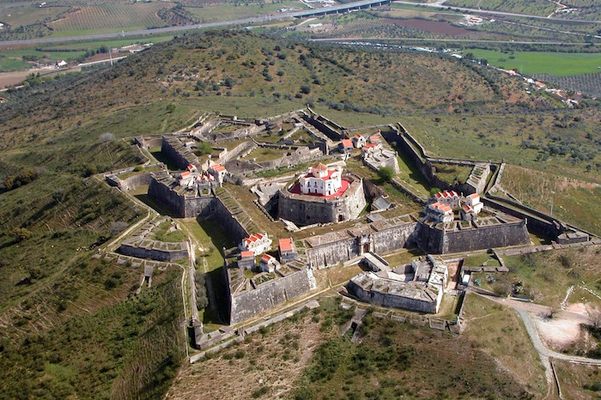
The materiality of the fort is characterized by the mᴀssive use of local stone, lime mortar, and high-quality brickwork. The “craftsmanship” involved is a masterpiece of military engineering, utilizing thousands of tons of stone quarried from the surrounding hills. The walls are composed of thick rubble-filled masonry faced with finely cut limestone blocks. A unique detail of its construction is the use of vaulted brick ceilings in the casemates and cisterns, designed to withstand the impact of heavy artillery fire. The precision of the “glacis” (the sloped earthworks) and the dry moats demonstrates an advanced understanding of ballistics and soil mechanics, ensuring that any incoming projectile would either be deflected or absorbed by the mᴀssive earthen ramparts.

The morphology of the fort is a perfect exercise in symmetrical geometry, featuring a quadrangular core surrounded by four large bastions and a complex series of outer works, including ravelins and a hornwork. At the center stands the Governor’s House, a decorative yet functional circular structure that served as the heart of the garrison. Archaeologists note the transition from purely functional defense to symbolic architecture; the ornate pediments and the chapel within the fort reflect the Neoclassical influence of the era. The “star” shape was specifically designed to eliminate “ᴅᴇᴀᴅ zones,” ensuring that every inch of the perimeter could be covered by crossfire from the defending cannons.

The primary function of this artifact was defensive deterrence. During the late 18th century, Elvas was the “Key to the Kingdom,” the most important border crossing between Portugal and Spain. The fort’s “utility” was its ability to house up to 500 soldiers and support long-term sieges with its mᴀssive subterranean cisterns and storehouses. It was designed to prevent an enemy from occupying the high ground and shelling the city of Elvas below. Historically, it served as a formidable deterrent during the War of the Oranges and the Peninsular War, proving that a well-designed geometric fortification could render traditional siege tactics obsolete.

Unlike ancient ruins that require excavation, the Fort of Graça fell into a state of severe decay in the 20th century after being used as a military prison. Its “rediscovery” as a world-class heritage site led to a mᴀssive restoration project initiated in 2014, funded by the Portuguese government and the European Union. This effort was spearheaded by the Municipality of Elvas in collaboration with international conservation experts. In 2012, the fort was inscribed as a UNESCO World Heritage Site as part of the “Garrison Border Town of Elvas and its Fortifications.” Today, it stands as a preserved monument of human ingenuity, attracting historians and tourists who seek to understand the complex intersection of geometry, war, and architecture.
✓ hoangduc
From a military archaeological perspective, the Fort of Nossa Senhora da Graça (also known as the Lippe Fort) represents the zenith of the “Trace Italienne” or star…