The Giants of Quiriguá: Stela E and the Pinnacle of Maya Megalithic Art
The monument depicted in this historical pH๏τograph is Stela E, the largest monolithic stone monument ever erected by the ancient Maya. Located in the Great Plaza of Quiriguá, in modern-day eastern Guatemala, this stela dates specifically to the Late Classic Period, dedicated on January 24, 771 CE (Long Count date 9.17.0.0.0). It was commissioned by the city’s greatest ruler, K’ak’ Tiliw Chan Yopaat (also known as “Cauac Sky”). This era represents a radical shift in regional power; only 33 years prior, Quiriguá had been a small vᴀssal state, but after K’ak’ Tiliw defeated and sacrificed the ruler of the superpower Copán in 738 CE, the city entered a “Golden Age” of monumental construction, using these mᴀssive stones to broadcast its newly won independence and imperial grandeur.

While the ruins of Quiriguá were never unknown to local populations, they were brought to global scientific attention in the 1840s by the explorers John Lloyd Stephens and Frederick Catherwood, whose detailed drawings captivated the Victorian world. This specific pH๏τograph likely dates to the late 19th-century expeditions led by Alfred Maudslay, a pioneer of modern scientific archaeology. Between 1881 and 1894, Maudslay, supported by the Royal Geographical Society, conducted the first systematic documentation of the site, producing high-quality plaster casts and pH๏τographs that remain vital for epigraphic study today. In the 20th century, the University of Pennsylvania Museum and the United Fruit Company collaborated on extensive stabilization projects, ultimately leading to Quiriguá being designated a UNESCO World Heritage Site in 1981.
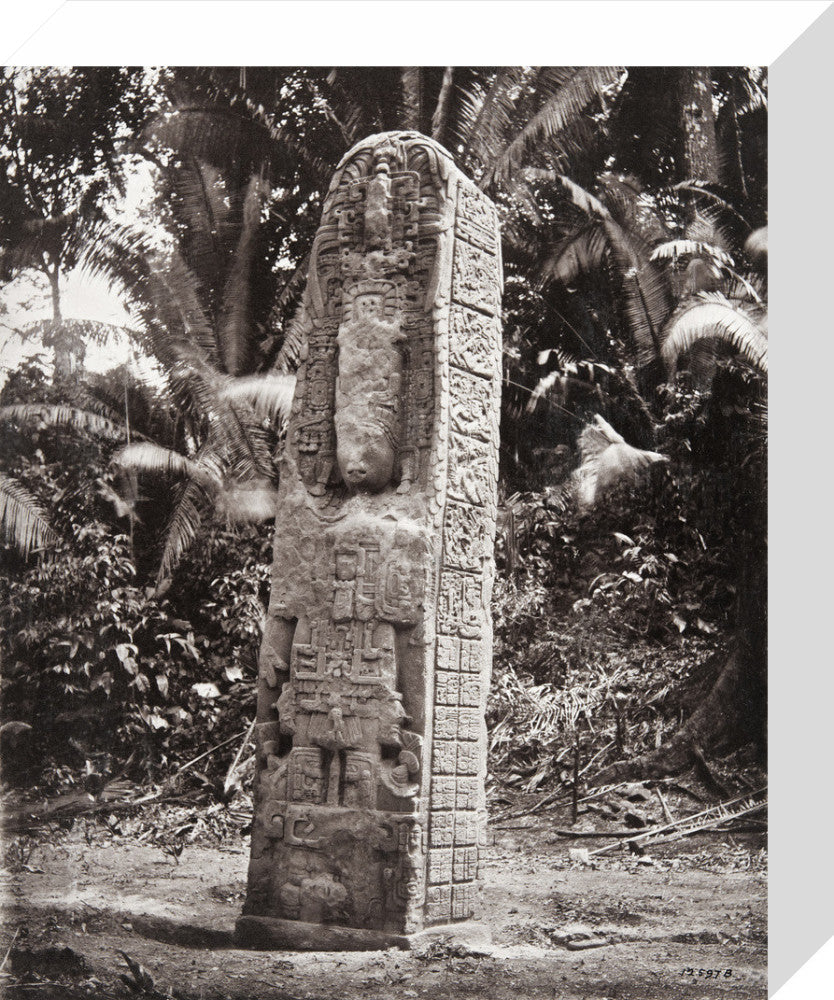
Stela E is an engineering marvel, standing approximately 10.6 meters (35 feet) tall, including its buried portion, and weighing an estimated 65 tons. The material is sandstone, specifically a high-quality “brownstone” quarried from the nearby foothills of the Sierra de las Minas. The craftsmanship is characterized by deep-relief carving that covers all four sides of the monolith. To create such a monument without metal tools, Maya stonemasons utilized chert, obsidian, and basalt chisels and abrasives. The front and back of the stela feature the idealized, larger-than-life portrait of the king in full ceremonial regalia, including a towering headdress and scepter, while the sides are densely packed with hieroglyphic inscriptions. The precision required to transport such a mᴀssive block over several kilometers of swampy terrain and raise it vertically is a testament to the advanced logistical organization of the Classic Maya.

Functionally, Stela E served as a public historical record and a potent tool of political propaganda. The hieroglyphic texts recount the lineage of K’ak’ Tiliw Chan Yopaat and his pivotal victory over Copán, effectively “rewriting” history to justify his divine right to rule. Iconographically, the ruler is depicted as a “World Tree,” the axis mundi that connects the underworld, the earthly realm, and the heavens. The stela was also a ritual device used for “period-ending” ceremonies; by dedicating the monument at the end of a 20-year k’atun cycle, the king ensured the continuation of time and the favor of the gods. In the Maya worldview, these stelae were not static statues but were considered “living stones” (lakam-tuun), imbued with the k’uh (sacred essence) of the ruler they portrayed.
From an archaeological perspective, the stelae of Quiriguá provide one of the most complete epigraphic sequences in the Maya world, allowing scholars to reconstruct the political history of the Motagua River valley with surgical precision. Today, the site is managed by the Ministry of Culture and Sports of Guatemala. The primary modern challenge is biological and environmental erosion; the high humidity of the tropical rainforest encourages the growth of lichens and mosses that chemically degrade the sandstone. Conservationists now use non-invasive cleaning methods and have installed large thatched roofs over the monuments to shield them from the torrential rains. Stela E remains a hauntingly beautiful witness to the Maya’s obsession with time, stone, and the enduring memory of their god-kings.
✓ Team
The monument depicted in this historical pH๏τograph is Stela E, the largest monolithic stone monument ever erected by the ancient Maya. Located in the Great Plaza of…