The Golden Scarab of Tutankhamun: A Lapis Lazuli Masterpiece from the 18th Dynasty
The exquisite piece of jewelry depicted is a royal bracelet belonging to Tutankhamun, the boy pharaoh of the 18th Dynasty during Egypt’s New Kingdom. Dating to approximately 1323 BC, this artifact was created during a period of immense artistic refinement and restoration following the Amarna Period. The bracelet centers on the scarab beetle, a manifestation of the god Khepri, who represented the rising sun and the concept of eternal renewal. In the context of the 14th century BC, such an object was not merely an ornament but a powerful protective amulet intended to safeguard the King’s health on earth and ensure his successful rebirth in the afterlife.
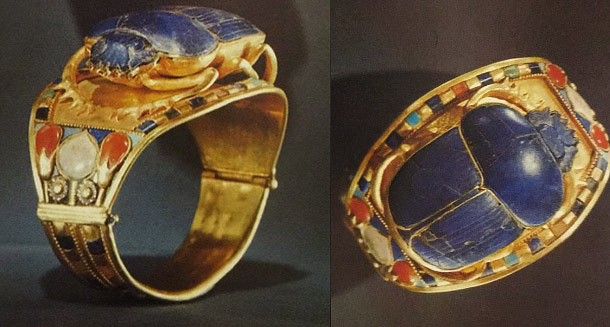
Discovery and the Labors of the Carter Expedition This artifact was discovered in November 1922 within the tomb of Tutankhamun (KV62) in the Valley of the Kings, Luxor. It was unearthed by the British archaeologist Howard Carter and his team, funded by Lord Carnarvon. Specifically, this bracelet was found among the personal effects and ritual jewelry packed within the treasury and the annex of the tomb. Unlike many other royal burials that were plundered in antiquity, the discovery by Carter’s team—documented with meticulous care by pH๏τographer Harry Burton—provided the first complete archaeological context for the private regalia of a Pharaoh. Today, the object is a centerpiece of the collection at the Grand Egyptian Museum (GEM) in Giza, having been meticulously conserved by international and Egyptian experts.
Material Composition and Gemological Craftsmanship The craftsmanship of this bracelet represents the pinnacle of ancient Egyptian goldsmithing and lapidary work. The primary frame is constructed from high-purity gold, fashioned into a hinged cuff that could be opened and closed with a delicate pin mechanism. The central scarab is carved from a single, large piece of Lapis Lazuli, an ultra-premium stone imported from the mountains of modern-day Afghanistan, prized for its deep blue color which symbolized the night sky and the divine. Surrounding the scarab is a vibrant display of cloisonné inlay, featuring semi-precious stones such as carnelian (red), turquoise (light blue), and feldspar (green). Each stone was precision-cut into “cloisons” or cells created by thin gold wires, a technique requiring immense patience and microscopic accuracy.

Symbolic Meaning and Royal Functionality The functional “utility” of this bracelet was deeply rooted in theological protection. The scarab beetle, which rolls balls of dung across the earth, was seen by Egyptians as a metaphor for the sun being rolled across the sky. By wearing the scarab in Lapis Lazuli, the Pharaoh was literally “wearing” the protection of the solar cycle. The red carnelian accents represented the vitality of blood and the heat of the sun, while the gold base served as the “flesh of the gods,” which was believed to be incorruptible. Furthermore, the bracelet acted as a talisman of status; only the King and high-ranking members of the royal court were permitted to wear such concentrated wealth, signaling his role as the intermediary between the Egyptian people and the divine pantheon.
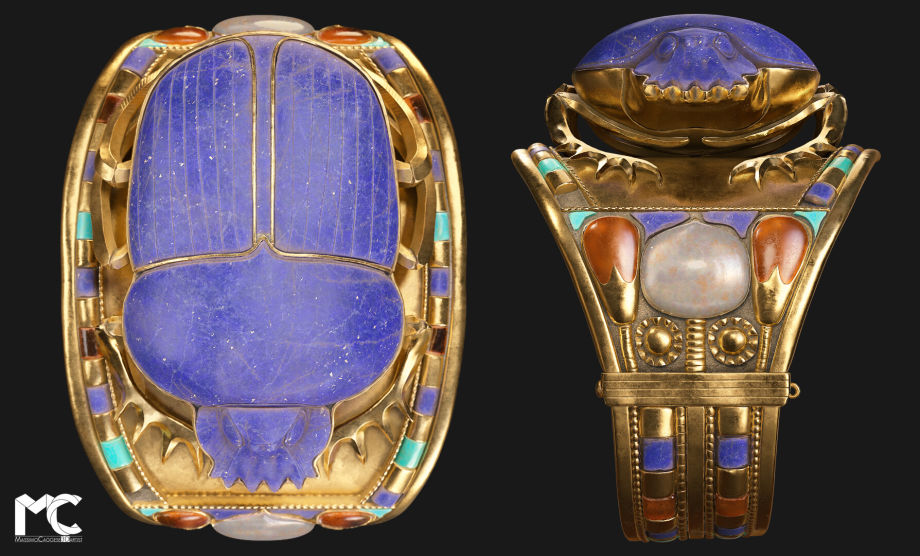
Archaeological Legacy and Cultural Impact The legacy of Tutankhamun’s jewelry, and this bracelet in particular, lies in its role as a benchmark for ancient technology. It challenged early 20th-century ᴀssumptions about the “primitive” nature of ancient tools, revealing instead a civilization with a sophisticated understanding of chemistry, mineralogy, and ergonomics. For modern archaeology, it serves as a vital record of the ancient trade routes that brought gold from Nubia and Lapis from Central Asia to the workshops of Thebes. Ultimately, the Golden Scarab remains an enduring icon of human creativity—a bridge of gold and stone that has successfully transported the name and spirit of a young king across more than three thousand years of history.
✓ hoangduc
The exquisite piece of jewelry depicted is a royal bracelet belonging to Tutankhamun, the boy pharaoh of the 18th Dynasty during Egypt’s New Kingdom. Dating to approximately…