The Granite Arteries: The Engineering Marvel of the Segovia Aqueduct
From an archaeological standpoint, the Aqueduct of Segovia is one of the most impeccably preserved Roman civil engineering projects in the Iberian Peninsula. Situated in the heart of the ancient city of Segovia, the structure spans the deep Clamores Valley, connecting the mountain springs of the Sierra de Guadarrama to the city’s highest point, the Alcázar. Unlike buried ruins, this “above-ground artifact” has remained a dominant feature of the urban landscape for nearly two millennia. It represents the pinnacle of Roman territorial expansion and the sophisticated hydrological management required to sustain a colonial population in the arid climates of Roman Hispania.

The “materiality” of this monumental artifact consists of approximately 20,400 mᴀssive blocks of unmortared granite. The craftsmanship is a testament to the Roman mastery of “opus quadratum”—the use of squared blocks laid in horizontal courses. Remarkably, the entire structure is held together by the sheer force of gravity and the precision of the stone-cutting; no cement or mortar was used in its ᴀssembly. Each block was quarried locally and carved with such exacting tolerances that the weight distribution remains stable after centuries of seismic and environmental stress. The visible “notches” or holes in many of the stones are archaeological evidence of the use of “lewis” lifting cranes, which allowed Roman engineers to hoist multi-ton blocks into place.
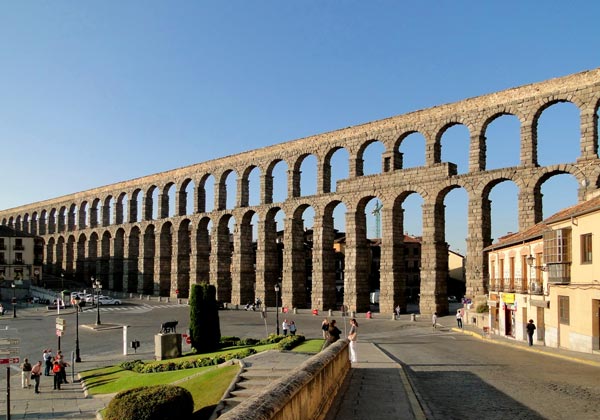
The aqueduct’s morphology is defined by its double-tiered arches, reaching a maximum height of approximately 28.5 meters (93.5 feet). The structure consists of 167 arches that maintain a constant, slight gradient to ensure the steady flow of water via gravity. Archaeologists have noted that the lower tier serves as a structural foundation to support the height necessary to cross the valley floor, while the upper tier carries the actual water channel (the specus). The use of the semicircular arch—the hallmark of Roman architecture—allowed for the displacement of immense vertical weight, creating a skeletal yet incredibly strong framework that has resisted the pᴀssage of time far better than modern reinforced structures.

The primary function of this artifact was the transportation of water over a distance of 15 kilometers, but its “meaning” extends far beyond mere utility. In the Roman world, an aqueduct was a symbol of Romanitas—the civilizing power of the Empire. By providing a constant supply of fresh water for public baths, fountains, and private residences, the aqueduct integrated Segovia into the Roman standard of living. It served as a permanent advertisement for the Emperor’s ability to subdue nature and provide for his subjects. Archaeologically, it marks the transition of a region from a local Celtic-Iberian settlement into a thriving, Romanized administrative center.

Unlike sites that required modern excavation, the Aqueduct of Segovia was never truly “lost.” However, its modern scientific study and preservation have been spearheaded by the Spanish Ministry of Culture and UNESCO, which designated it a World Heritage Site in 1985. Detailed pH๏τogrammetric surveys and structural analyses conducted in the late 20th century have provided insights into the precise surveying tools (such as the chorobates and groma) used by Roman engineers. Today, the City Council of Segovia and international conservation bodies work to mitigate the impact of modern pollution and vibration on the granite, ensuring that this colossal relic of the ancient world continues to stand as a bridge between the Roman past and the Spanish present.
✓ hoangduc
From an archaeological standpoint, the Aqueduct of Segovia is one of the most impeccably preserved Roman civil engineering projects in the Iberian Peninsula. Situated in the heart…