The Great Hunt of Piazza Armerina: A Masterpiece of Late Roman Narrative Art
The artifact depicted is the “Great Hunt” (Grande Caccia), a monumental floor mosaic located in the Villa Romana del Casale near Piazza Armerina, Sicily. This stunning archaeological treasure dates back to the early 4th century CE (c. 310–330 CE), during the late Roman Imperial period. This era was marked by the reign of the Tetrarchy and the subsequent rise of Constantine the Great. The villa is believed to have been the residence of a high-ranking Roman official or perhaps a member of the imperial family, such as Maximian Herculius. The Great Hunt is a defining example of Late Antique art, transitioning from the balanced realism of the High Empire to a more stylized, narrative-driven aesthetic that emphasized scale, movement, and the global reach of Roman influence across the Mediterranean and beyond.

The modern discovery of this site is a testament to the persistence of Sicilian archaeology. While local inhabitants had known of buried ruins for centuries, the first official excavations were conducted in 1881 by Luigi Pappalardo. However, the truly transformative work occurred in the 1950s, led by the archaeologist Gino Vinicio Gentili. Working under the Soprintendenza alle Antichità di Siracusa, Gentili uncovered the vast, sprawling complex of rooms, which had been perfectly preserved under a mᴀssive mudslide in the 12th century. This geological accident acted as a protective seal, keeping the colors of the Great Hunt as vibrant today as they were in antiquity. In 1997, the site was recognized as a UNESCO World Heritage Site, and it is currently managed by the Parco Archeologico della Villa del Casale, which continues to employ state-of-the-art conservation techniques to protect the tiles from environmental humidity.
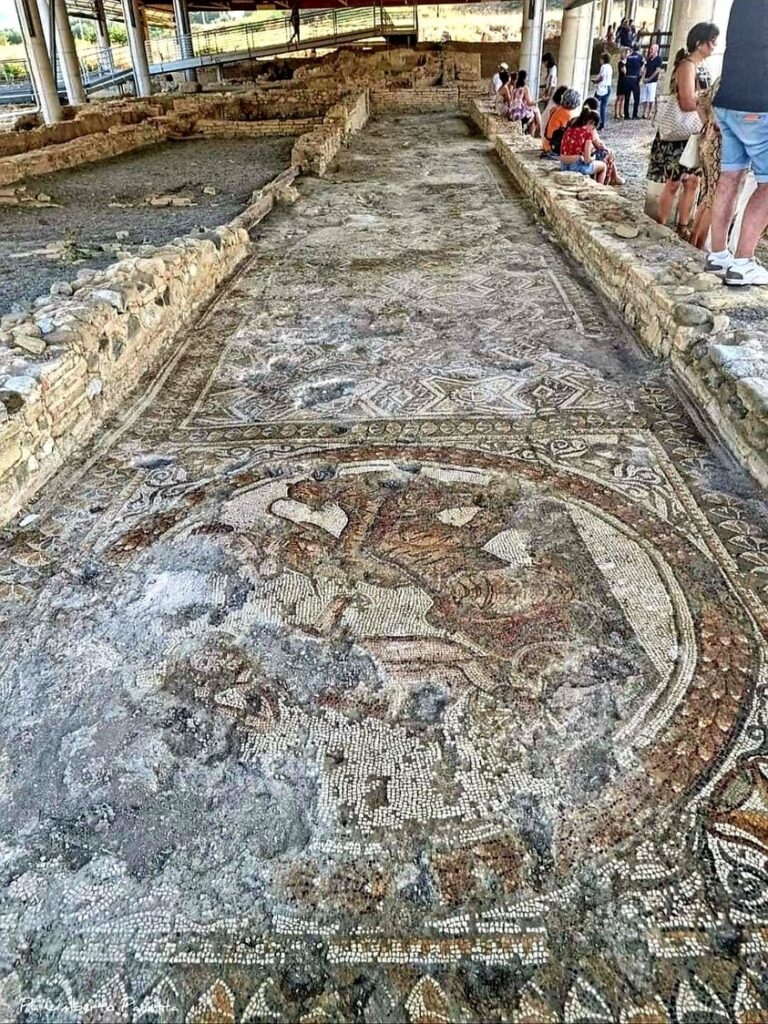
The Great Hunt is a marvel of opus tessellatum, composed of millions of tiny, multi-colored cubes known as tesserae. These tesserae are made from a variety of materials to achieve a painterly effect: local Sicilian limestone for the whites and ochres, imported marbles for the subtle greys, and fired terracotta for the deep reds and browns. To create the vibrant blues and greens, the craftsmen utilized glᴀss paste (smalti). The mosaic covers an astonishing 350 square meters, spanning the entire length of an 11-meter-wide corridor. The level of craftsmanship is exceptional; the artists used graduated shading to create a three-dimensional sense of volume in the animals and human figures. The floor was laid upon a complex foundation of statumen (large stones) and rudus (coarse lime-mortar) to ensure its durability against the weight of the mᴀssive villa structure.
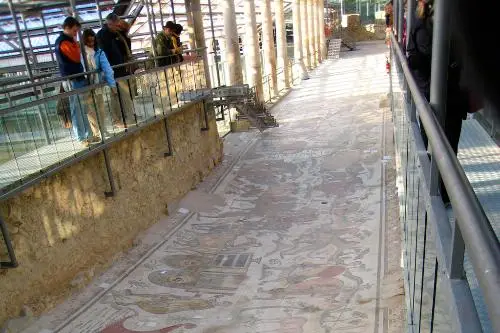
The primary function of this mosaic was propaganda and social display. The narrative does not depict a literal hunting scene for sport, but rather the collection and maritime transport of exotic animals—lions, tigers, elephants, rhinos, and hippos—from the farthest reaches of Africa and Asia to the amphitheaters of Rome. The mosaic serves as a visual map of the Roman oikumene (known world), showing the logistical genius of the empire. One can see soldiers and hunters wearing distinctive pilleus pannonicus hats, herding beasts into cages and loading them onto ships. This was meant to impress guests and dignitaries as they moved toward the villa’s throne room, signifying that the owner of the villa possessed the wealth and authority to harness the wild forces of nature from across three continents to serve the Roman state.

From an archaeological perspective, the Great Hunt provides an invaluable record of Roman logistics and biodiversity during the 4th century. It offers a “snapsH๏τ” of historical wildlife distributions and the specific technologies used for animal capture and transport, such as specialized cages and transport vessels. Today, the mosaic is viewed as a bridge between classical and medieval art; the lack of strict perspective and the emphasis on continuous storytelling foreshadowed the narrative tapestries of the Middle Ages. For the scientific community, the Villa Romana del Casale remains the world’s most important site for the study of late Roman domestic life. The Great Hunt stands as a vibrant, stony witness to an empire that, even in its twilight, remained a global powerhouse capable of transforming floors into epic masterpieces of history and myth.
✓ Team
The artifact depicted is the “Great Hunt” (Grande Caccia), a monumental floor mosaic located in the Villa Romana del Casale near Piazza Armerina, Sicily. This stunning archaeological…