The Guardian of the Fauces: The “Cave Canem” Mosaic of Pompeii
The discovery of the “Cave Canem” (Beware of the Dog) mosaic took place during the systematic Bourbon-led excavations of the early 19th century, a period when the Archaeological Park of Pompeii was first revealing its most intimate domestic treasures. Found in the fauces (the narrow entrance corridor) of the House of the Tragic Poet, the mosaic was preserved for nearly two millennia beneath the volcanic tephra of the 79 CE eruption of Mount Vesuvius. The site was famously documented by the archaeologist Giuseppe Fiorelli, who later revolutionized stratigraphic excavation at Pompeii. This specific artifact gained immediate worldwide fame, serving as a primary inspiration for Edward Bulwer-Lytton’s 1834 novel, The Last Days of Pompeii, and becoming a quintessential symbol of Roman daily life, domesticity, and the surprisingly modern anxieties of urban property owners.

The material composition of the mosaic follows the traditional opus tessellatum technique, utilizing thousands of minute tesserae—small, hand-cut cubes of natural stone and glᴀss. The artisan employed a starkly dramatic monochrome palette, using white limestone for the background field and dark basalt or black marble for the figure of the dog. To enhance the realism and ferocity of the animal, red glᴀss paste was likely used for the tongue or collar details, though much of this has faded or been replaced during centuries of exposure. The craftsmanship is characterized by finezza (delicacy), particularly in the way the tesserae are arranged in curvilinear patterns to suggest the rippling muscles and bristling fur of a guard dog in mid-snarl. This indicates that the homeowner commissioned a high-status workshop capable of blending functional floor covering with sophisticated graphic art.
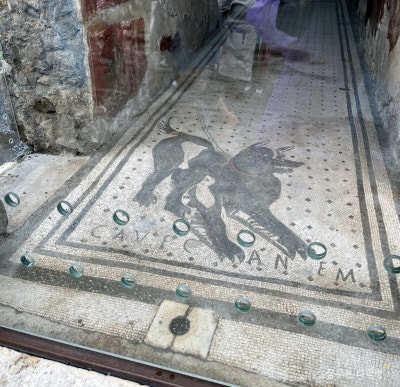
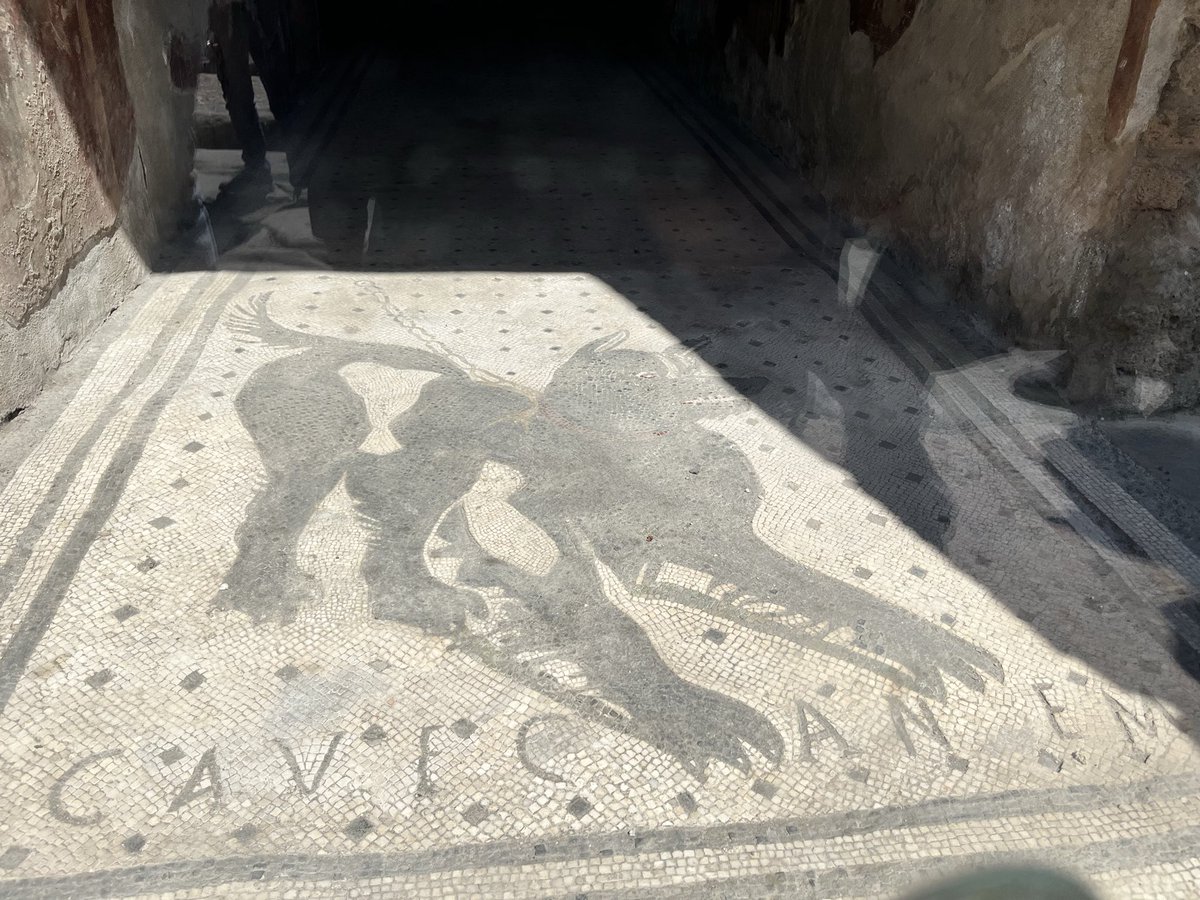
The manufacturing details reveal a deep understanding of psychological deterrence and visual perspective. The dog is depicted in a crouching, aggressive stance, tethered by a heavy chain that stretches toward the interior of the house, implying that while the animal is restrained, it remains a lethal threat to intruders. Below the figure, the Latin inscription CAVE CANEM is rendered in bold, sans-serif lettering, integrated directly into the mosaic’s border. The placement of this work was a deliberate architectural choice; as visitors stepped from the dusty street into the shaded corridor, the mosaic was the first object they encountered. The high-contrast black-on-white design ensured that the warning was legible even in low light, serving as a social “filter” that distinguished welcomed guests from potential thieves or uninvited solicitors.
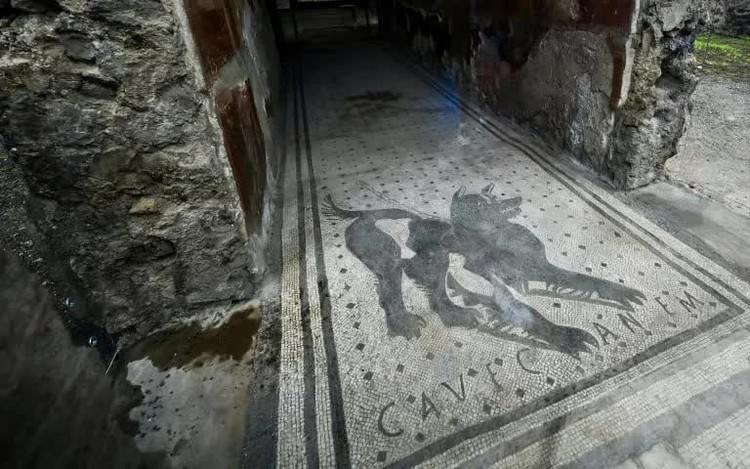
The utility and symbolic meaning of the mosaic extend beyond mere property protection. In the Roman world, the dog—specifically the Molossian hound—was a guardian of the household (custos domus) and a symbol of fidelity. However, the presence of such an aggressive “Beware of the Dog” sign in the House of the Tragic Poet—a residence otherwise filled with refined mythological frescoes from the Iliad—suggests a complex play on status. It reflects the rising social tensions of the mid-1st century, where the nouveau riche class of Pompeii sought to protect their wealth while simultaneously displaying their literacy and wit. The mosaic acted as a “liminal guardian,” marking the sacred boundary between the public forum and the private atrium, reminding all who crossed the threshold that they were entering a space governed by the rules and protections of a powerful Roman citizen.

In recent years, the Superintendency of Pompeii, under the direction of Dr. Mᴀssimo Osanna, undertook a mᴀssive restoration project as part of the “Great Pompeii Project,” funded by the European Union. This modern intervention involved cleaning the calcified volcanic deposits from the stone and installing a protective glᴀss walkway to prevent the foot traffic of millions of tourists from eroding the delicate tesserae. This conservation effort has allowed the “Cave Canem” dog to regain its original intensity, ensuring that the ancient warning remains as clear today as it was on the morning of the eruption. Through the lens of modern archaeology, this mosaic is no longer just a curiosity; it is a vital piece of evidence in the study of Roman urban psychology, security, and the enduring human desire to protect one’s home and family from an unpredictable world.
✓ hoangduc
The discovery of the “Cave Canem” (Beware of the Dog) mosaic took place during the systematic Bourbon-led excavations of the early 19th century, a period when the…