The Imperial Crown of the Holy Roman Empire: A Symbol of Medieval Sovereignty
The artifact depicted is the Imperial Crown of the Holy Roman Empire, a masterwork of medieval goldsmithing dating back to the late 10th century. While the image captures a moment during the aftermath of World War II, the crown itself serves as a profound archaeological and historical record of Ottonian art. Created around 962–980 CE, likely in a workshop in Western Germany, this crown was used for the coronation of kings and emperors, embodying the divine authority and political legitimacy of the Holy Roman Empire throughout the Middle Ages.
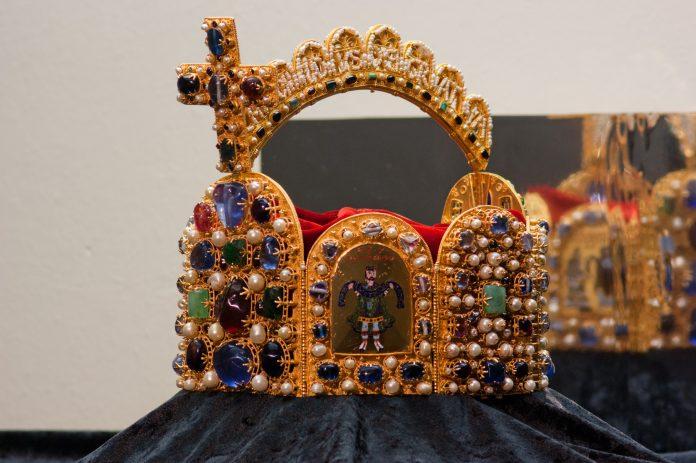
The crown is a breathtaking example of sophisticated craftsmanship, constructed from a series of eight hinged gold plates. The materials are exceptionally opulent; the surface is adorned with an intricate arrangement of over 140 precious stones, including sapphires, emeralds, and amethysts, alongside dozens of natural pearls. The centerpiece is a prominent cross and an arch added slightly later, featuring cloisonné enamel plaques that depict biblical figures and allegorical scenes. The precision with which these elements are set demonstrates the advanced skill of imperial goldsmiths who combine mechanical ingenuity with high-status artistic expression.
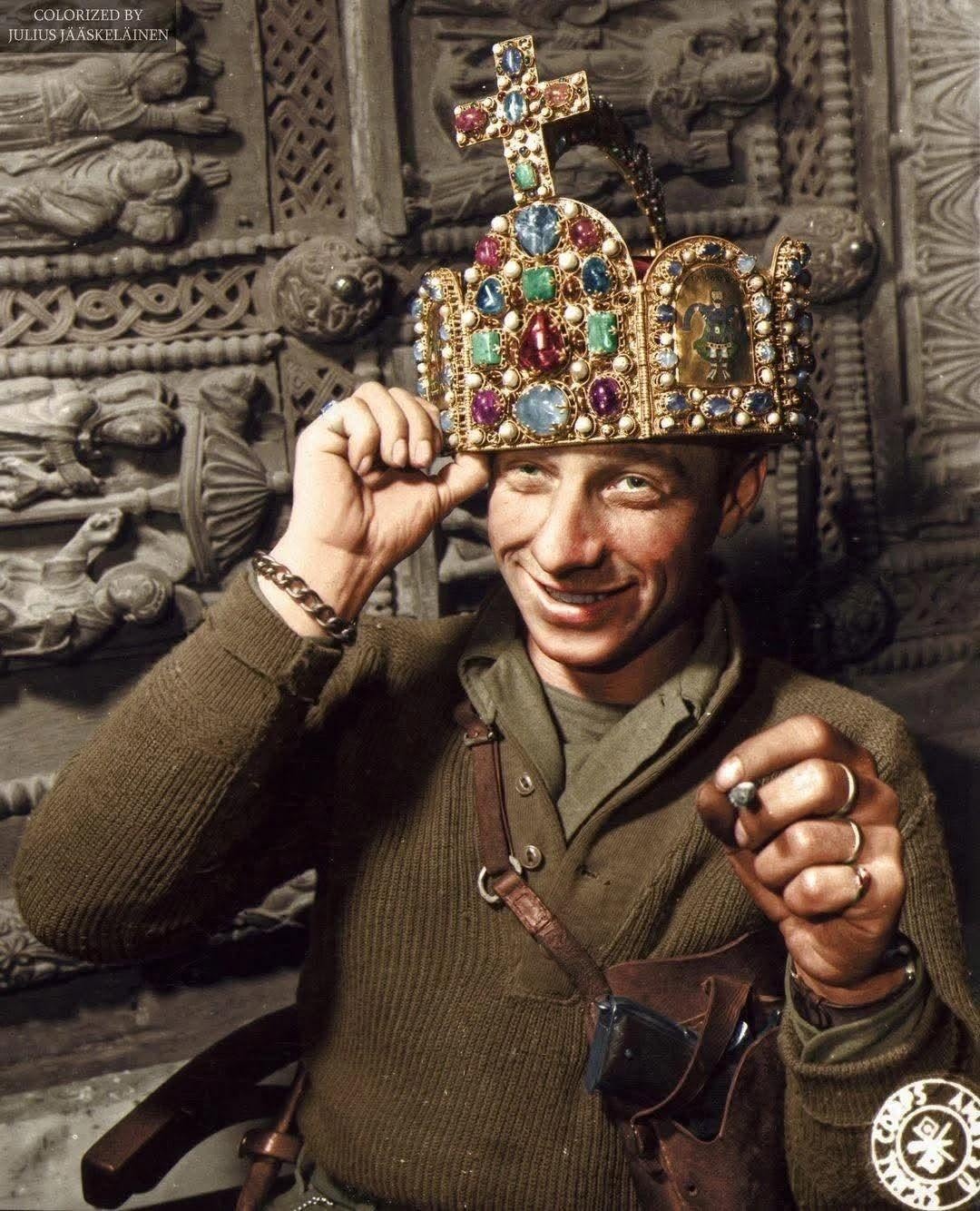
Beyond its material beauty, the crown functions as the ultimate symbol of the “Sacrum Imperium.” It was not merely a headpiece but a tangible manifestation of the emperor’s role as the protector of Christendom. The design, with its octagonal shape and rich iconographic program, mirrors the theological concept of the “Heavenly Jerusalem,” intended to elevate the ruler to a semi-divine status in the eyes of his subjects. Its use in coronation ceremonies across centuries solidified the bond between the church and the state, making it the most significant piece of the Imperial Regalia.

The historical context provides highlights an extraordinary chapter in the crown’s “archaeological” journey: its discovery by Allied forces at the end of World War II. After being hidden for safekeeping in a secret bunker in Nuremberg by the Nazi regime, the crown and other regalia were secured by members of the U.S. Army’s Monuments, Fine Arts, and Archives program (the “Monuments Men”). The picture soldierd represents this pivotal moment when the artifacts were recovered from their concealment and returned to public view, effectively saving these irreplaceable treasures from potential destruction or permanent loss.
Today, the Imperial Crown remains a central object of study, offering insights into the economic networks, artistic exchanges, and political ideologies of the Middle Ages. Its survival—from its creation in the Ottonian period to its dramatic recovery in 1945—is a testament to its enduring cultural value. By examining its material composition and its tumultuous history, researchers gain a deeper understanding of how medieval societies utilize luxury objects to articulate power and idenтιтy. The crown continues to stand as a bridge between the distant past and our modern efforts to preserve and interpret human heritage.
✓ hoangduc
The artifact depicted is the Imperial Crown of the Holy Roman Empire, a masterwork of medieval goldsmithing dating back to the late 10th century. While the image…