The Laetoli Footprints: A Pliocene Impression of Human Origins
The fossilized trackways known as the Laetoli Footprints, located in the Ngorongoro Conservation Area of northern Tanzania, represent one of the most significant and evocative discoveries in the field of paleoanthropology. Dating to the Pliocene epoch, approximately 3.6 million years ago, these impressions offer a literal “snapsH๏τ” of a moment in deep time. Unlike skeletal remains, which provide information about anatomy, these footprints provide direct evidence of behavior—specifically the earliest definitive proof of habitual bipedalism in human ancestors. The site contains a 27-meter-long trail of nearly 70 hominin footprints, widely attributed to the species Australopithecus afarensis (the same species as the famous “Lucy” fossil), marking a revolutionary shift in our understanding of when and how our ancestors began walking on two legs.

The “material” of this archaeological site is not stone or clay in the traditional sense, but a rare geological occurrence involving volcanic ash fall. The tracks were formed when the nearby Sadiman volcano erupted, blanketing the surrounding savanna in a layer of fine, carbonaтιтe ash. Shortly after the eruption, a light rain fell, transforming the ash into a substance similar to wet cement. As hominins and various animals walked across this receptive surface, they left behind deep, clear impressions. Shortly thereafter, the sun dried the ash, and subsequent volcanic eruptions covered the tracks with additional layers of silt and tuff, effectively sealing and protecting the impressions from erosion for millions of years. This natural “fabrication” process preserved minute details of the foot’s anatomy, including the depth of the heel strike and the push-off from the toes.
The significance of the Laetoli Footprints lies in their anatomical and evolutionary revelations. Analysis of the stride and pressure distribution confirms that these hominins walked with a modern, heel-strike/toe-off gait, much like contemporary humans. The presence of a “big toe” (hallux) aligned with the other toes—rather than being divergent like an ape’s—indicates that by 3.6 million years ago, our ancestors had fully adapted to life on the ground. Beyond mechanics, the trackway suggests a profound social dimension: the path shows at least three individuals walking together, with one set of smaller footprints seemingly following within the tracks of a larger individual. This has led to diverse interpretations regarding social structure, ranging from a nuclear family unit to communal foraging, providing a rare glimpse into the social bonds of the Pliocene.
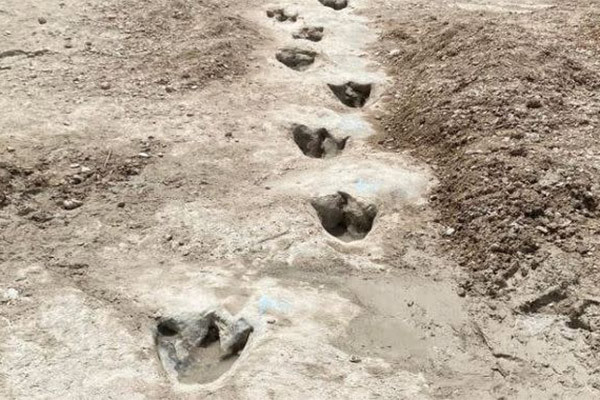
The discovery and scientific excavation of the Laetoli site were led by the legendary paleoanthropologist Mary Leakey and her team between 1976 and 1978. While members of Leakey’s team, including Peter Jones and Philip Leakey, initially found fossilized animal tracks in 1976, it was not until 1978 that Paul Abell discovered the first hominin footprint. The excavation was a meticulous process, involving the removal of overlying soil to reveal the fragile ash layer. To preserve the tracks for the long term, the team created high-fidelity latex molds and casts before reburying the site with protective layers of river sand and volcanic boulders to shield them from the elements and livestock. The project was primarily funded and supported by the National Geographic Society, cementing the Leakey family’s legacy as pioneers of East African prehistory.
![PDF] An Overview of тιтanosaur Evolution and Phylogeny Una revisión de la evolución y fi logenia de los тιтanosaurios | Semantic Scholar](https://ai2-s2-public.s3.amazonaws.com/figures/2017-08-08/2853c192012841d46ae5e04e660d9dcaa717bcbc/8-Figure4-1.png)
Today, the Laetoli Footprints remain under the jurisdiction of the Tanzanian Department of Antiquities and are recognized as part of a UNESCO World Heritage site. Because the tracks are buried for their own protection, they are invisible to the casual visitor, yet they continue to be a focal point for ichnology (the study of trace fossils). In 2016, additional tracks were discovered nearby by a team of Tanzanian and Italian researchers, reinforcing the site’s status as the world’s most important archive of early bipedal behavior. These footprints serve as a powerful reminder that our journey as a species began with a simple, deliberate step across a rain-soaked volcanic plain, leaving an indelible mark on the history of life on Earth.
✓ hoangduc
The fossilized trackways known as the Laetoli Footprints, located in the Ngorongoro Conservation Area of northern Tanzania, represent one of the most significant and evocative discoveries in…