The Lithic Conundrum of Puma Punku: Engineered Precision in the Andean Highlands
The stone blocks depicted in the image originate from the enigmatic archaeological site of Puma Punku, located within the larger Tiwanaku complex in modern-day Bolivia. Dating back to the Middle Horizon period, likely between 500 CE and 1000 CE, these megalithic structures represent one of the most sophisticated examples of pre-Columbian stone engineering. Puma Punku, whose name translates to “Door of the Puma” in Aymara, was a major ritual center that operated at the zenith of the Tiwanaku civilization, a culture that profoundly influenced subsequent Andean societies, including the Inca. The site is renowned for its monumental, precision-cut stone blocks that seem to defy the technological limitations of the era.
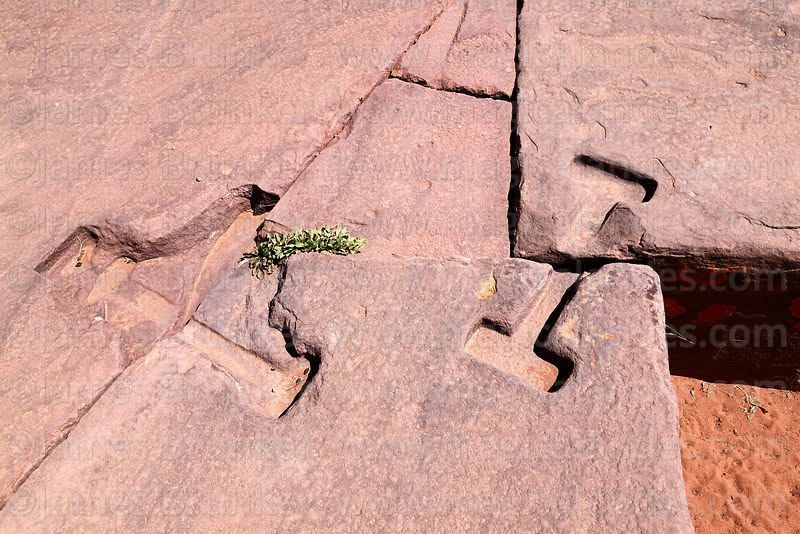
Puma Punku is situated on the Altiplano, a high-alтιтude plateau in the Andes mountains, at an elevation of approximately 3,800 meters. The blocks themselves are composed primarily of red sandstone and andesite, materials that were sourced from quarries several kilometers away and transported across the challenging mountainous landscape, a logistical achievement in itself. The red sandstone used for the blocks in the image is notable for its durability, yet it has been shaped with such extreme precision that it mimics the clean lines and uniform dimensions of modern machine-tooled industrial components.
The fabrication techniques applied to these stones are the subject of intense scholarly debate. The blocks feature highly complex, standardized recesses—often described as “H-blocks”—which include perfectly flat, 90-degree interior angles and uniform grooves that suggest a sophisticated method of modular construction. Archaeological analysis indicates that the Tiwanaku stonemasons employed advanced grinding and polishing techniques, likely utilizing hard stone tools and abrasive sands to achieve these smooth, flat surfaces. The uniformity of these recesses indicates a template-based or modular approach, where individual elements were pre-fabricated to fit together with near-perfect interlocking precision, a hallmark of their advanced lithic technology.
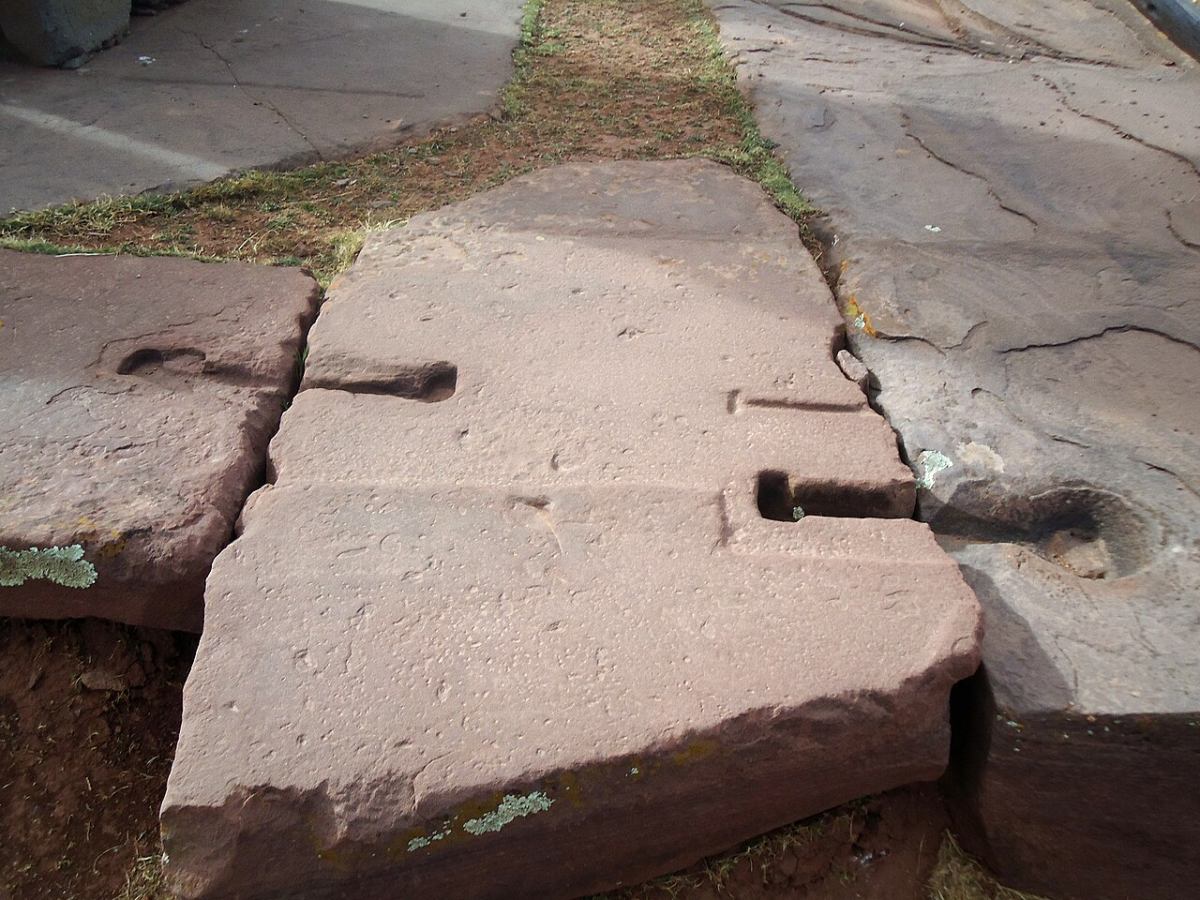
While the exact function of the Puma Punku structures remains a topic of archaeological conjecture, their design clearly points toward a monumental, ceremonial purpose. The presence of these interlocking “H” shapes suggests they were originally intended to be joined together, possibly as part of a grand gateway or a multi-tiered platform that served as the focal point for ritual activity. The sheer effort expended in quarrying, transporting, and shaping these mᴀssive blocks signifies that the site held immense socio-political and religious importance to the Tiwanaku state, serving as a physical manifestation of divine power and order in an otherwise harsh, high-alтιтude environment.

Puma Punku has been the subject of archaeological interest since the colonial era, but it was not until the systematic excavations of the 20th century that the true complexity of the site began to be understood. Figures such as Arthur Posnansky, who conducted extensive studies of the Tiwanaku region in the early 1900s, brought international attention to the technical prowess of the site’s builders. More recent academic excavations have employed modern scientific methods to map the site and analyze the construction materials, gradually stripping away layers of myth to reveal a remarkably advanced ancient culture. Today, Puma Punku stands as a testament to the ingenuity of the Tiwanaku civilization, remaining a primary focus for researchers studying the development of complex social structures in the pre-Columbian Andes.
✓ hoangduc
The stone blocks depicted in the image originate from the enigmatic archaeological site of Puma Punku, located within the larger Tiwanaku complex in modern-day Bolivia. Dating back…