The Monolithic Enigma: An Archaeological Survey of the Takht-e Rostam Stupa
The monumental structure featured in these aerial and ground-level perspectives is the Takht-e Rostam (Throne of Rostam), a unique Buddhist stupa complex located near the town of Haibak in the Samangan Province of Afghanistan. Unlike traditional stupas built with masonry or brick, this site is situated atop a hill and is entirely hewn into the living bedrock. The complex is part of a larger monastic system that includes several adjacent cave dwellings and a sanctuary. Historically, this region served as a vital cultural corridor on the Silk Road, connecting the Indian subcontinent with Central Asia. The site was first brought to the attention of the international archaeological community in the early 20th century and has since been surveyed by various missions, including the Délégation Archéologique Française en Afghanistan (DAFA), which documented the site’s extraordinary rock-cut architecture.

Based on architectural comparisons with the Buddhist sites of Gandhara and Bamiyan, archaeologists date the Takht-e Rostam to the Kushan-Sᴀssanian period, specifically between the 3rd and 5th centuries AD. This era marks the zenith of Buddhism in the region before the Islamic conquest. The stupa represents a transition in Buddhist art where the symbolic “mound” (anda) became increasingly stylized. Its dating is supported by the absence of late-period figurative carvings, suggesting it was created during a phase where the architectural form itself held primary ritualistic importance. The site predates the mᴀssive Buddhas of Bamiyan but shares the same technical tradition of “monolithic excavation” that defined the era’s religious fervor.
The “material” of the Takht-e Rostam is not added, but rather subtracted; the stupa is composed of natural limestone bedrock. The craftsmanship involved is a feat of ancient engineering known as monolithic carving. Instead of building upward, ancient stonemasons quarried a deep, circular trench into the hill, leaving a mᴀssive, solid core in the center to form the stupa. The main body is a hemispherical dome (anda) topped by a square, room-like structure known as a harmika, which traditionally held sacred relics. Technical analysis shows that the artisans used iron chisels and wedges to remove thousands of tons of stone, achieving a level of geometric precision that remains visible today despite centuries of erosion. The surrounding trench allowed pilgrims to perform circumambulation (walking around the stupa) at the base of the monument.
In the context of Buddhist archaeology, the Takht-e Rostam served as a relic container and a center for meditation. The stupa is a cosmogram—a physical representation of the Buddhist universe. The central pillar (axis mundi) that would have theoretically pᴀssed through the center of the dome connects the earth to the heavens. Uniquely, the harmika at the top of this stupa contains a small chamber, which some scholars believe once housed a physical relic of the Buddha or a high-ranking monk. The entire complex functioned as a vihāra (monastery), providing a secluded, cool environment for monks to live and pray away from the summer heat of the plains. Its naming as “Takht-e Rostam” is a later folk attribution to the legendary Persian hero Rostam, a common practice where local populations re-contextualize ancient, mysterious ruins through the lens of national mythology.
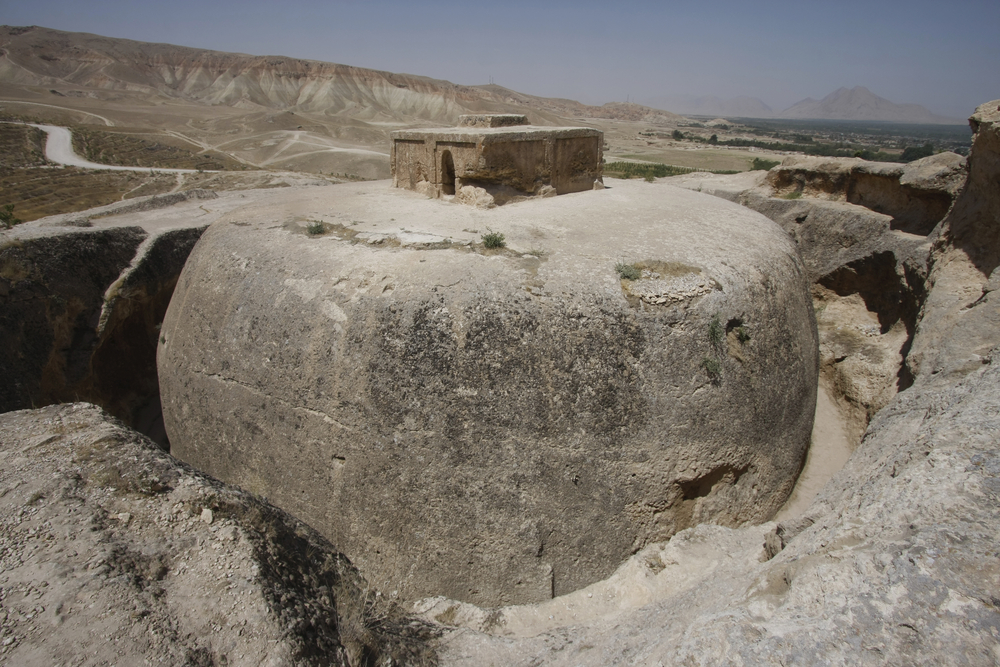
The systematic study of Takht-e Rostam has been spearheaded by DAFA and, in more recent decades, by the National Museum of Afghanistan in collaboration with international cultural agencies like UNESCO. During the 1960s and 70s, detailed mapping and pH๏τographic documentation were completed, which now serve as the primary records for the site given the regional instability of recent years. Archaeologists such as Mizuno Seiichi and Zemaryalai Tarzi have contributed significantly to our understanding of the site’s role in the “Bactrian” Buddhist tradition. Today, the site stands as one of Afghanistan’s most important pre-Islamic heritage sites. Despite the challenges of weathering and human encroachment, it remains a silent witness to the extraordinary technical and spiritual synthesis that once flourished in the heart of the Hindu Kush.
✓ Team
The monumental structure featured in these aerial and ground-level perspectives is the Takht-e Rostam (Throne of Rostam), a unique Buddhist stupa complex located near the town of…