The Monteleone Chariot: Masterpiece of Etruscan Metallurgical Artistry
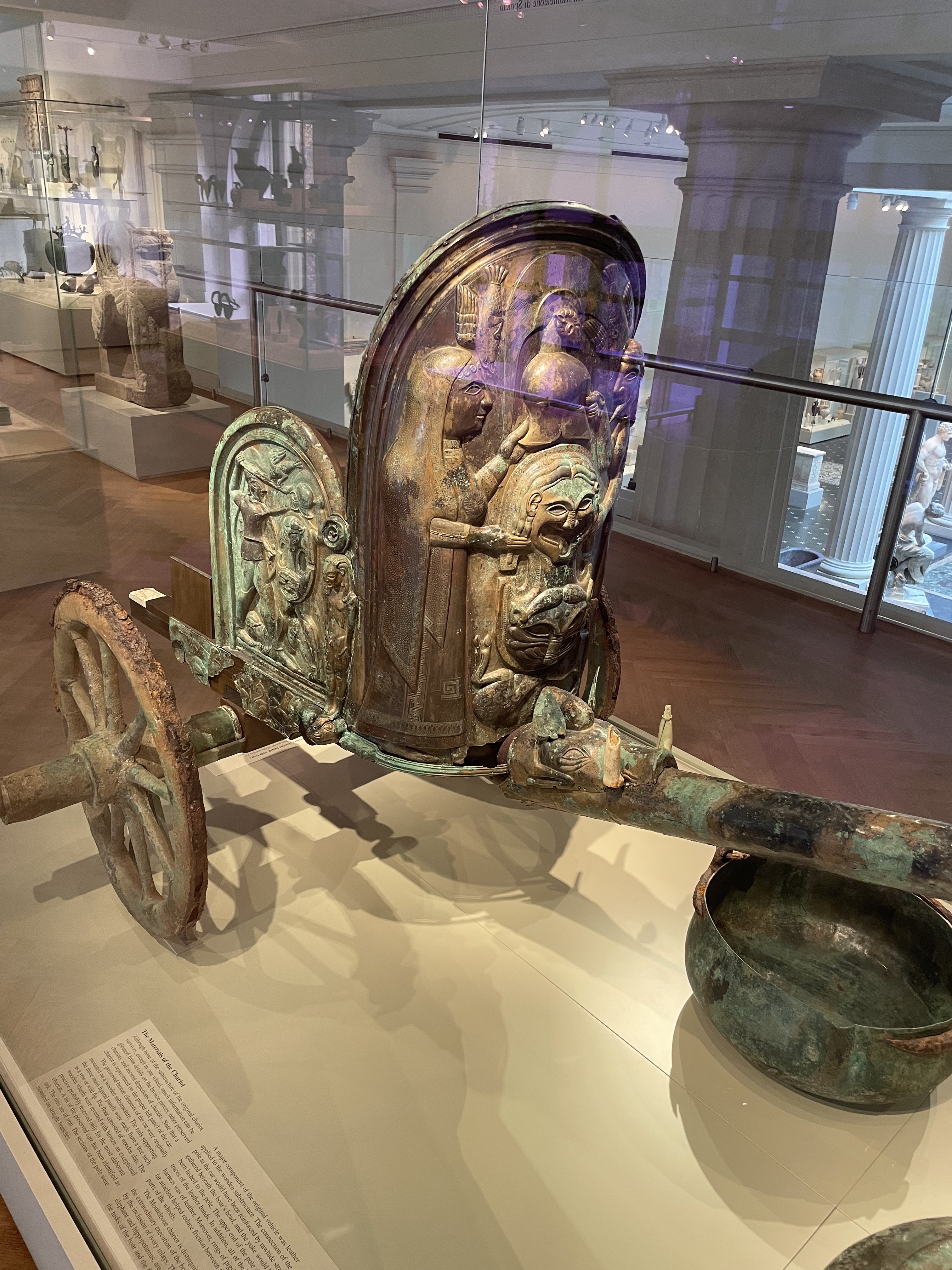
The Monteleone Chariot, a breathtaking artifact housed in the Metropolitan Museum of Art in New York, stands as one of the most significant and pristine archaeological discoveries from the pre-Roman Mediterranean. Dating back to the Archaic period, specifically the second quarter of the sixth century BCE (circa 530 BCE), this highly decorated vehicle provides an unparalleled glimpse into Etruscan aristocratic culture and their deep fascination with Greek mythology. Out of approximately three hundred ancient chariots known to survive in various states of fragmentation worldwide, the Monteleone specimen is uniquely celebrated as the most complete and impeccably preserved example in existence. The provided image presents two museum display perspectives, capturing the dynamic profile of the vehicle, its twin ten-spoke wheels, its elongated draft pole tipped with a stylized animal head, and the intricate relief work adorning its main body.

From a material and technical perspective, the chariot represents an extraordinary feat of ancient mixed-media craftsmanship, combining metallurgy with delicate organic carving. The structural core of the vehicle was originally framed from dense, flexible wood—likely walnut or oak—which acted as a natural shock absorber, though this original wood rotted away and was reconstructed by museum conservators based on ancient blueprints. The outer shell is completely sheathed in hammered bronze plates executed in high-relief repoussé technique, where the metalsmiths meticulously chased and punched details from the reverse side to create three-dimensional forms. To elevate its luxury, the bronze panels are heavily inlaid with intricately carved ivory accents derived from elephant and hippopotamus tusks, while the borders are embellished with complex geometric patterns and masterfully rendered zoomorphic figures.

Functionally, the Monteleone Chariot was never intended for the chaos of active battlefield combat or high-speed racing; instead, it was engineered as an elite parade vehicle and a highly symbolic prestige object. Its structural design features a two-wheeled, horseshoe-shaped car meant to be drawn by two magnificent horses, allowing an aristocratic owner to stand prominently during religious processions, triumphal entries, or civic celebrations. The iconography hammered into the three primary bronze panels depicts a narrative cycle from the life of Achilles, the ultimate Greek epic hero. The central panel illustrates Achilles’ mother, the sea-nymph Thetis, presenting her son with a divine helmet and shield, while the flanking panels depict legendary combat scenes and mythological creatures, all meant to project the heroic status, wealth, and divine favor of the chariot’s owner.

The miraculous discovery of this masterwork occurred entirely by chance in February 1902 in the rugged terrains of Monteleone di Spoleto, a town situated in the Umbria region of central Italy. A local farmer and shepherd named Isidoro Vannozzi was excavating a hillock on his property at Colle del Capitano to clear ground for a new farmhouse when his tools broke through into a hidden subterranean chamber. The cavity proved to be an ancient Etruscan dromos tomb containing the skeletal remains of a man and a woman, surrounded by rich grave goods, including iron utensils, imported ceramics, and the collapsed pieces of this bronze chariot. Unaware of the priceless nature of his find, Vannozzi initially stored the artifact in his barn and famously sold it to a regional scrap dealer to buy terracotta roof tiles for his home, after which it changed hands rapidly through Parisian art markets before being purchased by the American financier J.P. Morgan, who gifted it to the museum in 1903.
Today, the Monteleone Chariot remains an invaluable archaeological benchmark for studying the cross-cultural exchanges that defined the ancient Mediterranean world. The seamless fusion of local Etruscan bronze-smithing techniques with distinctly Homeric, Greek iconographic themes highlights the sophisticated trade networks and shared intellectual landscapes of the sixth century BCE. By transforming a functional vehicle of transportation into a canvas for epic poetry and cosmic imagery, the ancient artisans created a timeless monument. It has successfully bridged the gap between technological utility and high art, maintaining its power to captivate scholars and the public alike across more than two and a half millennia.
✓ hoangduc
The Monteleone Chariot, a breathtaking artifact housed in the Metropolitan Museum of Art in New York, stands as one of the most significant and pristine archaeological discoveries…