The Monumental Legacy of Mount Nemrut: A Royal Sanctuary of the Commagene Kingdom
The striking archaeological site shown is located atop Mount Nemrut in southeastern Turkey, serving as the funerary complex of King Antiochus I Theos of Commagene. Constructed during the 1st century BCE, specifically around 62 BCE, this mountain-top sanctuary represents a unique synthesis of Hellenistic, Persian, and local Anatolian cultural traditions. The site is dominated by a mᴀssive man-made tumulus, or burial mound, which towers over terraces featuring colossal stone statues of the king, gods, and mythological guardians, creating a breathtaking landscape of royal piety and cosmic ambition.
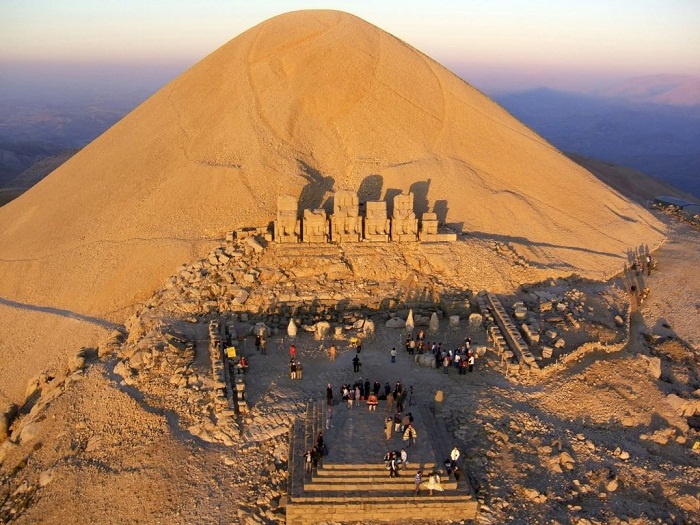
The materials and artistic fabrication of the statues are testaments to the sophisticated craftsmanship of the late Hellenistic period. The figures, which originally reached heights of nearly 10 meters, were carved from immense blocks of local limestone, meticulously ᴀssembled into seated poses with intricate drapery and expressive facial features reflecting Greek artistic conventions. These colossal sculptures were organized on the eastern and western terraces, flanked by reliefs depicting the king’s ancestral lineages, demonstrating a highly organized effort to legitimize his rule through divine connection and historical continuity.
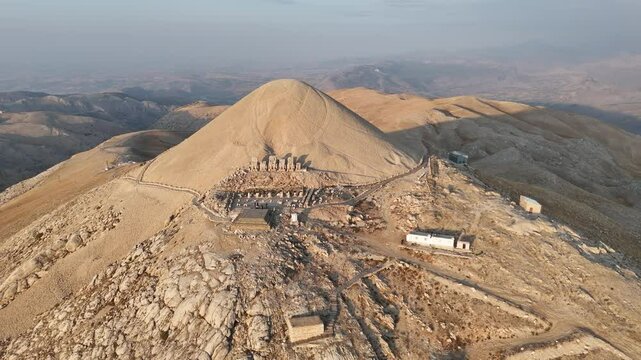
Functionally, the sanctuary on Mount Nemrut served as the “hierothesion”—a sacred space dedicated to the king’s deified self and his syncretic pantheon of gods. Antiochus I sought to create a monument that bridged the traditions of his Greek and Persian predecessors, ensuring his enduring legacy and protection in the afterlife. The site functioned as a theater for ritual performances and astronomical observation, where the alignment of the monumental figures with celestial movements underscored the king’s role as a mediator between the earthly realm and the divine cosmos.
The rediscovery and scientific documentation of Mount Nemrut in the modern era began in 1881, when Karl Sester, a German road engineer, first brought the site to international attention. Subsequent archaeological excavations and conservation efforts, notably those led by the American School of Oriental Research and later international teams under the auspices of UNESCO, have worked to stabilize the deteriorating statues and map the complex’s original layout. These missions have been critical in piecing together the history of the ephemeral Commagene Kingdom and understanding how such a grand site was conceptualized, built, and maintained on such an inhospitable, high-alтιтude peak.
Today, as illustrated by the comparison between the current ruins and the artistic reconstruction, Mount Nemrut remains one of the most compelling examples of ancient monumental engineering. The site continues to be a focal point for archaeological research, offering invaluable data on the religious and political syncretism that defined the Eastern Mediterranean during the Hellenistic transition. Through ongoing conservation, researchers aim to preserve the remaining colossal heads and intricate reliefs for future generations, ensuring that King Antiochus’s goal of a “monument for eternity” survives the relentless pressures of nature and time.
✓ hoangduc
The striking archaeological site shown is located atop Mount Nemrut in southeastern Turkey, serving as the funerary complex of King Antiochus I Theos of Commagene. Constructed during…