The Motilla del Azuer: Prehistoric Water Management and the Birth of Social Stratification
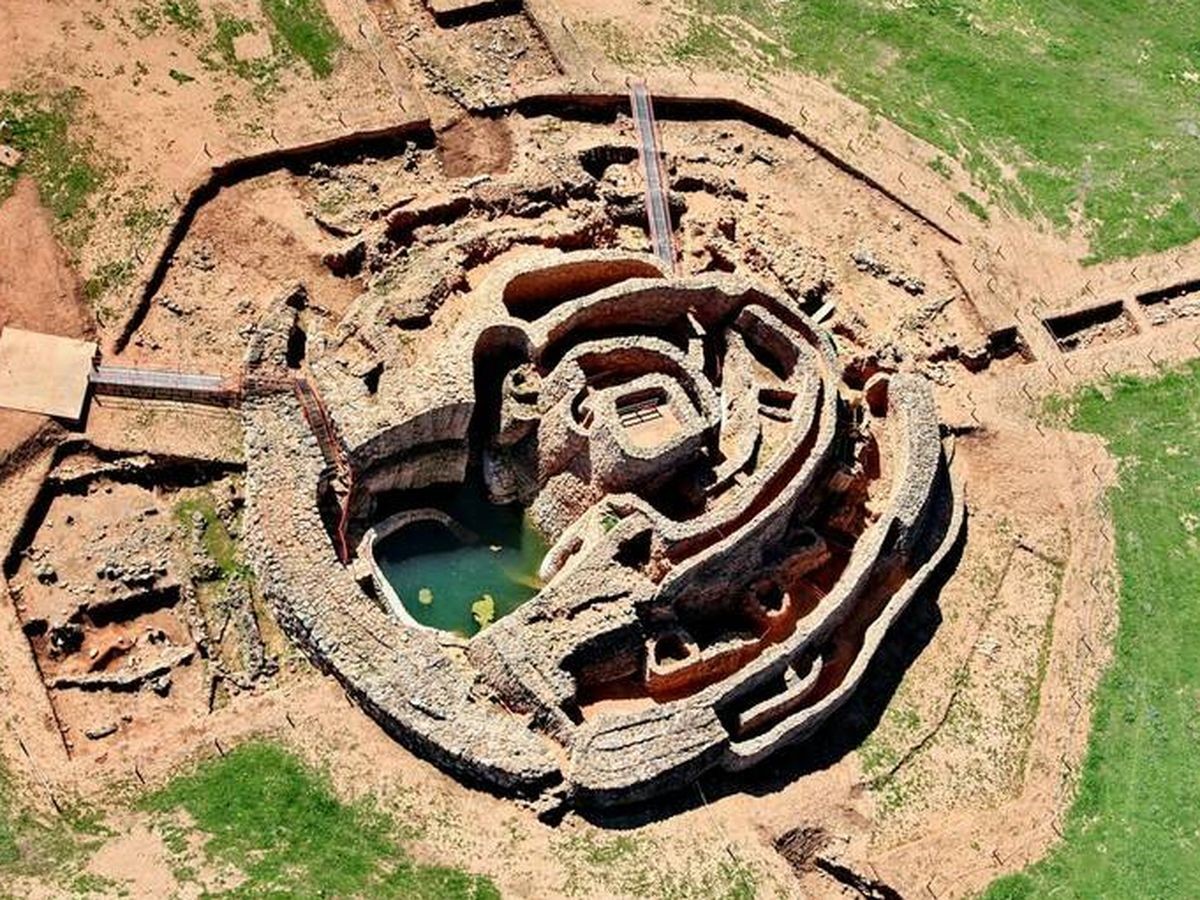
The architectural complex depicted in the images is the Motilla del Azuer, a unique fortified settlement located near Daimiel in the province of Ciudad Real, Spain. This site belongs to the Bronze Age of La Mancha (Cultura de las Motillas) and dates to the period between 2200 and 1300 BCE. This era represents a significant phase in the prehistory of the Iberian Peninsula, characterized by a prolonged and devastating regional drought that lasted for centuries. Chronologically, the Motillas mark a pivotal transition in human organization, where the scarcity of natural surface water forced communities to abandon traditional open settlements in favor of highly fortified, centralized hubs focused on the extraction and protection of groundwater.
While the “mounds” or motillas have been landmarks in the La Mancha plain for millennia, systematic archaeological excavation of the Motilla del Azuer began in 1974. The project was initiated and has been continuously managed by the University of Granada, specifically under the leadership of archaeologists Trinidad Nájera Colino and Fernando Molina González. Working in collaboration with the Junta de Comunidades de Castilla-La Mancha, the team spent decades meticulously clearing the stratigraphic layers of rubble to reveal the complex interior structure. Their work transformed our understanding of the European Bronze Age, proving that these were not mere burial mounds or defensive watchtowers, but sophisticated, multi-functional industrial complexes designed for environmental survival.
The primary material used in the construction of the Motilla del Azuer is local limestone, quarried from the surrounding plains and bound with a clastic-calcareous mortar (mud and crushed stone). The craftsmanship is a feat of prehistoric hydraulic engineering and dry-stone masonry. The site consists of a central circular tower surrounded by a series of concentric walled enclosures. However, the most technical achievement is the monumental well seen in the lower image. Reaching a depth of nearly 16 meters, it is considered the oldest well in the Iberian Peninsula. To construct it, the builders had to excavate a vertical shaft through layers of sediment and rock, reinforcing the sides with precisely laid stone walls and a ramped staircase that allowed for the manual haulage of water from the underlying aquifer.

In terms of archaeological utility, the Motilla del Azuer functioned as a fortified hydric and agrarian sanctuary. The central well provided a reliable water source during the extreme droughts of the sub-Boreal period, making the site the biological heart of the community. Beyond water, the “galleries” or narrow corridors between the walls served as large-scale grain silos and livestock pens, protected by the tower’s height and the defensive walls. Symbolically, the site represented the centralization of power. Because water was a rare and precious resource, the group that controlled the Motilla controlled the region’s economy. This utility led to the birth of social stratification in the area, as the complex acted as a fortress where surplus resources could be stockpiled, defended, and redistributed by an emerging elite class.
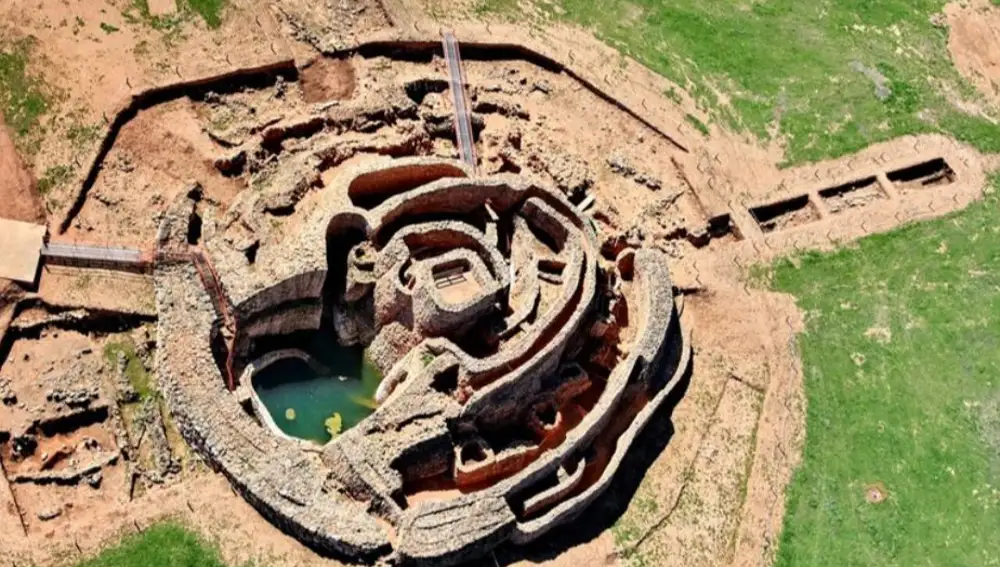
The legacy of the Motilla del Azuer is its status as one of the most important examples of human adaptation to climate change in the archaeological record. For researchers, the site provides a 900-year record of environmental resilience, showing how a society survived by engineering their landscape. Today, the site is managed by the Daimiel City Council and the Archaeological Museum of Ciudad Real. It is open to the public as a “living museum,” where visitors can witness the sheer scale of the Bronze Age walls. Conservation efforts focus on the stabilization of the stone blocks against modern thermal expansion and preventing the erosion of the exposed mud mortar. The Motilla stands as a silent, stony witness to a time when humanity looked at a parched earth and dug deep into its bones to ensure the survival of their civilization.
✓ Team
The architectural complex depicted in the images is the Motilla del Azuer, a unique fortified settlement located near Daimiel in the province of Ciudad Real, Spain. This…