The Mud-Brick Citadels of the Silk Road: An Archaeological Study of the Greater Kyz Kala
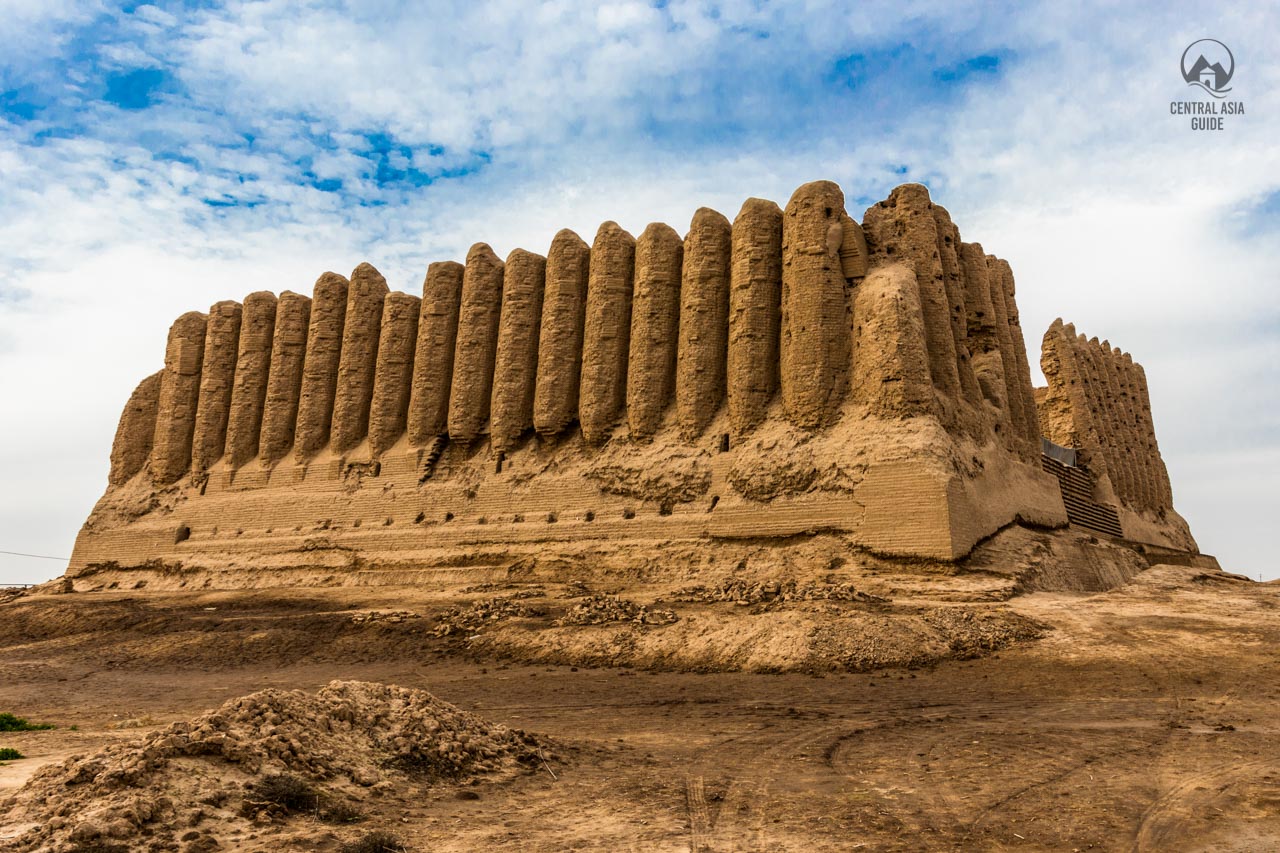
The architectural marvel depicted in these images is the Greater Kyz Kala (Kyz Kala-i Bozorg), one of the most iconic “kushks” or fortified aristocratic residences located in Merv (modern-day Turkmenistan). This site, situated in the heart of the Murghab delta, represents a unique pinnacle of Central Asian earthen architecture. While the foundations of the structure may date back as far as the 7th century, the visible “corrugated” walls primarily date to the Samanid and Ghaznavid periods, approximately the 9th to 11th centuries CE. As a critical node on the ancient Silk Road, Merv was once one of the largest cities in the world, and the Kyz Kala stands as a testament to the sophisticated defensive and domestic engineering of the medieval Islamic East before the devastating Mongol invasions of 1221 CE.

The primary building material for the Kyz Kala is adobe or sun-dried mud-brick, a traditional medium perfectly suited to the arid climate of the Kara Kum desert. The bricks were typically bonded with a clay-based mortar and occasionally reinforced with layers of reeds or wooden beams to provide tensile strength. The most striking detail of its manufacture is the corrugated facade—a series of mᴀssive, semi-circular engaged columns (ribs) that encircle the entire structure. These ribs were not merely decorative; they provided structural stability to the towering walls, which stand nearly 12 meters high, and offered significant defensive advantages by making the walls more resistant to projectiles and more difficult to scale. The precision of the brickwork in these uniform vertical folds demonstrates a high level of mathematical planning and specialized labor.
The functional significance of the Greater Kyz Kala has long been a subject of archaeological debate, though it is currently interpreted as a fortified manor house or “kushk” for a high-ranking official or member of the local nobility. The structure is built upon a high platform (a tel) to protect it from seasonal flooding and to provide a commanding view of the surrounding agricultural estates. Inside, the building originally contained two floors of vaulted rooms, living quarters, and reception halls arranged around a central courtyard. The thick mud-brick walls provided natural thermal insulation, keeping the interior cool in the scorching summer heat and warm during the freezing winter months. It served as both a display of wealth and a secure retreat for the elite during times of regional instability.

Symbolically, the architecture of the Kyz Kala reflects the cultural synthesis of the Sasanian Persian heritage and the evolving Islamic aesthetic. The use of corrugations is a direct stylistic descendant of earlier Sasanian fortresses, yet the internal organization aligns with the domestic requirements of the early medieval period. The sheer scale of the building—covering nearly 2,000 square meters—illustrates the economic prosperity of Merv as a center of trade, science, and literature. However, the top image suggests an even more complex history, showing evidence of architectural features like a pedimented entrance that might imply a long-lost Greco-Bactrian or Hellenistic influence, reflecting the many layers of civilization that occupied this desert oasis over two millennia.
The systematic scientific exploration of Merv and the Kyz Kala began in the late 19th century, with significant interest from the Imperial Russian Archaeological Commission. However, the most comprehensive modern excavations have been conducted by the Ancient Merv Project, a long-term international collaboration between the Insтιтute of Archaeology at University College London (UCL) and the Ministry of Culture of Turkmenistan, directed by figures such as Dr. Tim Williams and Professor Georgina Herrmann. In 1999, the State Historical and Cultural Park of “Ancient Merv” was designated a UNESCO World Heritage Site. Ongoing conservation efforts focus on protecting the fragile mud-brick surfaces from erosion, using specialized techniques to ensure that these mᴀssive corrugated walls continue to stand as silent sentinels of the Silk Road’s golden age.
✓ hoangduc
The architectural marvel depicted in these images is the Greater Kyz Kala (Kyz Kala-i Bozorg), one of the most iconic “kushks” or fortified aristocratic residences located in…