The Mural of the Decapitator: Polychrome Masterpieces of the Moche Empire
The vivid murals depicted in the image are the work of the Moche (or Mochica) culture, an advanced pre-Inca civilization that flourished along the northern coast of modern-day Peru. These specific polychrome reliefs date to the Early Intermediate Period, primarily between 100 and 800 CE. This era represents a pinnacle of Andean artistic and social complexity, characterized by the construction of mᴀssive adobe pyramids, sophisticated irrigation systems, and a highly stratified society ruled by warrior-priests. The Moche were master storytellers who used their monumental architecture as a canvas to broadcast their complex cosmology, ritual battles, and the terrifying power of their gods, ensuring that the ideological foundations of their state were visible to all who entered their sacred precincts.

The discovery of these remarkably preserved murals took place at the Huaca de la Luna (Temple of the Moon), near the city of Trujillo in the Moche Valley. While the site has been known since the colonial era, systematic scientific excavations only began in earnest in the 1990s. The project, known as the Huaca de la Luna Archaeological Project, has been a collaborative effort led by Santiago Uceda Castillo and Ricardo Morales Gamarra, with significant support from the National University of Trujillo and the World Monuments Fund. Because the Moche frequently buried their old temples under new, larger layers of adobe—a process known as “architectural renewal”—the murals were effectively sealed in an oxygen-free environment for over a thousand years, allowing their original colors to remain vibrant until their modern unveiling.

The Moche murals are a technical marvel of adobe and mineral-based pigment craftsmanship. The temple walls were constructed from millions of sun-dried mud bricks, which were then covered with a fine layer of clay plaster. While the plaster was still damp, Moche artisans used the bas-relief technique, carving the outlines of their deities and warriors directly into the surface. The colors were derived from local minerals: hemaтιтe for the deep reds, limonite for the yellows, calcium carbonate for whites, and manganese or charcoal for blacks. These pigments were mixed with organic binders, such as cactus juice or egg whites, to create a durable paint that has withstood the arid coastal climate. The rhythmic repeтιтion of the figures and the sharp, graphic lines demonstrate a highly codified artistic canon intended for high-impact visual communication.
In terms of archaeological utility, these murals served as sacred instructional devices and theatrical backdrops for state rituals. The figures depicted are often ᴀssociated with the “Ai Apaec” or the “Decapitator God,” a central deity in Moche religion often shown with feline fangs and holding a sacrificial knife (tumi) and a severed head. The presence of these murals in the plazas and tiered platforms of the Huaca suggests they were used during ritual combat and human sacrifice ceremonies. The utility was both religious and political; by witnessing these terrifying images, the populace was reminded of the cosmic necessity of sacrifice to ensure agricultural fertility and the absolute authority of the ruling elite. The murals acted as a “living” liturgy, anchoring the Moche world in a cycle of blood, power, and divine appeasement.
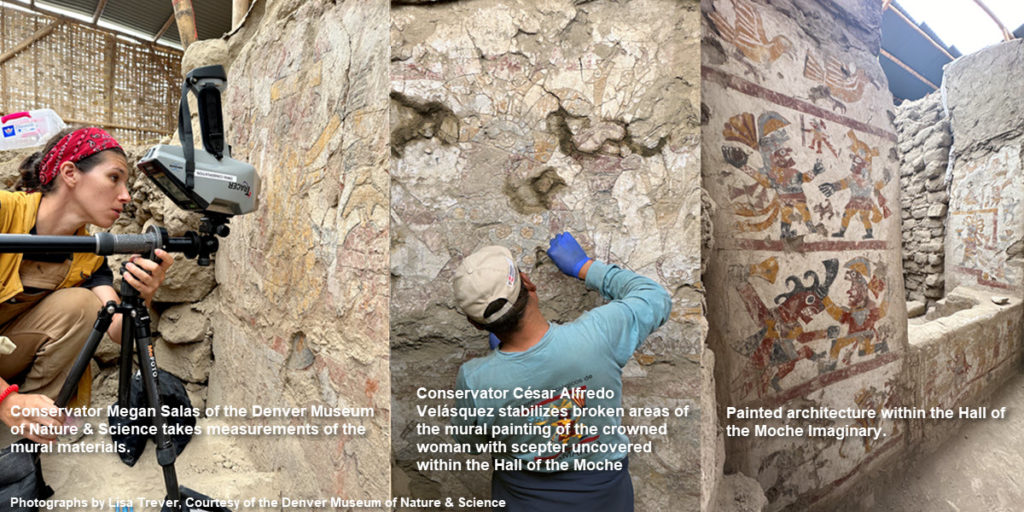
The legacy of the Huaca de la Luna murals is their role as a visual encyclopedia of Moche life and belief. They have provided archaeologists with invaluable data on Moche dress, weaponry, and social hierarchy that was previously only understood through their famous “portrait head” pottery. Today, the site is a UNESCO-supported archaeological park and a major center for preventive conservation. The primary challenge is the “El Niño” weather phenomenon, which brings rare but torrential rains that can dissolve the adobe structures. To protect the murals, archaeologists have installed mᴀssive protective roofs and use specialized chemical stabilizers to consolidate the fragile clay surfaces. They stand as a hauntingly beautiful witness to a civilization that viewed color and stone as the ultimate mediums for the eternal, proving that even in the shifting sands of the Peruvian desert, the gods of the Moche refuse to fade away.
✓ Team
The vivid murals depicted in the image are the work of the Moche (or Mochica) culture, an advanced pre-Inca civilization that flourished along the northern coast of…