The Ngāwhā тιтan: A 42,000-Year-Old Chronometer of Earth’s History
In early 2021, a monumental archaeological and geological discovery was made near the village of Ngāwhā in the Northland region of New Zealand’s North Island. While excavation work was being conducted, heavy machinery unearthed a gargantuan, ancient Kauri tree (Agathis australis) that had been interred in a waterlogged, oxygen-deprived environment for tens of millennia. The log, measuring approximately 20 meters in length and weighing roughly 65 tons, appeared as a dark, weathered monolith against the modern landscape. The preservation of this specimen was so exceptional that even organic matter, such as ancient leaves and cones, remained partially intact upon the underside of the trunk. This recovery provided scientists with a rare “time capsule,” offering a direct physical connection to an ecosystem that thrived long before the arrival of modern humans in the region.
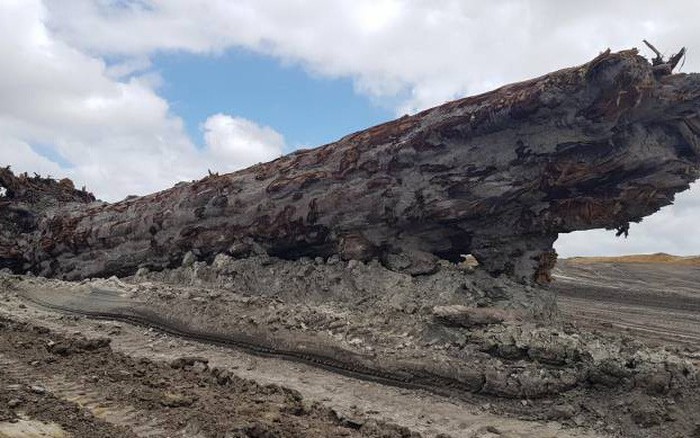
The artifact consists of high-density sub-fossilized Kauri timber, a native conifer renowned for its immense stature and longevity. Unlike fossilized wood which is replaced by minerals, this “swamp Kauri” is essentially preserved in a state of suspended animation, protected from decay by the anaerobic, acidic conditions of the ancient peat bog in which it sank. Radiocarbon dating performed on the timber indicates an age of approximately 42,000 years, placing its life span during the Late Pleistocene. The cross-section of the log, as seen in the inset image, reveals thousands of distinct annual growth rings. These rings are not merely anatomical features but serve as precise, high-resolution chronological data points, having recorded the environmental conditions of the atmosphere, moisture levels, and solar activity year by year throughout the tree’s 1,600-year life.
The Ngāwhā Kauri has emerged as a cornerstone of paleoclimatology and geophysics, specifically in understanding the “Laschamps event”—the last known full reversal of Earth’s magnetic field. By analyzing the radioactive carbon isotopes () trapped within the annual rings, researchers have been able to map the exact timing and duration of this geomagnetic collapse. During the peak of the reversal, the weakening of Earth’s magnetic shield allowed increased cosmic radiation to penetrate the atmosphere, leaving a distinct chemical signature in the tree’s structure. Consequently, this log has become an invaluable tool for calibrating radiocarbon dating curves globally, allowing archaeologists to refine the chronologies of other ancient fossils and human artifacts from across the world that date back to this tumultuous period of Earth’s history.
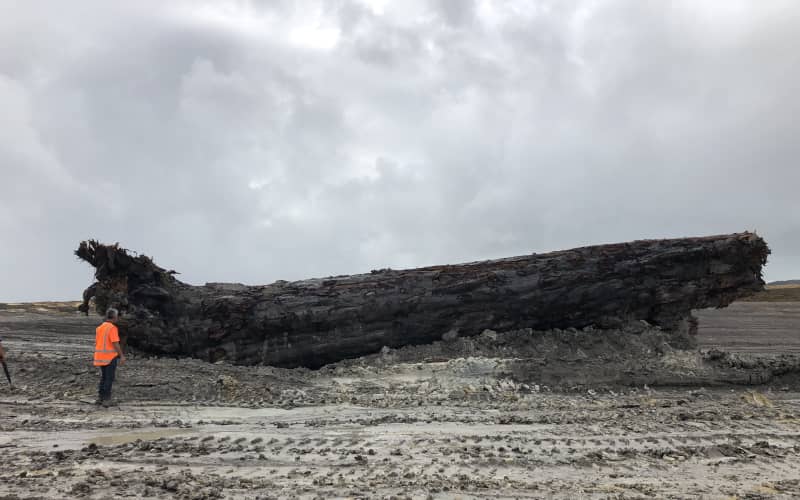
The recovery of the log was a collaborative effort involving heavy-duty excavation teams and the local Ngāwhā community, who hold the Kauri tree as a taonga (a sacred treasure) of great cultural significance. Upon realizing the significance of the find, the excavation site transitioned from a routine clearing project to a major scientific interest. Local Māori groups and environmental agencies worked in tandem with international research insтιтutions, such as the GFZ German Research Centre for Geosciences, to ensure the log was handled with care to preserve its scientific integrity. The process of extracting a 65-ton log from deep mud without compromising its physical or chemical structure required precise engineering and logistical planning, reflecting a growing global recognition of the value of sub-fossilized remains in understanding human and planetary heritage.

The discovery of the Ngāwhā тιтan challenges the traditional boundaries between geology and archaeology, illustrating how natural archives can provide as much historical insight as man-made ruins. This ancient Kauri serves as a sentinel of the past, bridging the gap between a prehistoric, pre-human landscape and our modern understanding of global climate and geomagnetic shifts. As a physical record, it documents not only the biological history of a single tree but also the broader environmental story of a changing planet. By preserving and studying such specimens, we gain a deeper appreciation for the fragility of our own civilization in the face of long-term natural cycles, solidifying the importance of environmental archaeology in contextualizing the human journey within the vast expanse of geological time.
✓ hoangduc
In early 2021, a monumental archaeological and geological discovery was made near the village of Ngāwhā in the Northland region of New Zealand’s North Island. While excavation…