The Sarcophagus Lid of Pakal the Great: An Icon of Maya Artistry
The limestone slab depicted in the right-hand panel is one of the most celebrated archaeological artifacts of the Maya civilization. Known as the sarcophagus lid of K’inich Janaab’ Pakal I, the powerful ruler of the city-state of Palenque, this masterpiece dates to the Late Classic period, specifically around 683 AD. Discovered within the deep subterranean recesses of the Temple of the Inscriptions in Chiapas, Mexico, the lid served as the protective cover for Pakal’s royal sarcophagus. Its discovery in 1952 by the Mexican archaeologist Alberto Ruz Lhuillier fundamentally altered the historical understanding of Maya funerary practices, proving that their pyramids were not merely temples for the gods but also sophisticated royal mausoleums akin to the structures of ancient Egypt.
The material of this artifact is a mᴀssive, finely grained limestone block, meticulously carved with elaborate bas-relief imagery. The level of detail achieved by the ancient artisans is staggering, featuring hundreds of individual hieroglyphs and complex symbolic figures that articulate the Maya belief system regarding death and resurrection. The central image shows Pakal depicted as a maize deity, suspended between the celestial realm (represented by the World Tree) and the watery depths of the underworld (Xibalba). The craftsmanship displays an advanced understanding of composition and spatial depth, with every square centimeter of the stone utilized to tell the story of the king’s transition into the divine sphere.
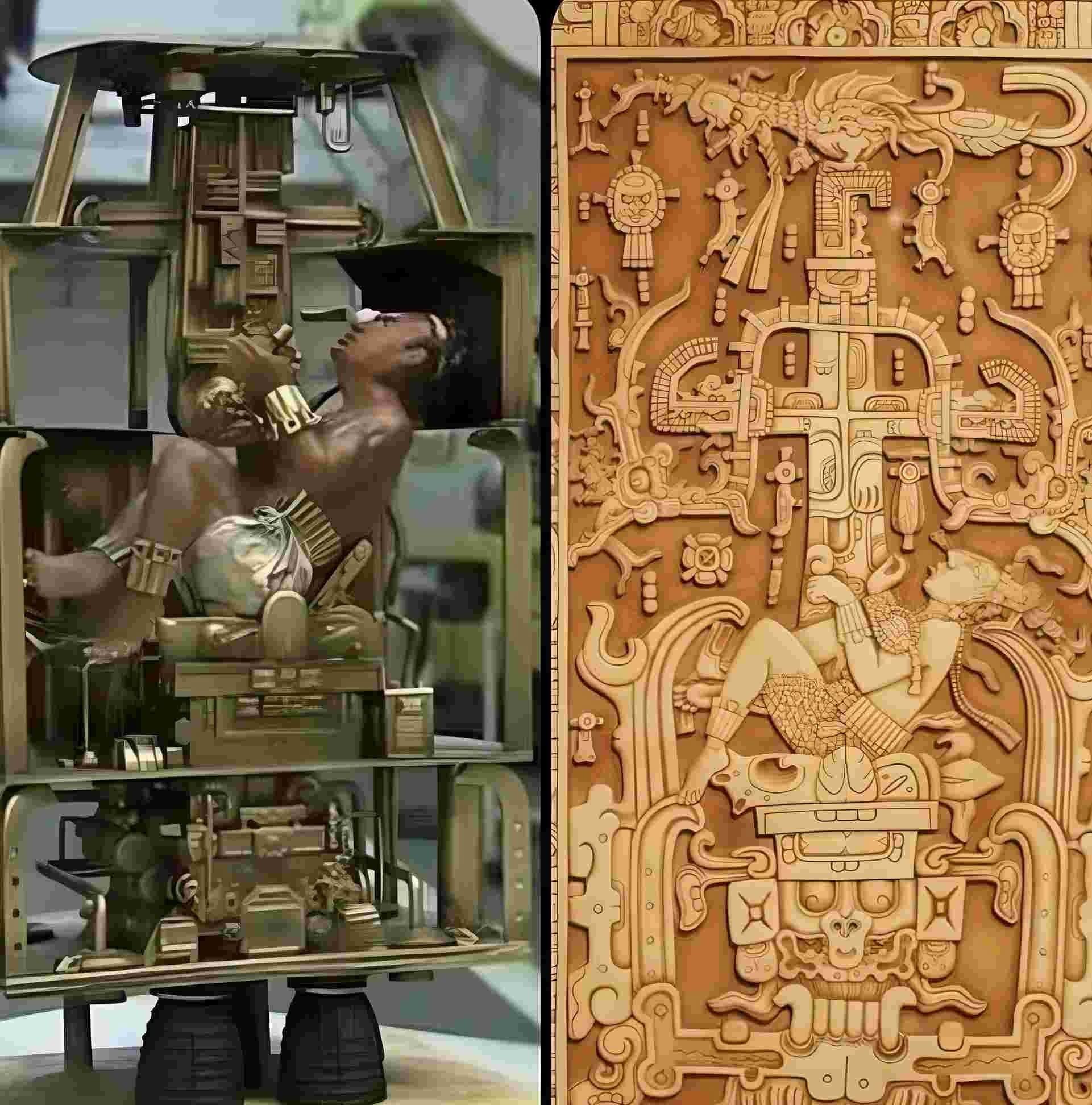
The significance and intended function of this lid extend far beyond its funerary purpose; it is a profound theological statement of royal authority. The iconography illustrates Pakal falling backward into the jaws of the underworld, while simultaneously ascending as a god through the stalk of the World Tree, signifying the cyclical nature of life and death that was central to Maya cosmology. This symbolic journey was meant to legitimize Pakal’s status as a semi-divine enтιтy and to project his power even in death. The left-hand panel, which presents a modern, speculative technological reinterpretation of this scene, stands in stark contrast to the traditional archaeological consensus that views the lid as an expression of indigenous religious devotion, rather than any literal depiction of machinery or space travel.
The excavation of this tomb was a landmark achievement in 20th-century archaeology. Alberto Ruz Lhuillier’s meticulous efforts, which took four years of clearing rubble-filled internal staircases, eventually revealed the hidden entrance to the tomb. His work provided the first definitive proof that Maya rulers were interred with such opulence and structural complexity. The findings at the Temple of the Inscriptions allowed for a more accurate reconstruction of the social and political hierarchy of the Classic Maya period, as the artifacts found within—including the jade mask and numerous ornaments accompanying the king—highlighted the immense resources commanded by the Palenque dynasty.
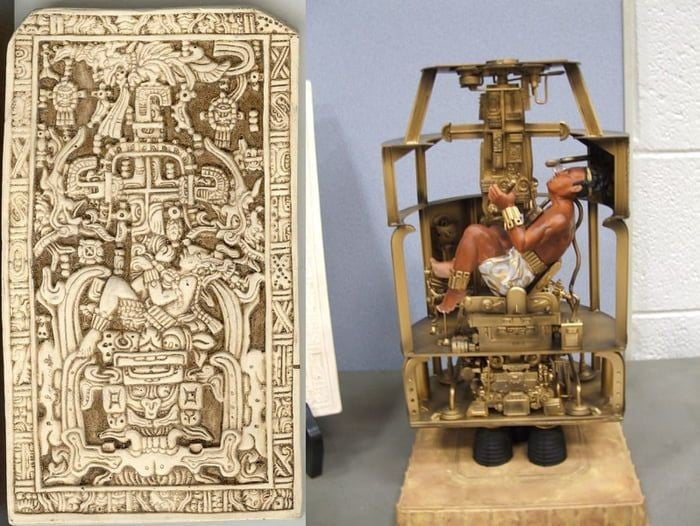
Today, the lid remains in its original location within the Temple of the Inscriptions, serving as a primary source for epigraphers and art historians studying Maya civilization. The ongoing scholarly discourse surrounding the lid, as evidenced by the contrast between its canonical interpretation and the imaginative visual comparisons seen, highlights the enduring power of ancient art to capture the contemporary imagination. By adhering to rigorous archaeological methodologies—such as stylistic comparative analysis and linguistic decipherment of the surrounding hieroglyphic texts—researchers continue to peel back the layers of symbolism embedded in the stone, ensuring that the legacy of Pakal the Great remains a foundational pillar in our understanding of Mesoamerican history.

✓ hoangduc
The limestone slab depicted in the right-hand panel is one of the most celebrated archaeological artifacts of the Maya civilization. Known as the sarcophagus lid of K’inich Janaab’…