The Schist Disk of Sabu: A Masterpiece of Pre-Dynastic Engineering
In January 1936, the world of Egyptology was presented with one of its most enduring enigmas. During a systematic excavation of the sprawling Saqqara Necropolis, a team led by renowned British archaeologist Walter Bryan Emery uncovered a high-status tomb belonging to the royal official Sabu. The mastaba (S3111), typical of the First Dynasty’s mud-brick architecture, was filled with traditional funerary offerings, including flint tools and pottery. However, tucked away in a corner of the burial chamber, Emery’s team discovered a shattered object that defied conventional classification. Upon reᴀssembly, the artifact revealed a radical, tri-lobed design that looked strikingly contemporary, standing in stark contrast to the archaic context of the pre-pyramid age.
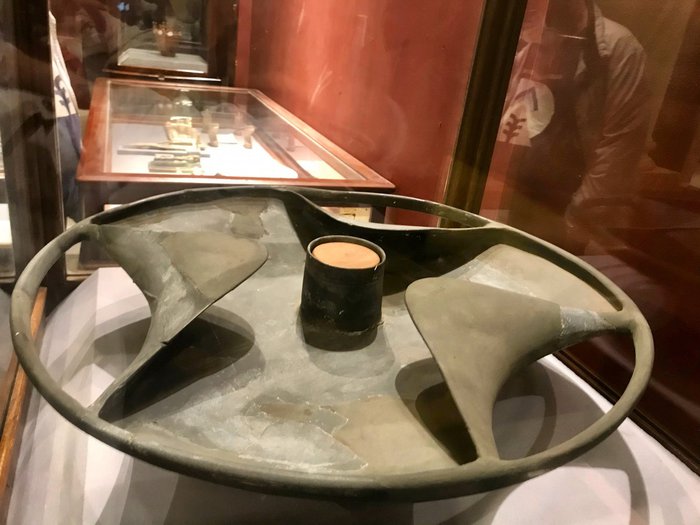
The artifact, now famously known as the “Sabu Disk,” is carved entirely from metasiltstone, often referred to in older texts as schist. This metamorphic rock is notorious among stone-masons for its tendency to flake and fracture under uneven pressure due to its layered structure. Measuring approximately 61 centimeters in diameter and 10 centimeters in height, the disk features three delicate lobes that fold inward toward a central hub. The walls of these lobes are incredibly thin—tapering to mere millimeters in some sections. Achieving such precise, fluid curves in a brittle material like schist without the aid of modern lathes or CNC machinery indicates a level of mastery over hand-abrasion and stone-carving that remains difficult for modern experimental archaeologists to replicate.
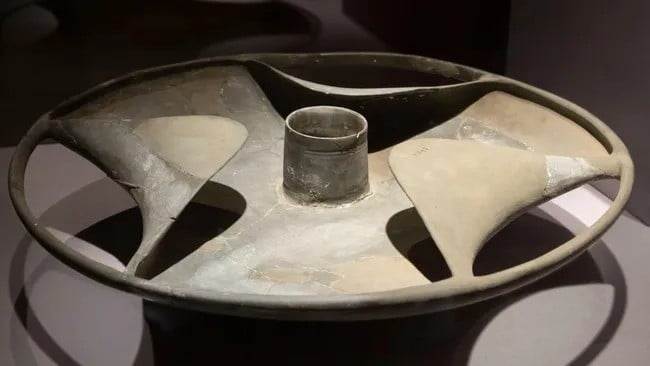
Since its discovery, the function of the Sabu Disk has sparked intense academic debate. Its aerodynamic shape—resembling a propeller or an impeller—has fueled fringe theories about “lost technology.” However, serious archaeological inquiry focuses on more grounded possibilities. One prevailing theory suggests it served as a specialized ritual vessel, perhaps designed to hold oil or incense, where the tri-lobed rim allowed liquids to flow evenly toward the center. Others suggest it was a decorative stand for a larger ceremonial centerpiece. The lack of wear marks on the central hub argues against it being a mechanical part, such as a wheel or a pulley, suggesting its value was primarily symbolic or liturgical, representing a high-status object of “prestige technology” for the court of the Pharaoh.
The most striking detail of the disk is the central cylindrical hub, which is perfectly aligned with the outer rim. The symmetry of the three lobes, spaced exactly 120 degrees apart, suggests that the Early Dynastic craftsmen utilized a sophisticated understanding of geometry and centrifugal balance. The rim is connected to the hub by the base of the bowl, but the lobes themselves are “free-hanging” in a way that provides no structural support, serving only to define the interior space. This design suggests the object was meant to be viewed from above, possibly during a pouring ceremony where the visual interaction of light and shadow on the curved schist would have created a mesmerizing effect for those gathered in the presence of the elite.

The excavation of Mastaba S3111 was a landmark for the Service des Antiquités de l’Égypte, the predecessor to the modern Ministry of Antiquities. Walter Emery’s meticulous recording of the find ensured that its provenance was never in doubt, placing it firmly within the 1st Dynasty despite its “futuristic” appearance. Today, the Sabu Disk is a centerpiece of the Egyptian Museum in Cairo, specifically housed in the Pre-Dynastic and Early Dynastic gallery. It remains a profound testament to the ingenuity of the human spirit at the dawn of civilization—a reminder that the ancient Egyptians were not just builders of pyramids, but masters of complex geometry and material manipulation long before the invention of the wheel in the Nile Valley.
✓ hoangduc
In January 1936, the world of Egyptology was presented with one of its most enduring enigmas. During a systematic excavation of the sprawling Saqqara Necropolis, a team…