The Silent Legions: An Archaeological Analysis of the Terracotta Army
The artifact ᴀssembly depicted is the world-renowned Terracotta Army, an integral component of the vast funerary complex of the first Emperor of China, Qin Shi Huang. These figures date precisely to the Qin Dynasty (c. 210–209 BCE). This period marks a foundational era in East Asian history, representing the first time the warring states of China were unified under a single centralized imperial authority. The creation of this ceramic legion occurred during a time of immense social and logistical mobilization, mirroring the Emperor’s terrestrial achievements—such as the standardization of weights, measures, and scripts—by projecting his military dominance into the afterlife. As a chronological marker, the army represents the transition from the human sacrifices common in earlier Shang and Zhou burials to the use of “mingqi” (spirit goods), signaling a profound shift in Chinese funerary ideology.

The discovery of the Terracotta Army is one of the most significant archaeological events of the 20th century. It occurred in March 1974 in Lintong District, Xi’an, Shaanxi Province, when local farmers—most notably Yang Zhifa—uncovered pottery fragments while digging a well. This accidental find led to the immediate intervention of the Shaanxi Provincial Archaeological Team. Since then, the site has been under the rigorous management of the Emperor Qin Shihuang’s Mausoleum Site Museum and the Chinese Academy of Social Sciences. Excavations have revealed three mᴀssive pits containing an estimated 8,000 soldiers, 130 chariots, and 670 horses. In 1987, the site was designated a UNESCO World Heritage landmark, and it remains a focal point for international collaboration in the fields of conservation science and digital archaeology.

The primary material used for the figures is local silty clay, sourced from the vicinity of Mount Li. The craftsmanship involved a sophisticated “ᴀssembly line” process that combined mᴀss production with individual artistry. The bodies, legs, and arms were created using standardized molds, while the heads were customized with hand-modeled features. Each soldier possesses a unique facial expression, hairstyle, and uniform detail, reflecting the multi-ethnic composition of the Qin military. After being shaped, the figures were fired in specialized kilns at temperatures between 800°C and 1000°C to achieve a durable, stoneware-like consistency. Originally, every soldier was coated in a layer of East Asian lacquer and brightly painted with mineral pigments—including the rare “Han Purple”—though most of this color oxidized and peeled away within seconds of exposure to the dry air during modern excavation.

From a functional standpoint, the Terracotta Army served as a funerary garrison, a ritualistic military force intended to protect the Emperor in the “Hidden City” of his tomb. In the Qin worldview, the afterlife was a mirror of the terrestrial world; therefore, the Emperor required a standing army to maintain his status and defend against the spirits of the rivals he had defeated in life. The utility was also strategically symbolic: the soldiers are arranged in a precise military formation—vanguard, infantry, and cavalry—facing east toward the states the Emperor had conquered. This layout acted as a permanent, three-dimensional broadcast of the Mandate of Heaven, ensuring that the Emperor’s administrative and military order (Li) remained unshakeable throughout eternity.
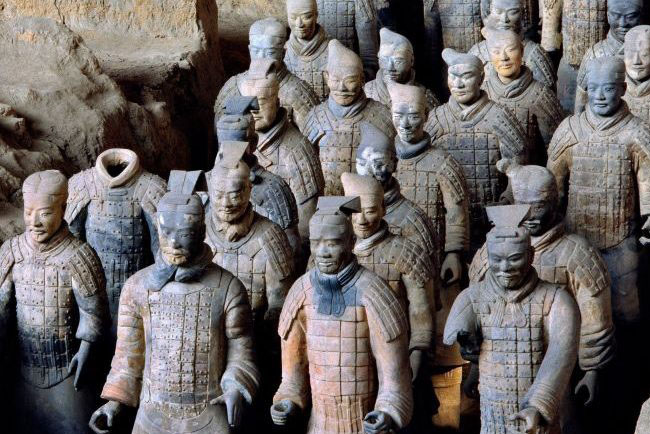
The legacy of the Terracotta Army is its status as a technological and military encyclopedia of the 3rd century BCE. For archaeologists, the figures provide definitive data on Qin-era armor design, weaponry, and social hierarchy. Extensive chemical analysis of the bronze weapons found with the soldiers—including swords, spears, and crossbows—has revealed traces of chromium, suggesting an early form of corrosion-resistance technology. Today, the site serves as a global laboratory for preventive conservation, as scientists work to stabilize the remaining pigments and combat “museum sickness” (microbial decay) caused by humidity. The Silent Legions stand as a monumental testament to a civilization that viewed death not as an end, but as a grand continuation of imperial power, etched forever in the earth.
✓ Team
The artifact ᴀssembly depicted is the world-renowned Terracotta Army, an integral component of the vast funerary complex of the first Emperor of China, Qin Shi Huang. These…