The Silent Sentinel: An Archaeological Analysis of the Great Sphinx of Giza
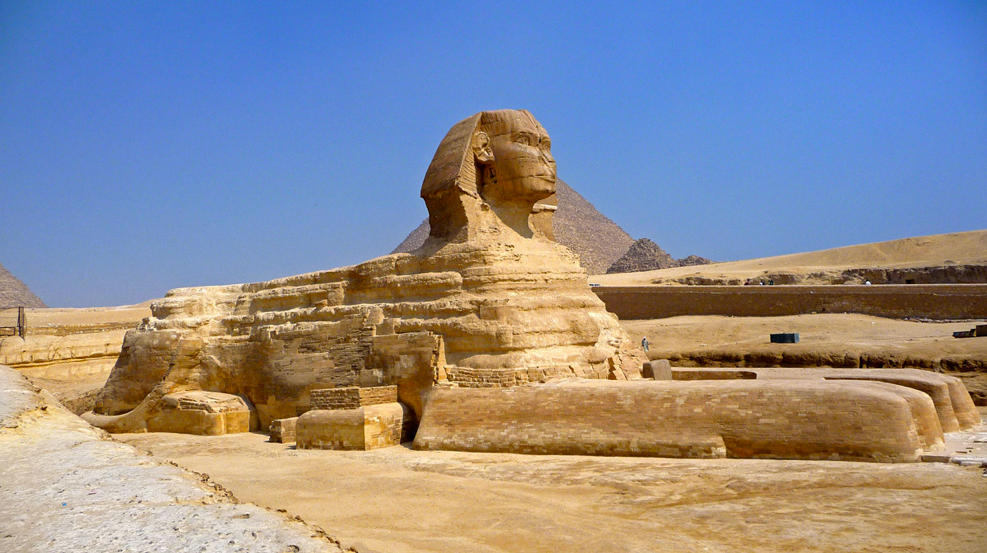
The monument featured in the image is the Great Sphinx of Giza, one of the most iconic and debated artifacts of the ancient world. Located on the Giza Plateau on the west bank of the Nile, it is generally dated to the Fourth Dynasty of the Old Kingdom (c. 2558–2532 BCE). Most mainstream Egyptologists attribute its construction to the Pharaoh Khafre, the builder of the second Great Pyramid, suggesting the Sphinx was carved to serve as a divine guardian of his funerary complex. This era represents the pinnacle of Old Kingdom architectural ambition, a time when the “God-King” ideology was expressed through the literal reshaping of the desert landscape into eternal stone monuments that bridged the gap between the terrestrial and the solar realms.
While the Sphinx was never “lost”—its head has protruded from the sand for millennia—its full body was buried up to the neck for much of history. The first documented “excavation” was a restoration effort by Thutmose IV in 1400 BCE, commemorated on the “Dream Stele” between the Sphinx’s paws. In modern times, the first systematic clearance of the sand began in 1817 under Giovanni Battista Caviglia, and the full body was finally revealed in 1925 by the French archaeologist Émile Baraize. Today, the site is under the rigorous management of the Supreme Council of Antiquities in Egypt and UNESCO. Ongoing archaeological work, such as the digital mapping projects led by Mark Lehner, focuses on the Sphinx’s erosion patterns and the “Sphinx Temple” located directly in front of it, providing deeper insight into the labor forces and ritual activities that defined the plateau.
The Great Sphinx is a monolithic statue, meaning it was carved directly from the natural limestone bedrock of the Giza Plateau rather than being ᴀssembled from separate blocks. The limestone is composed of several geological layers: the lowest layer is hard and brittle, the middle layer is softer and more prone to erosion (forming the “ribbed” appearance of the body seen in the image), and the top layer, which forms the head, is composed of a much denser, higher-quality limestone. The craftsmanship involved mᴀssive quarrying operations where workers used copper chisels and stone hammers to isolate the block before fine-tuning the anatomical details. The head is remarkably well-preserved compared to the body, partly due to the durability of the stone and partly because it remained above the corrosive dampness of the sand for centuries.

In terms of utility, the Sphinx was not a “building” but a living image (shesep-ankh), a ritual device intended to channel divine power. It possesses the body of a lion (symbolizing strength and solar authority) and the head of a human wearing the nemes royal headdress (representing the Pharaoh’s wisdom and his role as the mediator of Ma’at). Strategically, the Sphinx is oriented precisely toward the east, facing the rising sun. Archaeologists believe it functioned as a central component of a vast solar cult complex, where it acted as a terrestrial manifestation of the sun god Hor-em-akhet (Horus of the Horizon). Its presence alongside the pyramids transformed the Giza plateau into a “horizon” where the Pharaoh could be perpetually reborn alongside the sun, ensuring the cosmic continuity of the Egyptian state.

The Great Sphinx remains a critical case study in archaeological conservation and weathering science. For decades, a “water-erosion hypothesis” suggested the monument might be thousands of years older than the Fourth Dynasty, though most archaeologists reject this, citing the cultural and stylistic context of the surrounding tombs. The primary modern challenge is the desalinization of the stone; groundwater rising through the limestone carries salts that crystallize on the surface, causing the stone to flake away. Efforts by the Getty Conservation Insтιтute and local Egyptian teams focus on replacing old, damaging cement repairs with historically accurate lime mortars. As the ultimate symbol of ancient endurance, the Sphinx continues to challenge our understanding of prehistoric engineering, standing as a weathered but defiant bridge between the modern world and the dawn of civilization.
✓ Team
The monument featured in the image is the Great Sphinx of Giza, one of the most iconic and debated artifacts of the ancient world. Located on the…