The Stairs of Death: Engineering Verticality at Huayna Picchu
The architectural feature depicted in the image is the infamous “Stairs of Death,” a perilous section of stone steps leading to the summit of Huayna Picchu, the towering peak overlooking the Inca citadel of Machu Picchu in Peru. These stairs date to the height of the Inca Empire (c. 1450–1540 CE), specifically during the reign of the Sapa Inca Pachacuti and his successors. During this era, the Inca perfected the art of “andenes” (terrace) engineering, transforming near-vertical mountain ridges into stable, functional spaces. Huayna Picchu served as an administrative and religious high-point, a “watchtower of the gods” that represented the pinnacle of late-horizon Andean architectural ambition before the Spanish Conquest.
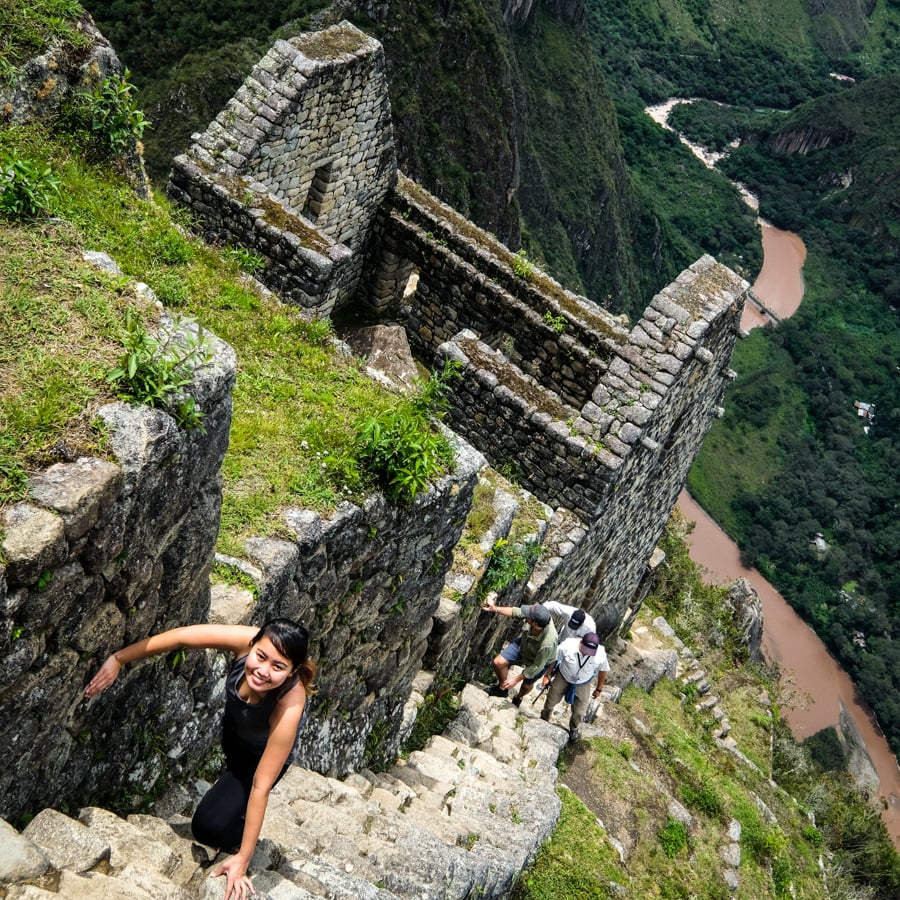
While the local residents of the Urubamba Valley were always aware of the ruins, the “scientific discovery” of Huayna Picchu and its staircases is attributed to the American explorer Hiram Bingham III during his 1911 expedition funded by Yale University and the National Geographic Society. Bingham’s team spent years clearing the thick cloud-forest vegetation that had obscured the stone pathways for centuries. In more recent decades, the National Archaeological Park of Machu Picchu, under the Ministry of Culture of Peru, has undertaken extensive stabilization projects. Archaeologists have focused on mapping the “Temple of the Moon”—a cavernous ritual site located on the northern slope of the peak—proving that these staircases were part of a larger, highly integrated sacred landscape rather than isolated lookout points.
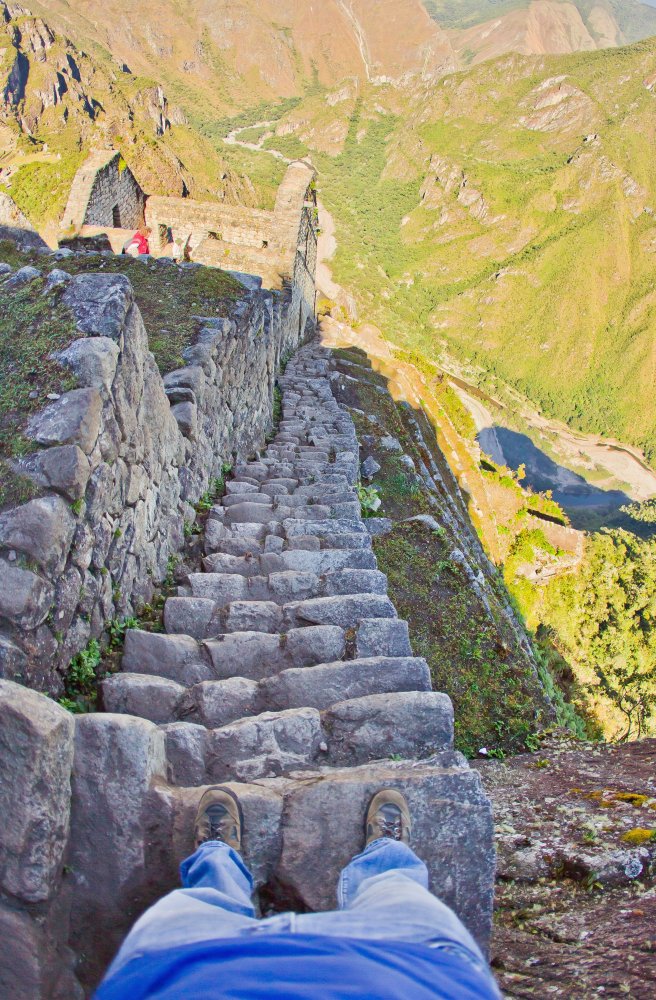
The “Stairs of Death” are a masterclass in Inca masonry and landscape adaptation. The primary material used is white granite, sourced from the very mountain itself. Unlike the finely polished “imperial” ashlar masonry found in the main temples below, these stairs utilize a more rugged, functional style of stonework. Many steps are not separate blocks at all but are carved directly into the living bedrock, as seen in the image, illustrating a deep architectural integration with the natural geology. Where stones were added, they were fitted using the mortarless interlocking technique, allowing the steps to expand and contract during seismic events. The craftsmanship also accounts for extreme environmental conditions; each step is slightly angled to allow for rapid drainage during tropical rainstorms, preventing the structural erosion that would otherwise destroy such a precarious path.
From a functional standpoint, these stairs served as the primary access route for the garrisons and high priests stationed at the summit of Huayna Picchu. The verticality was a defensive choice; the path is narrow enough that a single guard could hold off an entire approaching force. However, for the Inca, the utility was also deeply symbolic. The ascent represented a physical and spiritual transition toward the Apu (mountain spirit). The precariousness of the climb forced a slow, rhythmic pace, turning the act of walking into a form of ritual movement. These stairs connected the urban center of Machu Picchu to the high-alтιтude shrines and observation platforms where the Inca priests tracked the winter and summer solstices, ensuring that the state remained in harmony with the celestial cycles.

Today, the stairs of Huayna Picchu are a global icon of high-alтιтude archaeology. They provide critical data on how ancient civilizations managed soil stability and water runoff in the cloud forest—a field known as Inca paleohydrology. Because the stairs are exposed to high foot traffic from modern tourists, they are under constant surveillance by the UNESCO World Heritage monitoring teams. Preservation focuses on “bioclean” methods—removing lichens and mosses that can split the stones—while reinforcing the dry-stone retaining walls that prevent the entire staircase from sliding into the abyss. The site remains a powerful testament to the Inca vision of a world where gravity was not an obstacle, but a divine canvas for their stone-paved mastery.
✓ Team
The architectural feature depicted in the image is the infamous “Stairs of Death,” a perilous section of stone steps leading to the summit of Huayna Picchu, the…