The Stillingfleet Door: An Archaeological Study of Anglo-Scandinavian Syncretism
The Stillingfleet door, preserved at the Stillingfleet Church in North Yorkshire, represents one of the most significant archaeological survivals from the medieval period in England, offering a profound glimpse into the cultural transition between the Viking Age and the Christian era. Although its precise origins have been a subject of scholarly debate, the door is generally dated to the late 12th century, a time when the influence of Anglo-Scandinavian art was still deeply ingrained in local craftsmanship. The discovery and identification of this artifact as a premier example of “stave-built” door construction, adorned with intricate ironwork, have established it as a vital piece of evidence for understanding the aesthetic and spiritual hybridity of the time. The door serves as a physical manifestation of a society that was straddling two worlds: the fading, warrior-centric traditions of the Norse heritage and the rising, dominant ecclesiastical power of the Christian Church.

From a material perspective, the door is a masterpiece of early medieval engineering, constructed from robust planks of English oak. However, it is the wrought iron metalwork—the “Stillingfleet mountings”—that distinguishes this artifact from contemporary ecclesiastical joinery. The iron strips were meticulously forged and then applied to the surface of the wood, acting both as structural reinforcement and as a canvas for decorative expression. The craftsmanship reveals a high level of metallurgical skill; the smiths created delicate yet durable forms, shaping the iron into zoomorphic and geometric motifs that demonstrate a mastery of heating, beating, and shaping metal. The preservation of these ironwork elements over eight centuries is largely due to the specific environmental conditions within the church architecture, which allowed the metal to remain attached to the timber substrate despite the natural decay of the organic components.
The most striking feature of the ironwork is the depiction of a Viking longship, a motif rarely found in such a context, let alone on a church entrance. This carving—or rather, metal ᴀssembly—features a ship with a distinct stem and stern, complete with the arched, dragon-headed prows characteristic of Scandinavian maritime vessels of the Viking Age. The inclusion of such a distinctly pagan, warrior-oriented symbol on a house of Christian worship highlights a complex cultural syncretism. It suggests that the patrons or the craftsmen of the era viewed these maritime symbols not merely as remnants of a “barbaric” past, but as a source of local pride and idenтιтy that could coexist within a Christian framework. The ship is rendered with a dynamic curvature that implies movement, showcasing the transition from Viking naval design to the symbolic representation of the “ship of the church,” a common metaphor in medieval theology.
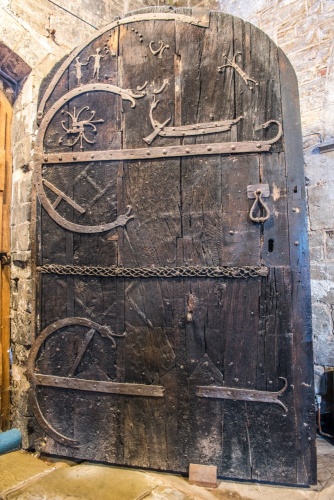
Adjacent to the maritime imagery, the door presents a juxtaposition that is unparalleled in medieval art: a pair of human figures, interpreted by archaeologists as Adam and Eve. These figures are flanked by a stylized tree—the Tree of Life—and a serpent or dragon-like creature winding through the foliage. This iconography is firmly rooted in the Genesis narrative, yet the stylistic execution of the figures carries the distinct hallmarks of the Ringerike and Urnes art styles, which were prevalent in Scandinavian metalwork. The dragon or serpent depicted here is visually indistinguishable from the creatures found in Norse mythology, creating a seamless visual integration where the biblical serpent and the Norse dragon become one. This fusion suggests that the conceptual boundaries between Norse cosmology and Christian scripture were highly porous, with local craftsmen utilizing their traditional artistic language to interpret and validate the new Christian theology.
In conclusion, the Stillingfleet door acts as a profound archaeological document, capturing the negotiation of idenтιтy in a post-Viking society. Its function was twofold: to provide a secure, intimidating threshold to the sanctuary of the church and to serve as a visual manifesto of the community’s heritage. The survival of this artifact provides researchers with invaluable data regarding the continuity of artistic expression during the 12th century, proving that the Christianization of England was not a simple, monolithic erasure of the past, but a complex, prolonged process of integration and adaptation. As a rare, intact example of high-medieval metalwork, the door remains a critical focal point for studies into how material culture can preserve the memory of a civilization long after its socio-political structures have dissolved, ensuring the legacy of the Anglo-Scandinavian aesthetic endures within the modern architectural landscape.
✓ hoangduc
The Stillingfleet door, preserved at the Stillingfleet Church in North Yorkshire, represents one of the most significant archaeological survivals from the medieval period in England, offering a…