The Sutton Hoo Helmet: A Masterpiece of Anglo-Saxon Kingship
The Sutton Hoo helmet, one of the most iconic archaeological finds in British history, dates back to the early 7th century AD, approximately 625 AD. This era marks the heart of the Anglo-Saxon period in England, a time of profound cultural shifting where warrior-kings ruled over small, competing kingdoms like East Anglia. The helmet is widely believed to have belonged to King Rædwald, the first East Anglian king to be recognized as Bretwalda (overlord of Britain). Its burial within a 27-meter-long ship signifies the height of Germanic pagan funerary traditions, where the status of the deceased was communicated through the immense wealth and artistic sophistication of their “grave goods” before the widespread adoption of Christian burial practices.

Discovery and the Great Excavation of 1939 The discovery of this extraordinary artifact took place in 1939 at Sutton Hoo, near Woodbridge in Suffolk, England. The excavation was initiated by the landowner, Edith Pretty, who possessed a deep curiosity about the mysterious earth mounds on her estate. She commissioned a local self-taught archaeologist, Basil Brown, to investigate. Upon discovering the outline of a mᴀssive ship under Mound 1, the scale of the find necessitated the involvement of the British Museum and the Office of Works, led by archaeologists Charles Phillips and Stuart Piggott. Working under the shadow of the impending Second World War, the team meticulously unearthed a treasure trove of gold and silver, with the helmet being found in hundreds of fragments, crushed by the collapse of the burial chamber.
Material Composition and Metallurgical Craftsmanship As showcased in the reconstructed display in image_35c5c6.jpg, the helmet is a feat of complex multi-metal craftsmanship. The core is made of iron, originally covered with tinned copper alloy panels that gave it a bright, silvery appearance. The most striking features are the gilded bronze and silver decorative elements. The helmet employs the pressblech technique—stamping intricate designs into thin metal sheets. These panels depict scenes of warriors, dancing figures, and animals. The iconic faceplate is an artistic marvel: the eyebrows are made of silver wire and garnets, ending in gilded boar’s heads. The nose, mustache, and mouth are cast in a single piece of bronze, creating a stern, lifelike visage that effectively transformed the wearer into a formidable and divine-like figure on the battlefield.

Iconographic Details and the “Great Dragon” Motif A closer archaeological analysis of the faceplate reveals a sophisticated visual puzzle. When viewed in its entirety, the eyebrows, nose, and mustache form the shape of a flying dragon or bird with outstretched wings (the eyebrows) and a tail (the mustache). The dragon’s head meets the head of another dragon curving over the crest of the helmet, creating a symbolic “protective” intersection between the man and the mythical beast. This zoomorphic imagery is characteristic of Germanic Style II art, where animals are intertwined into complex, rhythmic patterns. The boar’s heads on the eyebrows were not merely decorative; in Anglo-Saxon culture, the boar was a symbol of strength and protection, believed to guard the warrior against physical harm during combat.
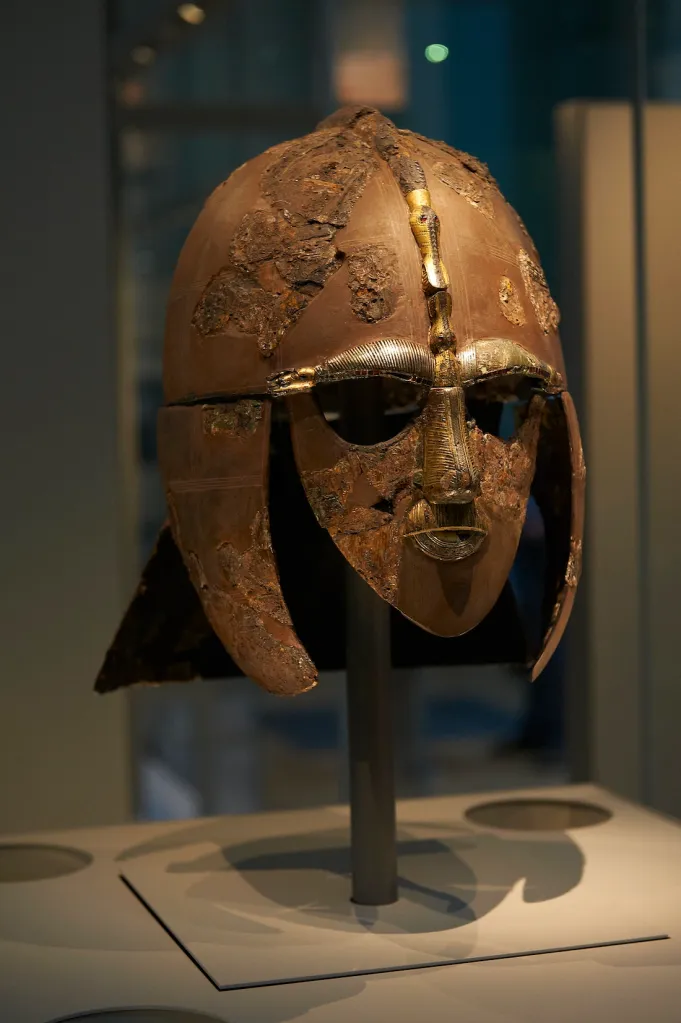
Significance and Functional Utility The Sutton Hoo helmet served a dual purpose: it was both a piece of functional battle gear and a high-status ceremonial regalia. While the iron cap offered protection to the head, face, and neck, the level of ornamentation suggests it was primarily used to project the absolute authority and semi-divine status of the king. It is more than armor; it is a crown. Archaeologically, it bridges the gap between the Roman military traditions (the helmet’s form is derived from Late Roman cavalry helmets) and the emerging Germanic idenтιтy. Today, after decades of painstaking restoration by the British Museum, the helmet stands as a symbol of the “Dark Ages” coming into the light, representing the birth of an English cultural idenтιтy rooted in a fusion of northern warrior ethos and Mediterranean artistic influence.
✓ hoangduc
The Sutton Hoo helmet, one of the most iconic archaeological finds in British history, dates back to the early 7th century AD, approximately 625 AD. This era…